University of Oklahoma
The first president of the University of Oklahoma ordered trees planted before the first building went up, because he could not visualize a treeless university seat. That instinct -- to build something beautiful before building anything practical -- has defined OU since December 18, 1890, when the Oklahoma Territorial legislature established a state university in Norman, seventeen years before Oklahoma even became a state. Norman residents donated land south of the railroad depot, and in August 1892, President David Ross Boyd arrived to enroll the first students. Classes began in the Rock Building in downtown Norman while the campus took shape, one sapling at a time.
Cherokee Gothic and the Fire That Nearly Ended It All
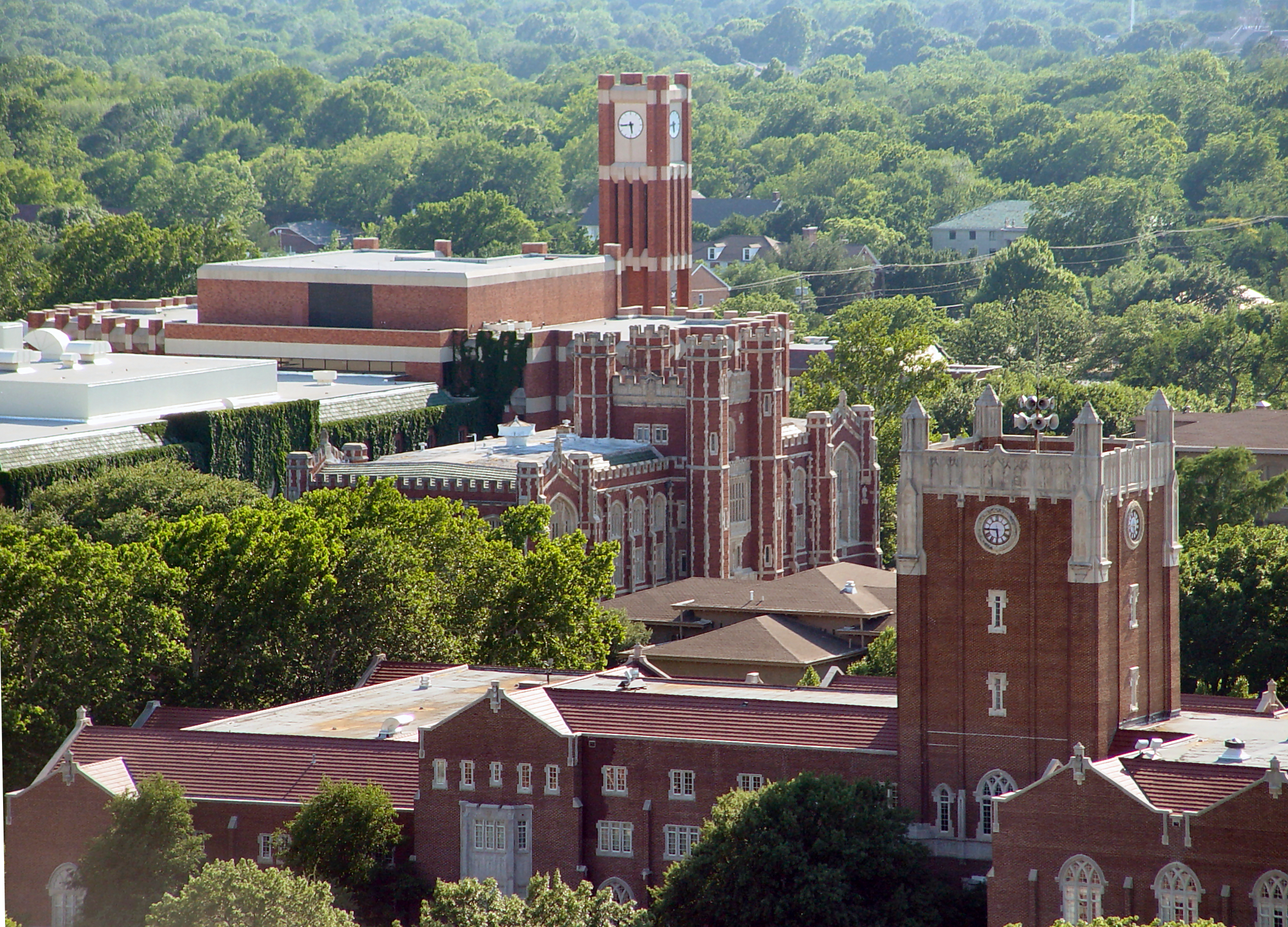
On January 6, 1903, the university's only building burned to the ground, destroying early records and giving rival towns an opening to poach the institution. President Boyd and the faculty refused to flinch. Mathematics professor Frederick Elder captured the mood: "What do you need to keep classes going? Two yards of blackboard and a box of chalk." English professor Vernon Louis Parrington responded to the disaster by creating a campus plan whose central feature -- the North Oval -- remains the heart of OU today. The buildings that rose from those ashes gave the campus its distinctive character. Frank Lloyd Wright, visiting years later, coined the term Cherokee Gothic for the architectural style that blends Collegiate Gothic forms with lighter native stone and Native American decorative elements. The university has built over a dozen buildings in this style, creating a campus aesthetic unlike any other in the country.
A Landmark for Civil Rights
The Bizzell Memorial Library, anchoring the South Oval with its handsome Cherokee Gothic facade, carries a significance far beyond its 4.7 million volumes and fifty incunabula. In 1948, G. W. McLaurin, a Black man, was denied admission to OU's graduate school. A court forced the Board of Regents to admit him, but the university directed McLaurin to study in a separate area within the library and eat only in a segregated section. The NAACP brought the case to the U.S. Supreme Court, which in McLaurin v. Oklahoma State Board of Regents ruled in 1950 that the university's segregation policy was unconstitutional at the graduate level. The decision became a critical precedent for the landmark 1954 Brown v. Board of Education case that dismantled separate but equal nationwide. Bizzell Memorial Library has been designated a U.S. National Historic Landmark in recognition of this history.
Sooner Born, Sooner Bred
The nickname says everything about Oklahoma's competitive spirit. The Sooners take their name from settlers who sneaked into offered territory and staked claims before the starting gun of the 1889 land run -- rule-breakers rewarded for audacity. That ethos has produced forty-five team national championships and the longest winning streak in NCAA Division I football history: forty-seven consecutive victories from 1953 to 1957. Seven Heisman Trophy winners have worn the crimson and cream, from Billy Vessels in 1952 to Kyler Murray in 2018. The softball program has won eight national titles, including an unprecedented four straight from 2021 through 2024. Men's gymnastics has captured twelve championships, more than any other sport on campus. President George Lynn Cross once told the Oklahoma State Senate with a wry smile: "I want a university the football team can be proud of." The Pride of Oklahoma marching band, 311 members strong, has marched in both the Tournament of Roses and Macy's Thanksgiving Day parades.
From Naval Air Station to Weather Capital
OU's north campus began life in the early 1940s as Naval Air Station Norman, an advanced flight training facility that could handle all but the largest bombers. After World War II, the university absorbed the installation, and naval aviator's wings still displayed at the terminal entrance honor that heritage. Today the north campus houses the Max Westheimer Airport, the Radar Operations Center, and the College of Aviation -- one of only twenty-nine aviation colleges accredited worldwide. The south campus research corridor has become a national hub for weather science, anchored by the National Weather Center, the Advanced Radar Research Center, and partnerships with the National Severe Storms Laboratory. With 34,523 students enrolled as of fall 2024 and campuses in Norman, Oklahoma City, Tulsa, and even a renovated monastery in Arezzo, Italy, OU has grown far beyond the treeless prairie it started on -- though the trees, as President Boyd insisted, came first.
From the Air
The University of Oklahoma campus sits at 35.21N, 97.45W in Norman, Oklahoma, about 20 miles south of Oklahoma City. The campus is identifiable by its distinctive oval layout and the large Gaylord Family Oklahoma Memorial Stadium on the east side. Max Westheimer Airport (KOUN, ICAO: KOUN) is on the north campus, approximately 2 miles north. Will Rogers World Airport (KOKC) serves the broader region, about 15 miles north. Best viewed at 3,000-5,000 feet AGL to see the campus layout, dual ovals, and stadium complex.