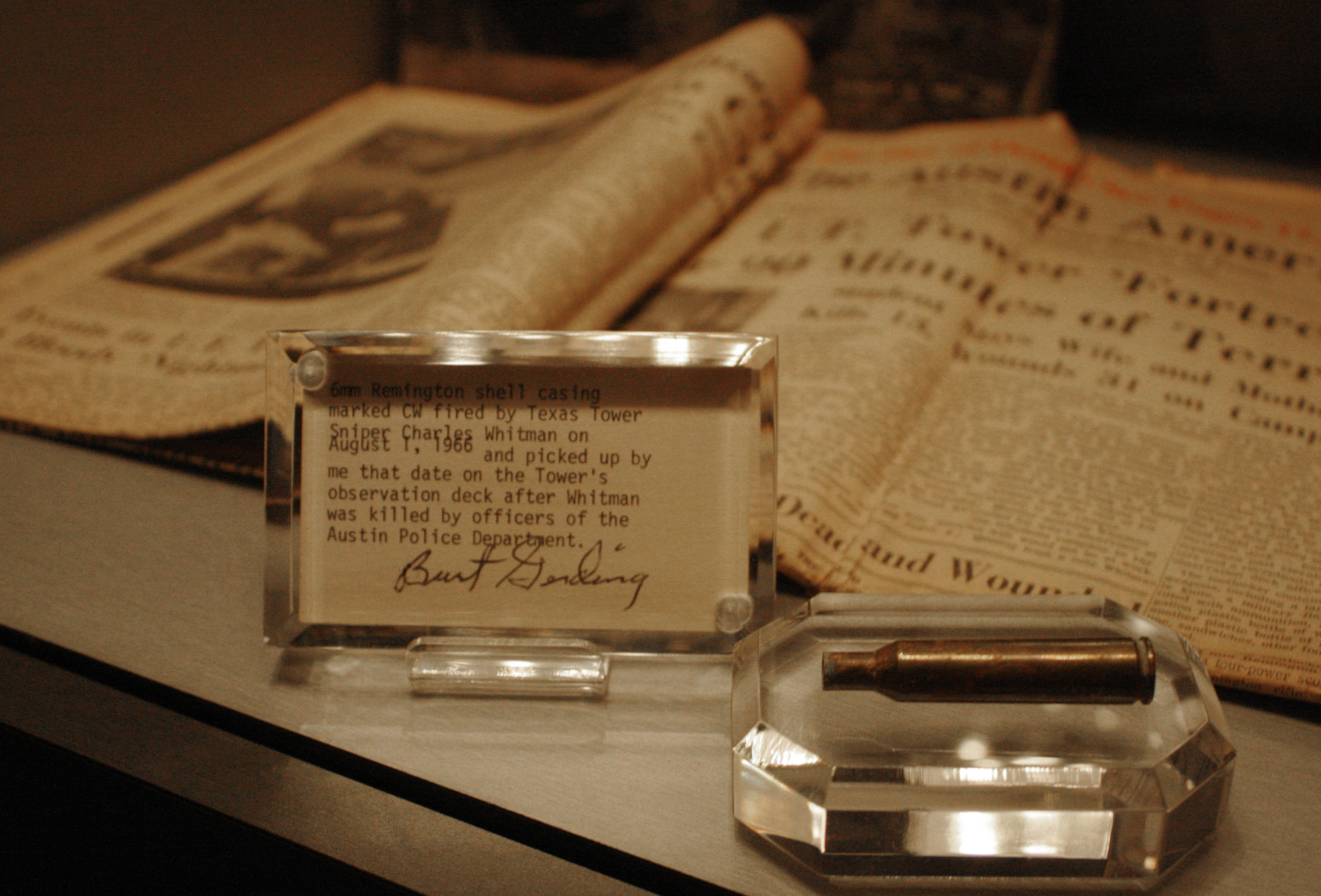
University of Texas Tower Shooting
The clock on the University of Texas Tower stopped at 11:48 a.m. on the fiftieth anniversary of the shooting and stayed frozen for twenty-four hours. It was a gesture toward an afternoon in 1966 that no clock could contain -- ninety-six minutes of gunfire from a 307-foot observation deck that killed seventeen people, wounded thirty-one others, and turned a symbol of academic achievement into a landmark of American violence. What happened on August 1, 1966, was not just a tragedy. It was the event that forced the nation to reckon with a new kind of horror: the mass shooting.
The Hours Before Noon
Charles Whitman began his final day long before sunrise. By the time the Texas sun climbed over Austin, he had already killed his mother in her Guadalupe Street apartment and his wife in their bed, leaving suicide notes professing love for both and blaming a hatred for his abusive father that he described as 'beyond description.' That morning he cashed bad checks, bought a Universal M1 carbine and a shotgun (telling the cashier he was hunting wild hogs in Florida), sawed off the shotgun's stock and barrel, and packed a Marine Corps footlocker with seven firearms, more than 700 rounds of ammunition, food, water, binoculars, a machete, and a transistor radio. Dressed in blue coveralls to look like a maintenance worker, he wheeled the footlocker into the Main Building on a rented hand truck shortly before 11:30 a.m., flashing a fake research assistant ID at the guard.
Ninety-Six Minutes of Terror
After bludgeoning the 28th-floor receptionist, Edna Townsley, and killing two members of a visiting family on the stairwell, Whitman stepped onto the six-foot-wide observation deck at approximately 11:46 a.m. Two minutes later, he opened fire. His first victim from the deck was Claire Wilson, an 18-year-old who was eight months pregnant; her unborn son died. Her fiance, Thomas Eckman, was killed seconds later. Within 20 minutes, Whitman had shot the majority of his victims. Several fell on the Drag -- the strip of Guadalupe Street lined with bookstores and coffee shops just west of campus. Student Norma Barger watched from a fourth-floor window as bodies accumulated below, initially expecting them to stand up. Police chartered a Champion Citabria light aircraft to get a sharpshooter close to the tower, but heat-generated turbulence made a clear shot impossible; Whitman fired twice into the plane before the pilot retreated.
Consider Yourself Deputized
Off-duty officer Ramiro Martinez heard the news on his radio at home and drove straight to campus. Allen Crum, a 40-year-old retired Air Force tail gunner who managed a bookstore near the tower, had already volunteered to help police after seeing a wounded teenager on the sidewalk. Together with officers Houston McCoy and Jerry Day, they ascended the tower -- past the bodies of the Gabour family on the stairwell, past the mortally wounded Townsley. On the stairs, Crum asked Martinez, 'Are we playing for keeps?' Martinez answered, 'You're damn right we are.' Crum replied, 'Well, you better deputize me.' Martinez said, 'Consider yourself deputized.' At 1:24 p.m., Martinez and McCoy rounded the observation deck's northeast corner. Martinez fired his revolver; McCoy hit Whitman between the eyes with a shotgun blast. Crum waved a white handkerchief from the parapet to signal it was over.
What Remained
Seventeen dead, thirty-one wounded. The youngest victim was an unborn child; the oldest was a 64-year-old shopkeeper shot while helping people into his store. Officer Billy Speed, 23, was killed by a round that threaded a six-inch gap in a stone balustrade. Electrician Roy Dell Schmidt was the farthest fatality from the tower -- shot after standing up in the belief he was out of range. One victim, shot at age 23, died thirty-five years later; his death was ruled a homicide. The observation deck closed to the public and did not reopen until 1999, and then only for guided tours with metal detector screenings. In 2006, a memorial garden was dedicated north of the tower. On the fiftieth anniversary in 2016, a stone monument engraved with the names of the dead was unveiled, its inscription -- Interfecti August 1, 1966 -- facing away from the deck where they fell.
The Legacy in Blue
The shooting catalyzed the creation of campus police forces across Texas. In 1967, Governor John Connally signed Senate Bill 162 into law, establishing commissioned officers at state universities. The first class of University of Texas System police graduated the following year. Houston McCoy, the officer whose shotgun ended the siege, spent the rest of his life resisting the spotlight. In an interview a year before his death, he said, 'I do not want what I did that day to define me. Just be sure to say that I was not the only police officer there that day; it was teamwork.' The 2016 documentary Tower, directed by Keith Maitland, used rotoscope animation and survivor interviews to reconstruct the events. It remains the most complete cinematic account of the day the tower became something other than a symbol of learning.
From the Air
Located at 30.286°N, 97.739°W in the heart of the University of Texas at Austin campus. The UT Tower stands 307 feet tall and is unmistakable from the air, its observation deck visible as a distinct crown atop the Main Building. Best viewed from 2,000-4,000 ft AGL. Nearest airports: KAUS (Austin-Bergstrom International, 7 nm SE), KEDC (Austin Executive, 12 nm NW). The tower is surrounded by the campus Forty Acres, with Guadalupe Street (the Drag) running along the western edge. The tower clock and orange lighting scheme are visible at night.