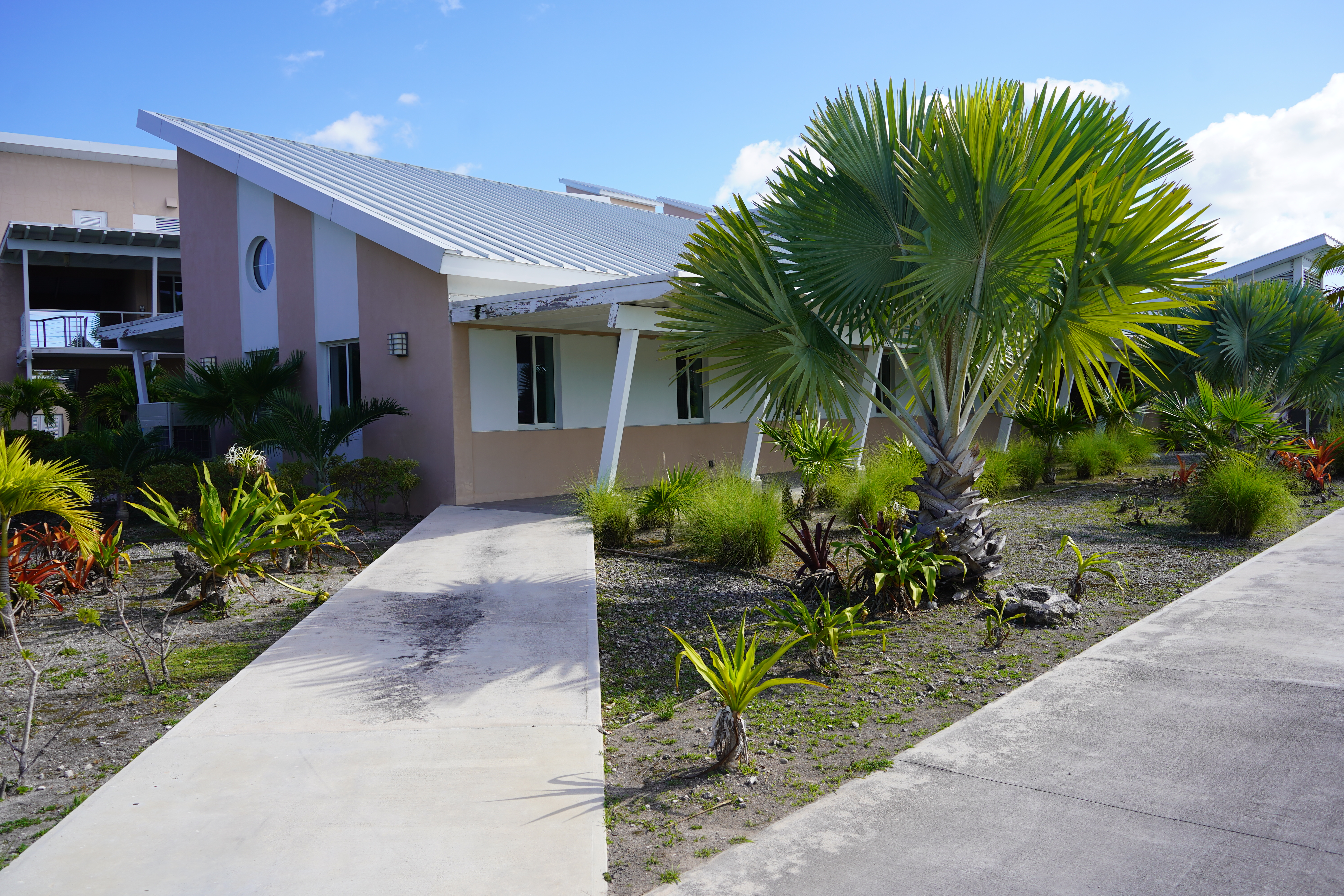
University of the Bahamas
It took forty-two years. The College of the Bahamas was established in 1974 by merging four existing institutions - the Bahamas Teachers' College, the San Salvador Teachers' College, the C. R. Walker Technical College, and the sixth form programme of Government High School - into a single entity that was always intended to become something more. Parliament finally made it official on November 10, 2016, when the University of the Bahamas Act transformed the college into the nation's first and only public university. The delay was not indifference. Building a university across an archipelago of more than 3,000 islands, where the nearest campus might be a boat ride away, requires a kind of institutional patience that mainland nations rarely have to practice.
Classrooms Scattered Across the Sea
The university's physical footprint mirrors the geography it serves. The main Oakes Field campus sits in Nassau on New Providence, alongside the Grosvenor Close campus that houses the Division of Nursing and Health Sciences. A Northern Campus opened in 2011 near Freeport on Grand Bahama, ten kilometers east of Port Lucaya, planned as the seed of an entire university community. Satellite campuses in Abaco, Andros, Exuma, and San Salvador extend the institution's reach to islands where students might otherwise have no access to higher education at all.
This scattered architecture is deliberate. In a country where 70 percent of the population lives on New Providence, it would be easy to concentrate everything in Nassau. The university's network of teaching sites across the Family Islands represents a commitment that the other 30 percent - living on islands where opportunities have historically been limited - deserve the same access to degrees and professional training.
Where the Reef Meets the Lab
The university's research footprint punches well above its weight class. The Gerace Research Centre on San Salvador Island, perched on the shores of Graham's Harbour, serves as a base camp for over 10,000 scientific researchers and students annually, studying everything from archaeology to marine biology to the island's extensive cave systems. On Andros, the Bahamas Environmental Research Centre has operated since 1995 as a collaboration with George Mason University, focused on ecological research in one of the Caribbean's least-developed large islands.
The Marine and Environmental Studies Institute provides year-round access to the subtropical ecosystems that make the Bahamas a living laboratory - coral reefs, mangrove forests, and sea grass communities that researchers elsewhere can only study seasonally. Even the Poultry Research Unit, tucked onto six acres near the Oakes Field campus, addresses a question that sounds mundane but matters enormously to an island nation: how do you practice sustainable agriculture when nearly everything must be imported?
The Library That Became an Archive
The Harry C. Moore Library opened in 2011 as a 60,000-square-foot facility that is quietly becoming something larger than a university library. Its historical archives are intended to serve as the de facto national library of the Bahamas, housing the personal papers of Bahamian prime ministers alongside institutional records and exhibition spaces. Named for Harry C. Moore, an American-born Bahamian philanthropist who lived from 1913 to 2003, the building includes a 24-hour computer commons, an auditorium, a media production studio, and group study spaces.
For a nation that gained independence only in 1973, the decision to anchor its national memory within a university rather than a separate institution reflects a practical truth about small countries: resources are scarce, and institutions must serve multiple purposes. The library does not merely support scholarship. It preserves the documentary record of a country still young enough that its founding generation's papers need active collecting.
Five Thousand Students and a Long Roster of Presidents
With approximately 5,000 students, over 12,000 alumni, and 700 faculty and staff, the University of the Bahamas ranks among the largest employers in the country. Seventy-six percent of its 300-plus faculty are Bahamian - a proportion that reflects both national pride and the practical challenge of recruiting international academics to a small island nation. The university offers 66 majors across certificates, diplomas, associate, baccalaureate, and master's degrees, with pharmacy, law, and other professional programs delivered through partnerships with Caribbean and American universities.
The institution's governance has been eventful. Presidents are typically appointed to three-year terms, and the university has cycled through more than a dozen leaders since 1974. The athletic teams compete as the Mingoes, a name drawn from local culture that carries the same fierce identification that larger universities invest in their mascots. What the University of the Bahamas may lack in ivy-covered tradition, it compensates for with something harder to manufacture: the knowledge that it exists because a nation of islands decided it needed one, and then spent four decades building it.
From the Air
Located at 25.06N, 77.35W on New Providence Island, Nassau, Bahamas. The main Oakes Field campus is visible in central Nassau, south of the harbor area. The Northern Campus near Freeport is on Grand Bahama Island to the northwest. The Gerace Research Centre on San Salvador Island lies far to the southeast. Nearby airports: Nassau/Lynden Pindling International (MYNN) is adjacent to the Oakes Field area, approximately 2nm west. The campus area is identifiable by its cluster of institutional buildings south of the main Nassau commercial district. Caribbean weather with generally good visibility; afternoon convective activity possible.