University of Washington
The school colors came from Lord Byron. In 1892, students at the University of Washington voted to adopt purple and gold, inspired by the opening lines of "The Destruction of Sennacherib" -- "And his cohorts were gleaming in purple and gold." It was a literary flourish for a university that had spent its first three decades struggling to stay open, closing three separate times for low enrollment and lack of funds. Today, the institution those students championed spends over $1.73 billion annually on research and development, ranks among the top six universities worldwide, and sprawls across 700 acres on the shores of Lake Washington. The distance between Byron's verse and billion-dollar research budgets tells you something about what ambition can do in the Pacific Northwest.
A University Before There Was a City
When the Territorial University of Washington opened on November 4, 1861, Seattle was a lumber town of a few hundred people. The campus amounted to ten acres on Denny's Knoll in downtown Seattle, donated by Arthur and Mary Denny and fellow pioneers Edward Lander and Charlie and Mary Terry. John Pike -- the man for whom Pike Street is named -- served as the university's architect and builder. The school closed in 1863 for low enrollment, then again in 1867 and 1876 for lack of funds. Its first graduate, Clara Antoinette McCarty Wilt, earned a Bachelor of Science in 1876, the same year the university shuttered for the third time. Methodist preacher Daniel Bagley had originally persuaded Arthur Denny that a university would do more for Seattle than becoming the territorial capital. He was right, though it took decades to prove it.
From Denny's Knoll to Union Bay
By 1889, when Washington achieved statehood, the campus was hemmed in by downtown development and the student body had grown from 30 to nearly 300. A committee led by graduate Edmond Meany selected a new site on Union Bay, historically the land of the Duwamish people. In 1895, the university moved into newly built Denny Hall on the new campus. The old downtown site became the Metropolitan Tract -- one of the most valuable pieces of real estate in modern Seattle, generating millions in annual revenue. When the original building was demolished in 1908, Meany salvaged four 24-foot hand-fluted cedar Ionic columns. He and Dean Herbert Condon named them Loyalty, Industry, Faith, and Efficiency -- spelling LIFE. They still stand in the Sylvan Grove Theater, the oldest surviving fragments of a university that predates the city it built.
World's Fair and World Wars
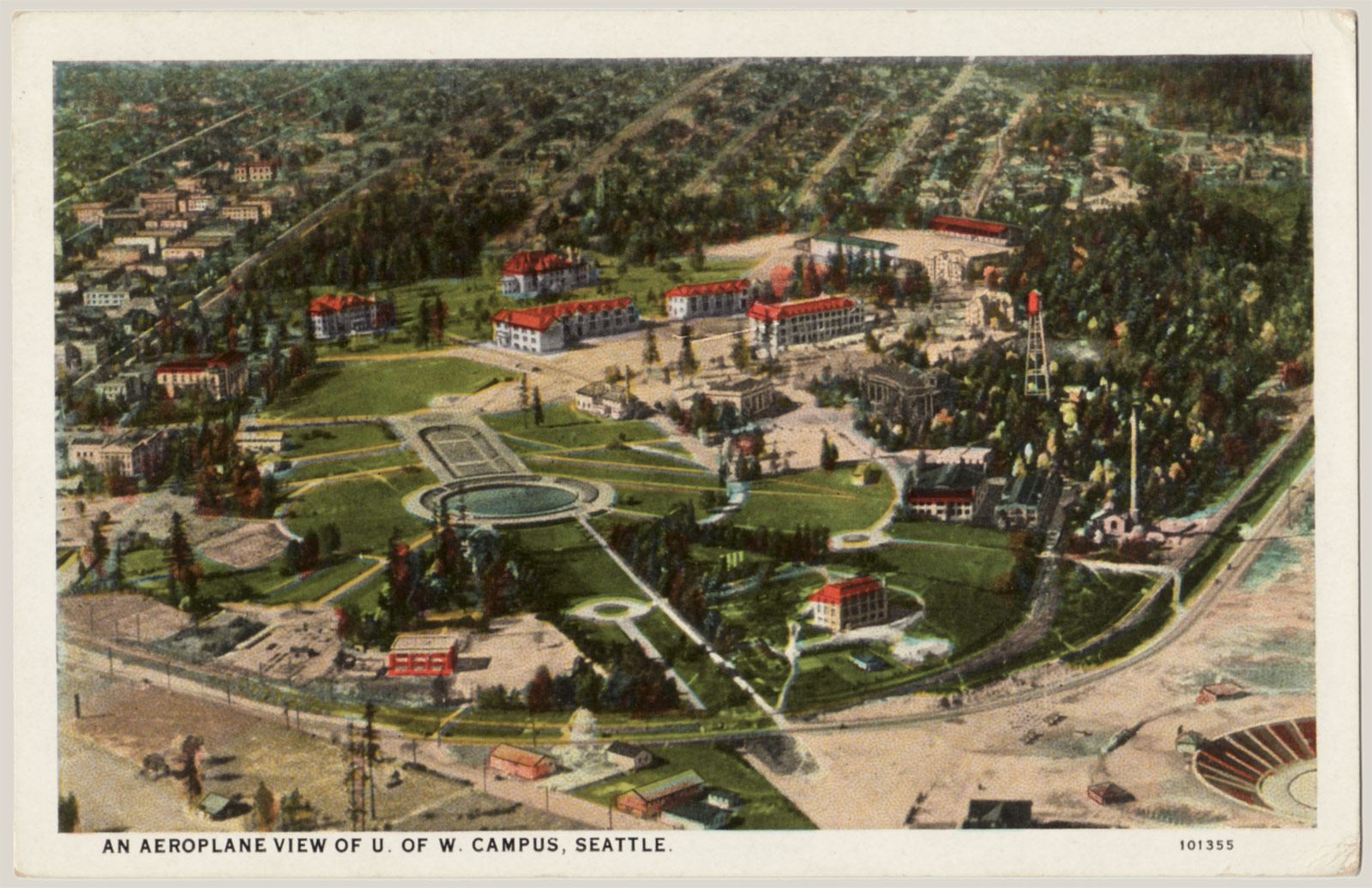
The 1909 Alaska-Yukon-Pacific Exposition transformed the still-developing campus into a world's fair ground. Organizers struck a deal with the Board of Regents: use the grounds for the exposition, and the university keeps the infrastructure afterward. Landscape architect John Charles Olmsted helped craft a plan centered on what is now Drumheller Fountain, framing a view toward Mount Rainier that remains the campus's most photographed sightline. Both World Wars brought the military to campus, but the interwar period saw the construction of the Liberal Arts Quadrangle -- "The Quad" -- between 1916 and 1939, and the architectural centerpiece Suzzallo Library in 1926. During World War II, President Lee Paul Sieg worked to transfer Japanese American students to inland universities before Executive Order 9066 forced Seattle's Japanese community into internment camps. Many students could not transfer in time. The university did not formally recognize their lost opportunities until the Long Journey Home ceremony in May 2008.
Oars in the Water
No story about the University of Washington is complete without rowing. The program dates to 1901, but its defining moment came at the 1936 Summer Olympics in Berlin, where the Washington men's crew won gold, defeating the German and Italian boats while Adolf Hitler watched from the stands. The feat was later immortalized in the bestseller The Boys in the Boat. In 1958, the crew deepened their legend at the Moscow Cup, beating Leningrad Trud's world champion rowers in the first American sporting victory on Soviet soil. A Russian crowd gave them a standing ovation during the Cold War. The men's program has amassed 46 national titles and 15 Olympic gold medals. The tradition of sailgating -- fans arriving by boat to Husky Stadium, which has sat on the shores of Lake Washington since 1920 -- makes game days unlike anything else in college sports.
The Research Engine
Under President Charles Odegaard, who served from 1958 to 1973, the university's operating budget grew from $37 million to over $400 million. Washington senators Henry M. Jackson and Warren G. Magnuson used their political influence to steer federal research funds toward Seattle. The rise of Boeing, Microsoft, and Amazon in the region amplified the effect -- the Paul G. Allen School of Computer Science and Engineering occupies labs where Bill Gates and Paul Allen once worked as students. In 2019, the Bill and Melinda Gates Center for Computer Science and Engineering opened on East Campus. The university's medical school, which fought the Washington State Medical Association's opposition to open in 1946, now ranks consistently as the top medical school in the nation. Today, more than 50,000 students attend the university, making it the largest on the West Coast despite its selective admissions. The institution that closed three times in its first fifteen years now ranks fifth nationally in research spending.
From the Air
Located at 47.654N, 122.308W on the shores of Union Bay and Portage Bay in Seattle. The sprawling 700-acre campus is easily identifiable from the air by the distinctive Husky Stadium on the waterfront, the cherry-tree-lined Quad, and Red Square at the campus center. Drumheller Fountain provides a visual axis toward Mount Rainier on clear days. Nearby airports include Boeing Field/King County International (KBFI, 6 nm south) and Seattle-Tacoma International (KSEA, 13 nm south). Best viewed at 2,000-3,000 ft AGL approaching from over Lake Washington.