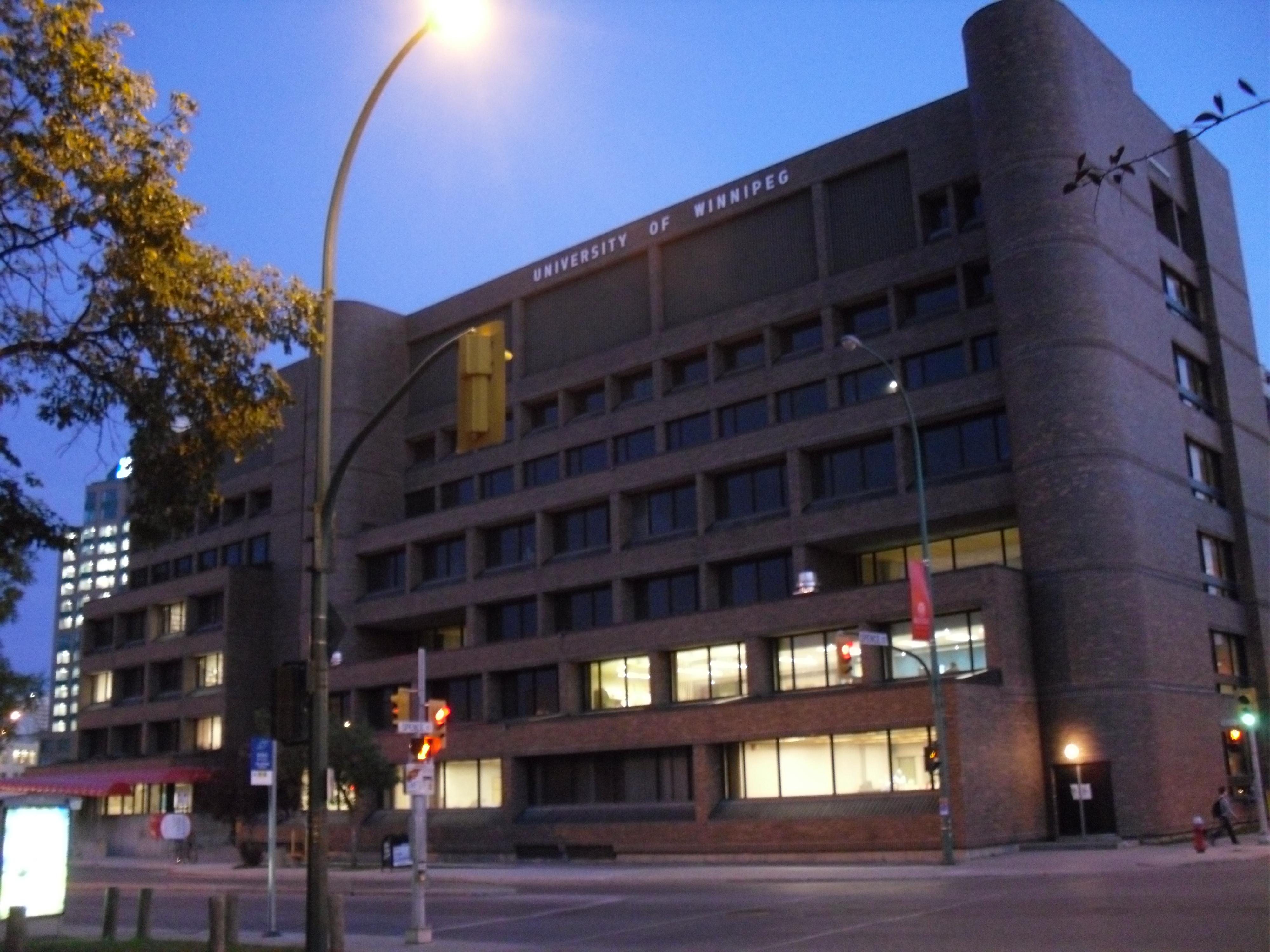
University of Winnipeg
Every September, teams of three students sprint across the front lawn of Portage Commons, racing from Wesley Hall to a granite boulder monument. The fastest team in the history of the UWinnipeg Duckworth Great Rock Climb covered the distance in 9.4 seconds, back in 1979 -- a record that has stood for over four decades. The tradition, running for more than 67 years, is a fitting ritual for a university built on the idea that small, determined institutions can anchor the renewal of an entire downtown. The University of Winnipeg sits on Portage Avenue in the heart of Manitoba's capital, a compact campus that has undergone more than ten major building projects in the past decade alone, transforming itself from an aging commuter school into an engine of urban revitalization.
Two Colleges Become One
The roots reach back to 1871, when Manitoba College was founded, just one year after the province itself came into being. Wesley College followed in 1888. Both were Protestant institutions affiliated with the University of Manitoba. In 1938, they merged to form United College, consolidating their resources in the hard years of the Great Depression. Wesley Hall, the stone-clad brick structure built in 1894-95 that now anchors the campus at 515 Portage Avenue, survives from that era and is listed on the Registry of Historic Places of Canada. Its convocation hall contains documented stained glass windows that connect the institution to its denominational origins. On July 1, 1967 -- Canada's centennial -- United College received its charter and became the University of Winnipeg, an independent degree-granting institution free from its longtime affiliation with the University of Manitoba.
Downtown Anchor
The campus reads like a timeline of architectural ambition. The Buhler Centre, opened in September 2010, houses the Faculty of Business and Economics alongside the Plug In Institute of Contemporary Art and Stella's Cafe on its main floor -- a deliberate mixing of academic and commercial life. McFeetors Hall, the student residence, was partly funded by a $2.67 million personal donation from Raymond L. McFeetors, chairman of the Great West Life Assurance Company. The Axworthy Health and RecPlex opened in 2014, named for Lloyd Axworthy, the Nobel Prize-nominated politician who served as university president from 2004 to 2014. Downtown Commons, a 14-storey apartment complex on Colony Street, provides student and community housing. The University of Winnipeg Community Renewal Corporation, a not-for-profit subsidiary, manages all this development with a stated focus on environmental, social, economic, and cultural sustainability.
Arctic Research in a Prairie City
For a primarily undergraduate institution, the university punches well above its weight in research. Grant income doubled from $6 million in 2015-16 to $12 million in 2019-20. The Richardson College for the Environment, one of the most energy-efficient educational buildings in North America, conducts research in biology, chemistry, environmental studies, Indigenous science, and the social sciences. Canada Research Chairs here span fields from Fundamental Symmetries in Subatomic Physics to Quantum Materials Discovery to Indigenous Arts, Collaboration and Digital Media. The university is an active member of the University of the Arctic, a cooperative network of more than 200 institutions in the Circumpolar Arctic region. That northern orientation shapes the academic identity: the UWinnipeg offers Canada's only master's degree in Development Practice with a focus on Indigenous Development, part of a global network of 22 universities supported by the MacArthur Foundation.
From Crash Test Dummies to a Premier's Office
The alumni list reads like a cross-section of Canadian cultural and political life. Brad Roberts, lead singer of the Crash Test Dummies, studied here. So did Guy Maddin, the Winnipeg-born film director known for dreamlike recreations of silent-era cinema. Margaret Laurence, one of the most celebrated Canadian novelists of the twentieth century, passed through these halls. Fred Penner entertained a generation of Canadian children after his time at UWinnipeg. On the political side, Howard Pawley went on to serve as Premier of Manitoba, while Lloyd Axworthy became Foreign Affairs Minister before returning as university president. Wab Kinew, the broadcaster and politician, was named the university's first Director of Aboriginal Inclusion in 2012 before going on to his own political career. The Winnipeg Wesmen compete in U Sports in basketball, soccer, and volleyball, carrying the university's competitive tradition forward from those Great Rock Climb sprints across the campus lawn.
From the Air
Located at 49.89N, 97.15W in downtown Winnipeg, Manitoba, along Portage Avenue -- one of the city's main east-west arteries. The campus is identifiable from the air as a cluster of institutional buildings between Portage Avenue and Ellice Avenue, near Portage Place Mall. Winnipeg James Armstrong Richardson International Airport (CYWG) lies approximately 7 km to the west. The junction of the Red River and Assiniboine River (The Forks) is visible roughly 1.5 km to the southeast. The Manitoba Legislative Building and its grounds are immediately south. Best viewed at 2,000-4,000 feet for campus detail amid the downtown grid.