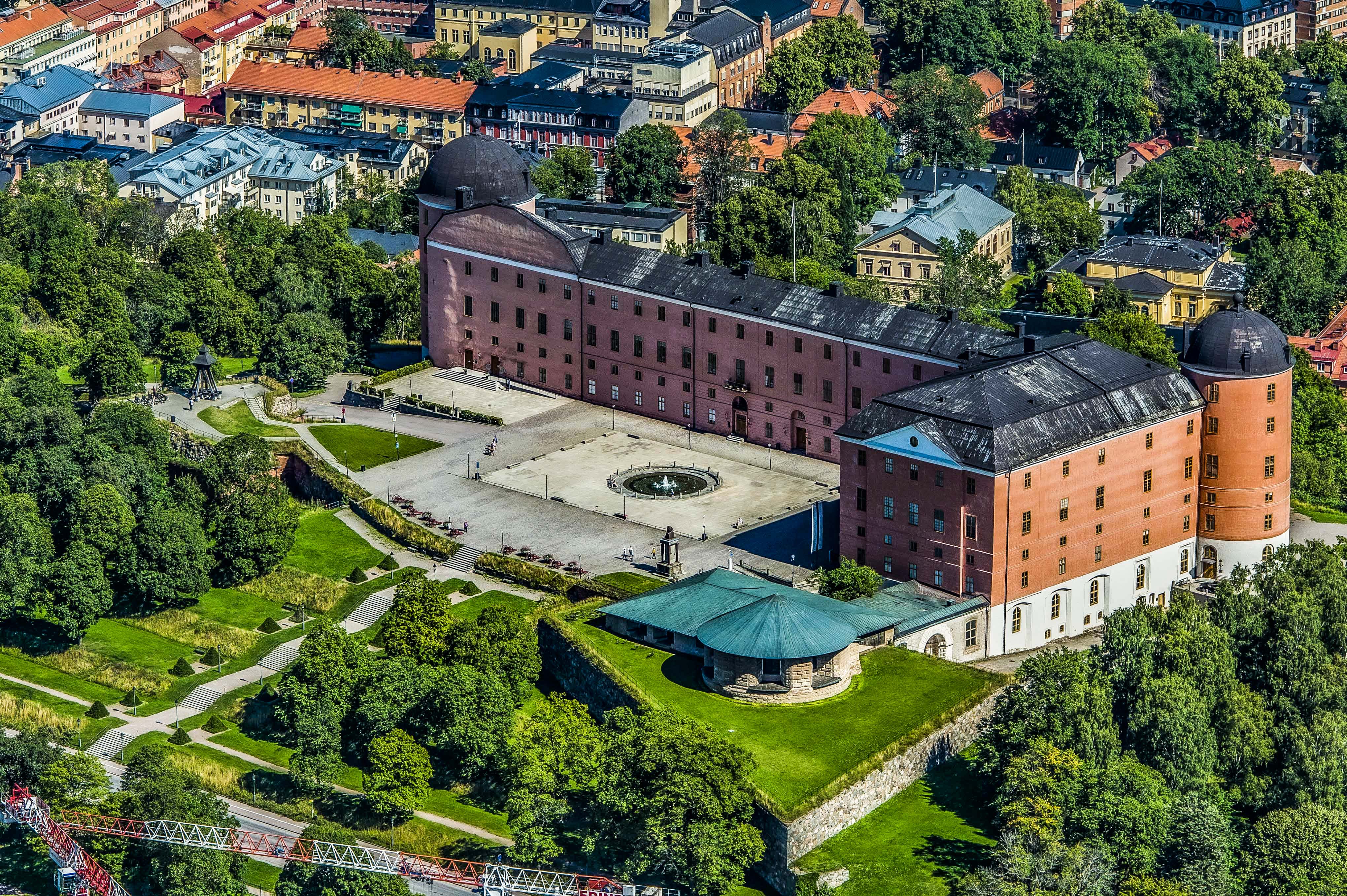
Uppsala Castle
The Styrbiskop battery at Uppsala Castle was not named randomly. In Swedish, it means Bishop-Controller, and King Gustav Vasa ordered those cannons trained permanently on Uppsala Cathedral below. The message was unmistakable: the crown would dominate the church. Built in 1549 after a peasant uprising nearly toppled his throne, Uppsala Castle began as a statement of raw military power and evolved into a Renaissance palace where Swedish history would unfold in blood, intrigue, and transformation.
Born from Rebellion
The Dacke War changed Gustav Vasa's thinking about fortifications. When peasants rose against him in the 1540s, the king realized he needed defensive strongholds throughout his kingdom. Uppsala, already home to Sweden's most important cathedral and the ancient sacred site at Gamla Uppsala, demanded a royal presence. Construction began in 1549 atop Kasasen, a glacial ridge called an esker that provided natural elevation and defensive advantage. The initial complex included royal apartments in the southwest corner and two massive bastions on the western side: Grasgarden and Styrbiskop. The latter's perpetually aimed artillery represented more than military readiness. The hostility between Gustav Vasa and the church had defined his reign since the Protestant Reformation began reshaping Swedish society. Those cannons pointing downhill at the cathedral served as a constant reminder of who held ultimate power.
A Palace Takes Shape
Under Gustav Vasa's successor Eric XIV, the castle transformed from fortress to court. Representation premises emerged: a hall of state and church were added east of the royal apartments, while elaborate gardens spread at the base of the hill. The castle church received large multi-story stucco reredos covering the entire wall behind the altar, parts of which survive today. But Eric XIV's reign would end in madness and murder. In 1567, within these walls, the king personally participated in the killing of members of the noble Sture family, an act of violence that helped seal his eventual deposition. His half-brother John III would later confine Eric to this very castle before eventually having him poisoned. The beautiful Renaissance palace became both a seat of power and a prison, its halls witnessing some of Sweden's bloodiest political dramas.
Fire and Rebirth
The great fire of 1702 devastated Uppsala Castle, destroying much of what the Vasa kings had built. Restoration dragged on for decades, with major repairs continuing until 1762. The architect Carl Harleman gave the rebuilt castle a more restrained appearance, though the southeast tower remained truncated at two floors until 1815, when it was fully reconstructed to serve as a county prison. Today's pink-painted structure bears the marks of many eras. The original 1549 foundations survive as the Vasaborgen museum, opened in 2004 in the ruins where Gustav Vasa once kept his apartments. The castle now houses the governor of Uppsala County, various businesses, and an art museum. Between 2006 and 2019, a Peace Museum operated here, an ironic occupant given the building's militaristic origins, though it closed after dangerous radon levels were discovered in the medieval stonework.
Seat of Kings and Governors
For nearly five centuries, Uppsala Castle has commanded the ridge above the city. The Yngling dynasty had ruled from nearby Gamla Uppsala since the 5th century, making this region the cradle of Swedish monarchy long before Gustav Vasa asserted his authority with stone walls and bronze cannons. Uppsala University's art study collection resided here from 1997 until 2017, when it moved to the university's Gustavianum museum. The castle's position remains commanding: from its ramparts you can see Uppsala Cathedral's twin spires below, the River Fyris winding through the city, and the distant mounds of Gamla Uppsala where Sweden's story began. The Styrbiskop battery no longer threatens the cathedral, but the physical relationship between castle and church still speaks to the power struggles that shaped Swedish history.
From the Air
Located at 59.853N, 17.635E on a prominent ridge (esker) overlooking Uppsala city center. The pink castle is highly visible from the air, sitting on elevated ground southwest of Uppsala Cathedral's distinctive twin spires. The River Fyris winds through the city below. Best viewed at 2,000-3,000 feet altitude. Gamla Uppsala's burial mounds are visible 5km to the north. Nearest airports: ESSA (Stockholm Arlanda, 35nm south), ESKN (Skavsta, 50nm south).