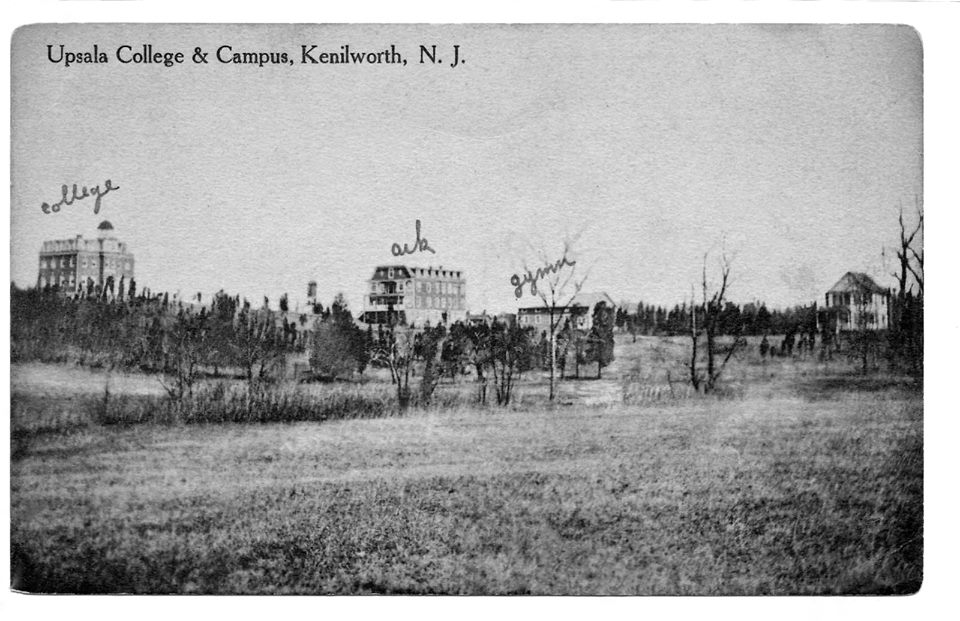
Upsala College
On October 3, 1893, a man named Beck stood before sixteen students in the Swedish Evangelical Lutheran Bethlehem Church in Brooklyn and began teaching. The institution they were founding carried the name Upsala, chosen to honor Uppsala University in Sweden and the historic Uppsala Synod. Early instruction was conducted in Swedish, because most of the students were Scandinavian immigrants still finding their footing in America. By the end of that first year, enrollment had grown to seventy-five. No one in the room could have predicted that a century later the college would be dead, its campus looted and demolished -- or that its strangest and most enduring legacy would be a radio station.
Three Addresses in Thirty Years
Upsala College was restless from the start. After four years in Brooklyn, the school relocated in 1897 to Kenilworth, New Jersey -- then called New Orange -- when a local industrial association offered fourteen acres of free land. The first building rose on the Kenilworth campus in 1899. But Kenilworth was not the final stop. In 1924, Upsala moved again, this time to East Orange, where it would remain for the rest of its life. The college was affiliated with the Augustana Synod, a Lutheran church body rooted in the Swedish immigrant community that emphasized mission, ecumenism, and social service. Those values shaped a small, earnest institution that trained generations of first-generation Americans and, eventually, students from around the world.
The Long Decline
At its peak in 1969, Upsala enrolled roughly 1,400 students. Then the world around it shifted. The 1967 Newark riots transformed the demographics and reputation of East Orange, making it harder to recruit prospective students to what was increasingly perceived as a dangerous neighborhood. Enrollment fell steadily -- to 475 by 1990. College president Robert E. Karsten launched a turnaround strategy in the early 1990s, pivoting recruitment to focus on minority and international students. It worked, briefly. By 1992, enrollment had rebounded to 882, with 35 percent of the student body identifying as Black or African American and 30 percent arriving from abroad. A major fundraising drive raised money in the first half of 1992, and a consortium of lenders and Lutheran colleges extended a loan.
The Final Class
It was not enough. Faculty salaries were cut by 40 percent. A hoped-for infusion of cash from South Korean industrialist In Tae Kim fell through when the college's administration said South Korea's restrictions on exporting funds to nonprofit organizations blocked the transfer. On March 3, 1995, the board of trustees voted to close Upsala on May 31. The last class -- approximately 200 students -- graduated on May 14, 1995. At the time of closure, total enrollment stood at 435. What followed was grimmer still: the western half of the campus deteriorated, was looted and vandalized, and sat blighted until demolition in the summer of 2005. A residential development called Woodlands at Upsala now occupies the site. Roughly 60 percent of the college library was sold to the newly established Florida Gulf Coast University in Fort Myers; Fairleigh Dickinson University and a German investor bought the rest.
The Radio Station That Survived
Upsala College is gone. Its campus is gone. Its library is scattered across Florida and northern New Jersey. But WFMU still broadcasts. The freeform radio station that began as Upsala's campus station became something far larger than the institution that spawned it. In 1992, as the college spiraled toward insolvency, station staff formed a nonprofit called Auricle Communications and purchased WFMU's broadcast license in 1994 -- one year before Upsala closed its doors. The station continued to occupy space on the abandoned campus until 1998, when it purchased a building in Jersey City and moved. WFMU went on to become one of the most celebrated independent radio stations in the country, famous for its eclectic programming and fierce independence. The college that created it is a footnote. The station is the legacy.
From the Air
Located at 40.776N, 74.209W in East Orange, New Jersey. The former campus site is now a residential neighborhood (Woodlands at Upsala). Not individually identifiable from the air. Nearest airports: Essex County Airport (KCDW, 6nm NW), Teterboro (KTEB, 10nm NE), Newark Liberty International (KEWR, 6nm SE). Under New York Class B airspace.