Where the Marquees Still Glow
Duke Ellington played here. So did Ella Fitzgerald and Cab Calloway, their music drifting down from the second floor of the Oakland Floral Depot building, where Sweets Ballroom hosted the biggest names in jazz from the 1930s through the 1960s. The Sweet family ran the ballroom the entire time, and the neighborhood around it -- the stretch of Broadway and Telegraph Avenue north of 14th Street -- was Oakland's undisputed commercial heart. Then the department stores closed, the shoppers left, and for decades Uptown Oakland was a district of parking lots waiting for a future that kept falling through. Shopping mall proposals, entertainment complex schemes, even a professional baseball stadium -- all proposed, all abandoned. The future, when it finally arrived, looked nothing like any of those plans.
Capwell's Ghost
The bones of Uptown's golden age are still standing. At 1955 Broadway, the former H.C. Capwell department store -- designed by architect Ernest Alan Van Vleck and opened in 1929 -- anchored the neighborhood for half a century. The Emporium owned it, then Sears took over, then Sears closed in 2014. Uber bought the building in 2015 and branded it "Uptown Station," then sold it to a developer. By 2018, Square had leased the space to house hundreds of employees. The building's journey from department store to ride-hailing headquarters to fintech office tells the story of American commerce in miniature. Nearby, the green terracotta I. Magnin Building, built in 1931, traded luxury retail for office space. The Payless Drug Store at Telegraph and 20th -- which once housed a SAAG's sausage counter and a USO branch -- was demolished in the early 1960s to make room for parking. Uptown kept losing its landmarks to cars that needed somewhere to sit.
Theaters of Light and Shadow
Two grand theaters survived the decades of decline, and their survival made Uptown's revival possible. The Paramount Theatre, built in 1931, was the largest multi-purpose theater on the West Coast when it opened, seating 3,476. Its Art Deco interior is a cathedral of geometric ornament and warm light. Today it hosts the Oakland East Bay Symphony, the Oakland Ballet, and everything from gospel concerts to screenings of Golden Era Hollywood films. A few blocks away on Telegraph Avenue, the Fox Oakland Theatre sat dark and deteriorating for years -- a 3,800-seat palace designed by Weeks and Day, listed on the National Register of Historic Places, and slowly crumbling. Its reopening on February 5, 2009, after extensive renovation, marked a turning point. The Fox now operates as a major live music venue and houses the Oakland School for the Arts, filling the neighborhood with students and concertgoers where there had been only silence.
The 10K Gamble
When Jerry Brown became Oakland's mayor in 1999, he designated Uptown as the city's entertainment center and launched the 10K program -- an ambitious effort to bring 10,000 new residents to the downtown area. West of Telegraph Avenue, where parking lots had dominated for years, apartment buildings began rising. The largest was "The Uptown," a five-story, three-building complex built by Forest City Enterprises that included Fox Square, a dog-friendly park. A new street in the development was named Rashida Muhammad Street, honoring the community activist whose story Alice Walker had immortalized in her essay collection Living by the Word. The complex also features Mario Chiodo's "Remember Them" sculpture, one of the largest bronze works in the United States, honoring 25 humanitarians including Oskar Schindler, Maya Angelou, Ruby Bridges, and Cesar Chavez. Bars and restaurants filled in between 16th Street and Grand Avenue, and the cafes and galleries followed. Uptown had tried for decades to reinvent itself through grand schemes. What worked, in the end, was simply adding people.
Walls That Speak
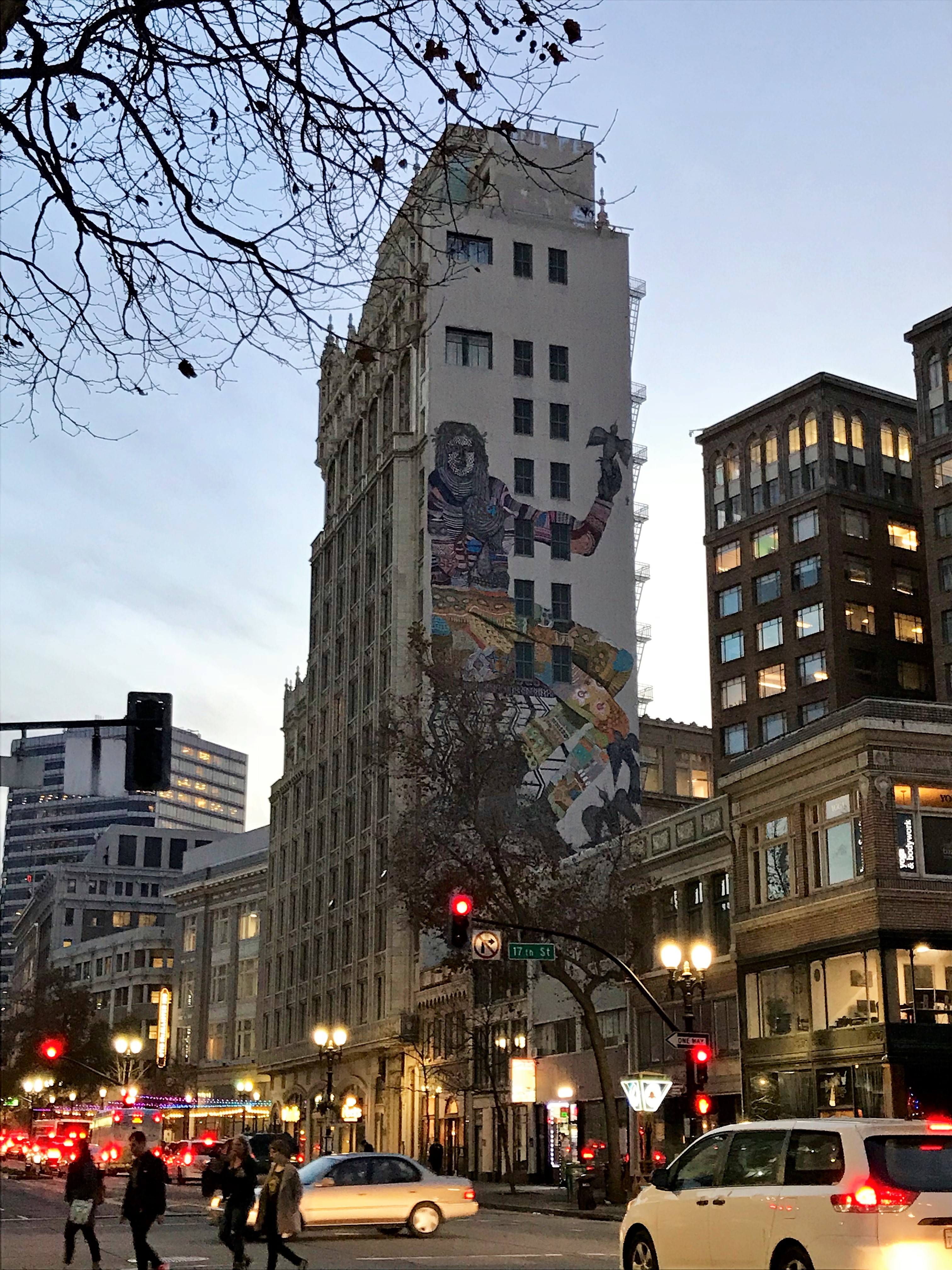
Uptown's identity today is written on its buildings -- literally. The neighborhood has become one of the Bay Area's most concentrated mural districts. Zio Ziegler painted the back of the Gothic Revival Cathedral Building to mark the United Nations' 70th anniversary in 2015. Joshua Mays's "Beacon: Frequency Reader" wraps 1700 Broadway in pattern and color. On 21st Street, the "Water Writes" mural, created in 2011 by artists and volunteers with the Estria Foundation, addresses water conservation in a sprawl of blues and greens. A Stephen Curry commemorative mural by Andre Jones appeared along the Oakland YMCA at 2350 Broadway in 2022. The murals serve a purpose beyond decoration: in a neighborhood that spent decades as a blank canvas of parking lots and vacant storefronts, they declare that someone is paying attention, that the walls belong to the community now.
The Deco Corridor
Walking Telegraph Avenue through Uptown is an education in 1930s California architecture. The Oakland Floral Depot at 19th Street, designed by Albert J. Evers in 1931, wears a cobalt blue and silver terracotta frieze with geometric and floral motifs -- it was originally a flower shop, and now houses the Uptown nightclub and the Flora restaurant, a name that nods to the building's roots. The May Bowles Building at 1718 Telegraph features blue-green terracotta and geometric window screens by architect Douglas Dacre Stone. At the district's edge, the 40-story Atlas tower rises 400 feet, the second-tallest building in Oakland, while the 34-floor "17th and Broadway" stands at 380 feet. The 19th Street BART station runs beneath Broadway, linking Uptown to San Francisco and the wider Bay Area. An Art Moderne Greyhound bus depot still sits on San Pablo Avenue. The neighborhood layers its eras without apology -- Depression-era ornament beside 21st-century glass, jazz-age bones beneath tech-economy skin.
From the Air
Uptown Oakland is centered at approximately 37.809N, 122.271W, in the northern portion of downtown Oakland. The Paramount Theatre and Fox Oakland Theatre are visible landmarks. Nearest airports: Oakland International (KOAK, 8nm south) and San Francisco International (KSFO, 15nm southwest). Best viewed at 2,000-4,000 feet AGL. The high-rise Atlas tower (400 feet) and 17th & Broadway building (380 feet) are useful reference points from the air.