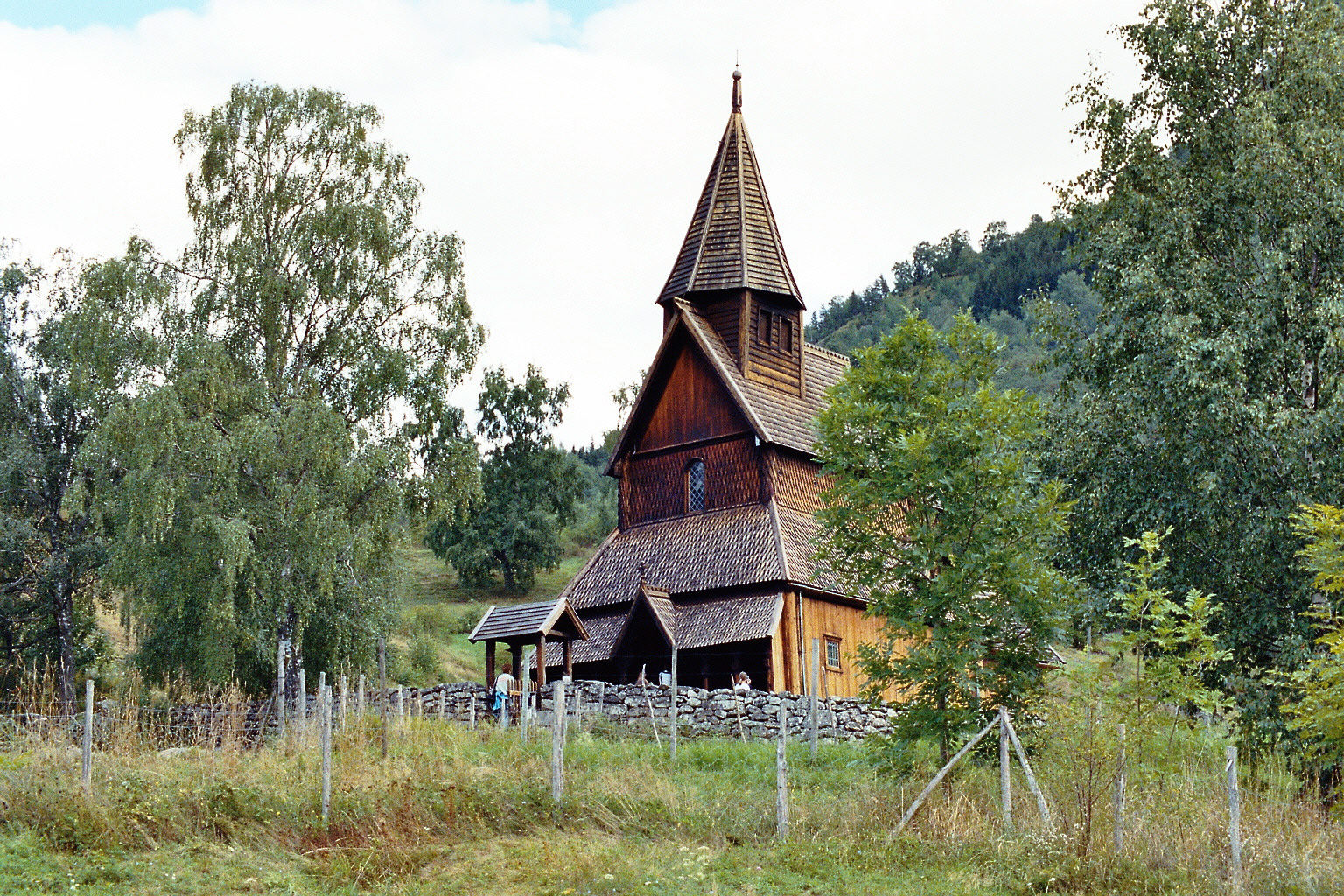
Urnes Stave Church
On the north portal of a small wooden church perched above the Lustrafjorden in western Norway, a serpent and a great beast are locked in combat. The serpent coils around the creature, biting into its body. Tendrils of vine twist through the tangle until animal and plant become indistinguishable, a single mass of interlocking life. Art historians call this the Urnes style, the final phase of Viking decorative art, and this doorway is where the style gets its name. The carving dates to the 11th century, older than the church it now decorates. When the current structure was built in the 12th century, the builders salvaged these panels from an even earlier church on the same site and incorporated them into the new walls. The serpent's struggle may represent Nidhogg gnawing at the roots of Yggdrasil, the World Tree of Norse mythology, a scene depicting the onset of Ragnarok. Or it may simply be what a skilled woodcarver, standing at the threshold between two faiths, chose to leave behind.
Where Two Faiths Met
Urnes Stave Church sits on the eastern shore of the Lustrafjorden, an inner arm of the Sognefjorden, directly across the water from the village of Solvorn. The location is remote even by Norwegian standards, reachable by a narrow road that winds above the fjord or by ferry from Solvorn itself. This isolation may explain why the church preserves what so many others lost. The transition from Norse paganism to Christianity in Norway was neither sudden nor clean. It stretched across two centuries, from the late 900s to the 1100s, and the decorative program at Urnes captures the overlap. The north portal's interlaced animals belong to the Viking tradition. Inside, the 12th-century column capitals carry carvings of human, animal, and vegetal motifs, some abstract, some unmistakably Christian. A centaur appears on one capital. A pilgrim figure stands atop another. The building is a palimpsest, each layer recording a different moment in the long negotiation between old gods and new.
The Bones of the Building
Like all stave churches, Urnes is a wooden frame structure, its name derived from the sturdy vertical posts, or staves, that form the corner columns and bear the weight of the roof. Parts of the timber construction date to the second half of the 11th century, making Urnes among the oldest stave churches in Norway. The church was built on a long-church basilica plan with cylindrical columns and semi-circular arches, a form borrowed from the stone churches of medieval Christianity but executed entirely in wood. Over the centuries, practical interventions accumulated. The nave was extended southward in the 17th century. A baptismal font arrived in 1640, a wooden canopy above the altar in 1665, a pulpit between 1693 and 1695. The altarpiece, depicting Christ on the cross flanked by the Virgin Mary and John the Baptist, dates from 1699. Windows were cut into the walls in the 18th century, admitting light that the original builders had deliberately excluded. Each addition is a record of the community's changing needs.
The First Heritage Listing
In 1881, the Society for the Preservation of Norwegian Ancient Monuments acquired the church, beginning a preservation effort that has continued for nearly a century and a half. In 1979, UNESCO inscribed Urnes Stave Church as a World Heritage Site, the first stave church to receive the designation and one of the earliest cultural sites listed anywhere. The citation recognized not only the building itself but the decorative carvings as evidence of the Viking culture's transformation, assimilation, and adoption of Christianity. The intertwined snakes and beasts of the north portal were singled out as an exceptional example of the transition between Nordic animal ornamentation and the Romanesque style that would dominate European church art for the next several centuries. Today, Urnes is one of the most visited tourist sites in Norway, though the fjord-side setting and limited road access keep the crowds smaller than at more accessible stave churches like Borgund.
The View from the Churchyard
Stand in the churchyard at Urnes and the Lustrafjorden drops away below, its water deep blue-black in the shadows of the surrounding mountains. Across the fjord, the village of Solvorn spreads along the opposite shore, its white wooden houses bright against the dark green hillside. Behind the church, the terrain climbs steeply into forested slopes. The church itself is modest in scale, a dark wooden structure with a shingled roof, unremarkable from a distance. Its power lies in the details: the flowing lines of the portal carvings, the warm amber of the interior wood in the thin light that filters through the small windows, the worn smoothness of columns that human hands have touched for 900 years. What survives here is not just a building but a record of the moment when Scandinavian civilization turned from one world to another, preserving enough of the old to remind itself where it had been.
From the Air
Located at 61.30N, 7.32E on the eastern shore of the Lustrafjorden in Luster Municipality, Vestland county. The church sits on a hillside above the fjord, visible as a small dark wooden structure against green slopes. The village of Solvorn is directly across the water. Nearest airports: Sogndal/Haukasen (ENSG) approximately 25 km southwest, Bergen/Flesland (ENBR) approximately 185 km southwest. Best viewed at lower altitudes; the fjord setting provides strong visual contrast between water, mountains, and the small building on the hillside.