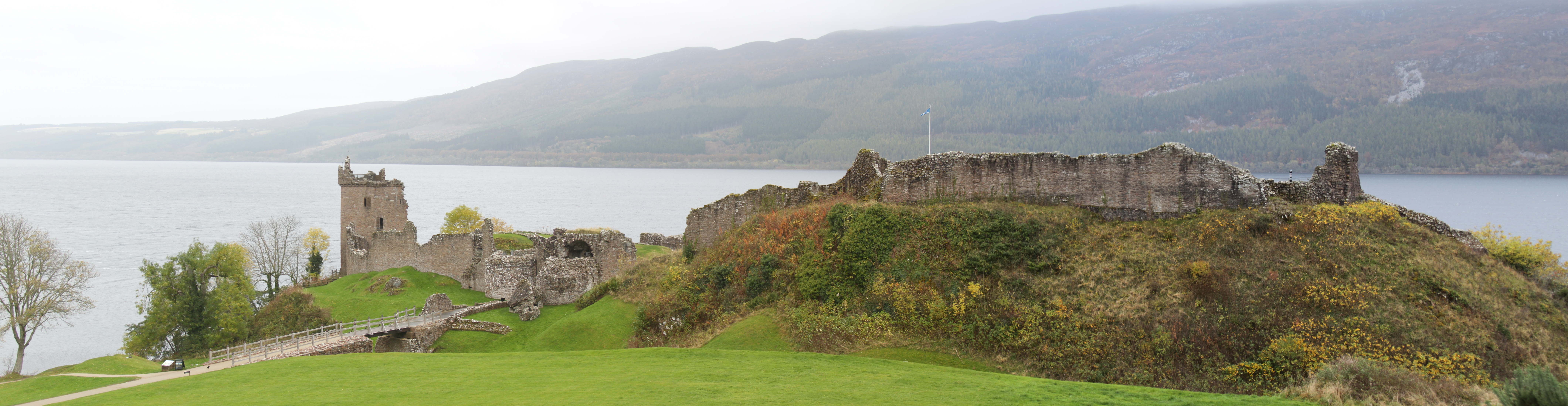
Urquhart Castle
The garrison that destroyed Urquhart Castle did so on orders. In 1692, with the Jacobite cause still smoldering across the Highlands, the government decided that this fortress on Loch Ness must not fall into rebel hands again. Soldiers packed the gatehouse with gunpowder and brought it down, leaving the ruins that visitors see today. It was the final act in a history of siege, seizure, and strategic calculation stretching back at least to the sixth century -- a history in which the castle changed hands so many times that keeping track requires a scorecard and a tolerance for ambiguity.
The Promontory and the Picts
Urquhart Castle sits on Strone Point, a triangular headland on the northwestern shore of Loch Ness, commanding both the route along the Great Glen and the entrance to Glen Urquhart. The name itself is ancient: it derives from the seventh-century form Airdchartdan, a blend of Old Irish and Old Welsh meaning roughly 'point of the thicket.' The site was fortified long before the stone castle existed. Excavations in 1983 by Professor Leslie Alcock uncovered vitrified stone -- rock fused by intense heat, characteristic of early medieval timber-and-stone fortifications -- and radiocarbon dating confirmed that an extensive fort occupied the rocky knoll at the castle's southwest corner between the fifth and eleventh centuries. Adomnan's Life of Columba records that Saint Columba, during his visit to the Pictish king Bridei sometime between 562 and 586, converted a nobleman named Emchath at a place called Airdchartdan. Professor Alcock concluded that this was most likely the site of Emchath's residence, making Urquhart one of the few places in Scotland where a specific early medieval event can be linked to a specific piece of ground.
The Castle That Could Not Stay in One Hand
The stone castle was probably built in the mid-thirteenth century after Alexander II granted the lands to his door-ward Thomas de Lundin, whose son Alan Durward constructed the original fortification centered on a motte at the southwest corner. From that point, Urquhart's history becomes a chronicle of possession and dispossession. Edward I of England captured it in 1296, marking the beginning of the Wars of Scottish Independence. Sir Andrew de Moray ambushed the English constable in 1297 and laid siege. The castle changed hands twice more before Robert Bruce took it in 1307 during his march through the Great Glen. It became a royal castle, held for the crown by constables -- but the crown's grip was never secure. Over the next two centuries, the MacDonald Lords of the Isles raided the Great Glen repeatedly. Domhnall of Islay seized Urquhart in 1395 and held it for over fifteen years. His grandson John seized it again in 1452. Each raid brought destruction: cattle driven off, provisions looted, defenses damaged. Each recovery brought rebuilding. The castle's fabric is a palimpsest of these cycles -- fourteenth-century curtain walls augmented by sixteenth-century towers, each layer a response to the violence of the previous generation.
The Grants and the Tower
In 1509, James IV granted Urquhart to John Grant of Freuchie on the condition that he repair and rebuild the castle. The Grants did precisely that, and the five-storey Grant Tower at the castle's northern tip -- the most prominent feature of the ruins today -- is largely their work, built on fourteenth-century foundations. The tower has walls three metres thick, with machicolations above its doors through which defenders could drop objects on attackers, and pistol holes beneath its large windows for close-range fire. But even the Grants could not hold Urquhart in peace. After the Scottish disaster at Flodden in 1513, Sir Donald MacDonald of Lochalsh occupied the castle and drove off three hundred cattle and a thousand sheep before Grant could retake it. In 1545, the MacDonalds and their Cameron allies attacked and captured the castle again. By the middle of the seventeenth century, Urquhart was largely abandoned -- its strategic value diminished, its walls battered by centuries of intermittent warfare. The deliberate demolition of 1692 was less an act of destruction than a recognition that the castle's fighting life was over.
Ruin and Revival
For nearly two centuries after the demolition, Urquhart decayed into the romantic ruin that attracted nineteenth-century painters and tourists on Highland excursions. The southern wall of the Grant Tower collapsed in a storm in the early eighteenth century, opening the interior to the elements. By the 1770s the castle was roofless. In 1911, the Dowager Countess of Seafield's will instructed that the castle be entrusted to state care, and by 1913 the government had taken responsibility for its preservation. Excavations between the wars uncovered a large collection of artifacts -- a fifteenth-century bronze ewer, coins, jewelry, and crosses spanning four centuries -- most of which are now in the National Museum in Edinburgh. Today Urquhart Castle is one of the most visited historic sites in Scotland, drawing over half a million visitors a year. A modern visitor centre, sunk into the embankment below the road so as not to intrude on the view, provides historical context. But the real experience is standing on Strone Point itself, looking south along the dark water of Loch Ness, with the Grant Tower rising behind you and the Great Glen stretching into the distance -- a view that has been watched, fought over, and defended for fifteen hundred years.
From the Air
Urquhart Castle sits at 57.32°N, 4.44°W on Strone Point, a headland on the northwestern shore of Loch Ness. The castle ruins, particularly the Grant Tower, are clearly visible from the air against the dark water of the loch. Drumnadrochit lies 2 km to the west. The Great Glen runs northeast to Inverness. Nearest airport: Inverness (EGPE) approximately 12 nm to the northeast.