'Uruq Bani Ma'arid
The last wild Arabian oryx fell to a hunter's bullet in 1972, somewhere in the deserts of Oman. The species that had roamed the Arabian Peninsula for millennia -- white-coated, spiraling horns catching the light like twin scimitars -- was gone from the Earth's open spaces. But on the western fringe of the Rub' al Khali, the Empty Quarter, a protected area had already been set aside where the story might be rewritten. 'Uruq Bani Ma'arid sits where Saudi Arabia's limestone escarpments crumble into the largest continuous sand desert on the planet, a transition zone between bare rock and endless dunes that harbors more life than the surrounding emptiness would suggest.
Where Stone Meets Sand
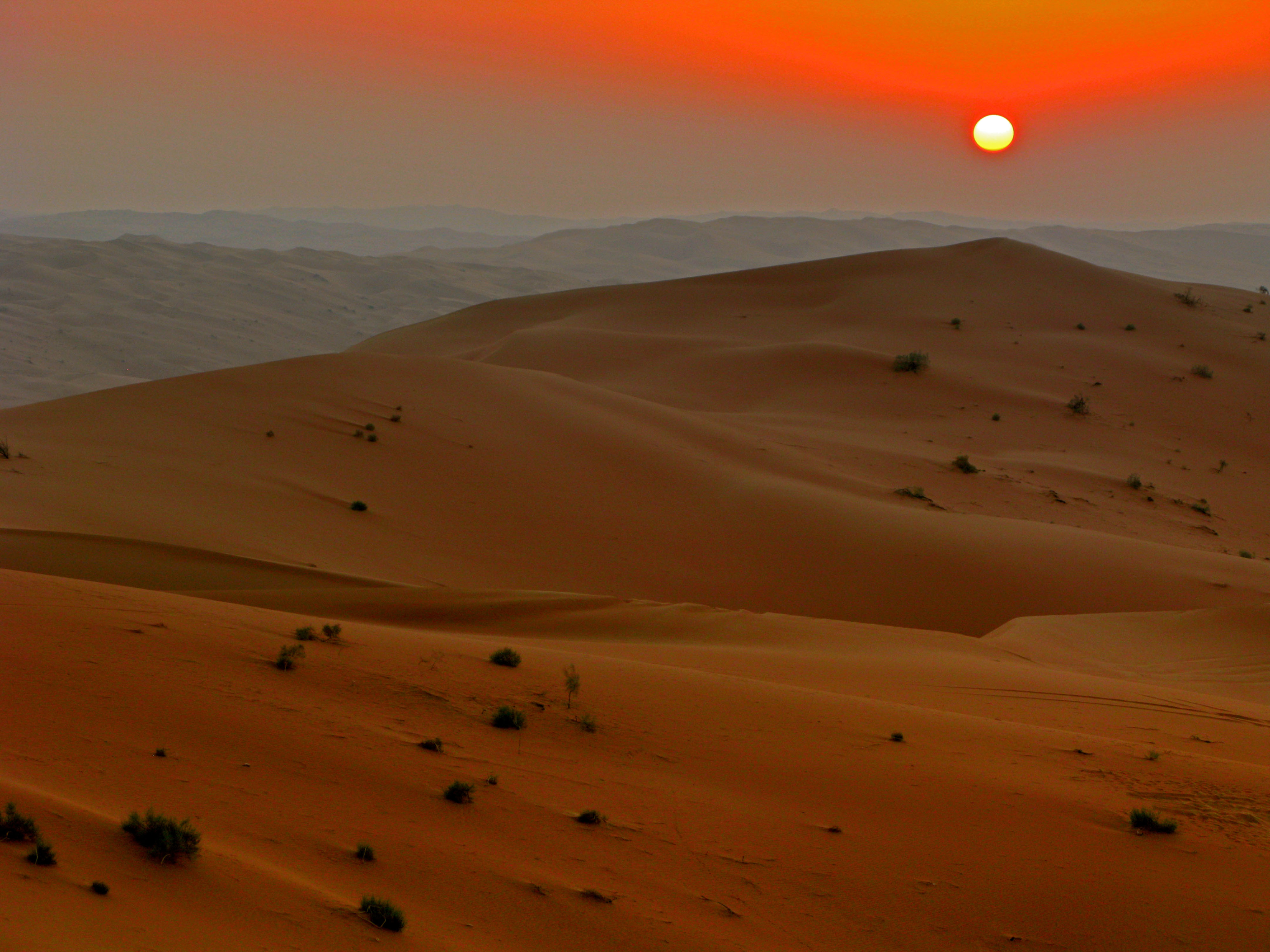
The reserve occupies a landscape of stark contrasts. A limestone escarpment, nearly bare of vegetation, drops toward the Empty Quarter's western edge. Wadis -- dry riverbeds that carry water only after rare rains -- crease the escarpment's flanks, and in their sheltered channels grow acacias, perennial grasses, and leguminous shrubs. The dunes themselves are not entirely lifeless: Calligonum crinitum, a wispy desert shrub adapted to shifting sands, clings to their slopes alongside sedges and tough perennial grasses. Between the dunes, in corridors where sand gives way to harder ground, dwarf Haloxylon persicum bushes grow beside Moringa peregrina and Commiphora myrrha, the tree that produces the myrrh traded across Arabia for thousands of years. In total, 106 plant species have been recorded here -- a number that sounds modest until you consider the setting. Annual plants are nearly absent; the perennials wait, dormant, until rain falls and triggers a brief flush of green shoots.
Bringing Back the Ghosts
The protected area is divided into three zones: a core nature reserve where wildlife can live undisturbed, a buffer zone permitting controlled grazing, and an outer hunting zone. This tiered design serves a specific purpose. 'Uruq Bani Ma'arid was selected as the site for reintroducing the Arabian oryx from captive breeding programs -- animals descended from the handful saved in zoos before the wild population vanished. The choice was deliberate: this was historically oryx country, and the mix of escarpment shelter and dune grassland provided the habitat the species needed. Beginning in 1995, Arabian sand gazelles and mountain gazelles were successfully released into the reserve as well. The reintroductions have held. Oryx herds now move through the corridors between dunes, grazing on the sparse vegetation that sustains them, their white coats visible against the tawny sand from considerable distance.
Recognition from the World
In September 2023, UNESCO inscribed 'Uruq Bani Ma'arid as a World Heritage Site, recognizing both its desert ecosystem and the conservation work that had restored species to a landscape from which they had been erased. The inscription acknowledged what the reserve represents: proof that even in one of the harshest environments on Earth, deliberate human effort can reverse deliberate human destruction. The Empty Quarter itself remains one of the least inhabited regions on the planet, a sea of sand stretching across southeastern Saudi Arabia into Oman, Yemen, and the United Arab Emirates. Most of it is too hostile for permanent settlement. But at its western edge, where the escarpment catches just enough moisture to support a thin web of plant life, 'Uruq Bani Ma'arid demonstrates that the desert was never quite as empty as its name implies.
The View from Above
From altitude, the reserve's geography reads clearly. The pale limestone escarpment runs roughly north-south, its edges scalloped by wadi channels. To the east, the dune fields begin -- long, parallel ridges of orange-red sand that extend toward the Empty Quarter's interior. The corridors between dunes appear as darker strips where vegetation and harder substrate break the uniformity. There are no cities nearby, no roads of consequence. The nearest significant settlement is Najran, roughly 300 kilometers to the west. What you see instead is the boundary between two kinds of desolation: the hard, bright rock of the escarpment and the soft, undulating sand beyond it. Somewhere in that transition, oryx are walking again.
From the Air
Located at 19.34N, 45.90E on the western edge of the Rub' al Khali (Empty Quarter) in southern Saudi Arabia. The limestone escarpment and parallel dune ridges are visible from cruising altitude. No nearby airports of significance; Najran Regional Airport (OENG) lies roughly 300 km to the west, and Sharurah Domestic Airport (OESH) is approximately 200 km to the south. Elevation ranges from approximately 500 to 900 meters. Best viewed in morning light when the dune shadows create strong contrast against the escarpment.