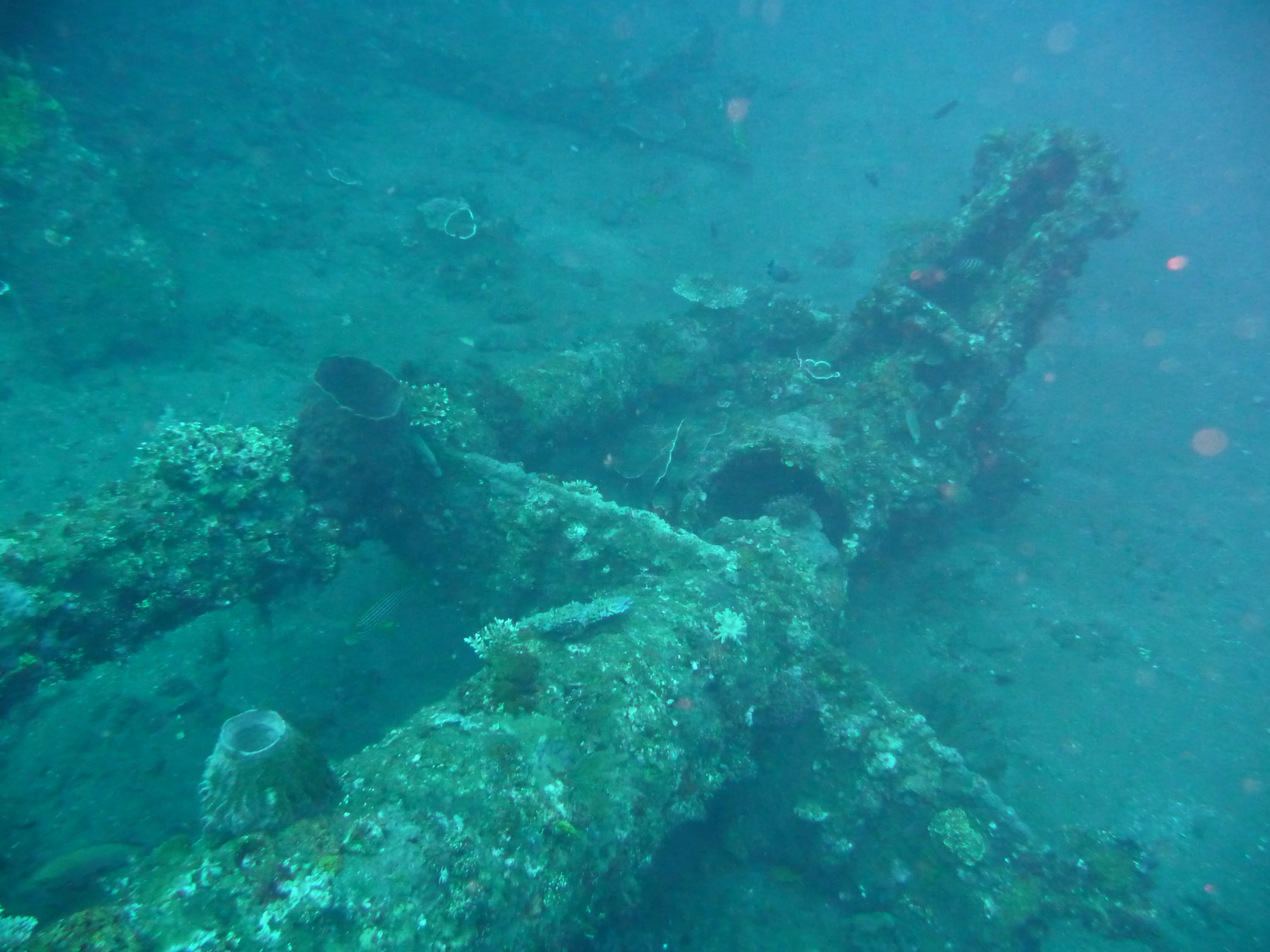
USAT Liberty: From Horse Transport to Coral Kingdom
She started her career carrying horses to France and ended it as a coral reef. In between, the USAT Liberty collided with a French tug, sank it, rammed an American cargo ship, survived two world wars, took a Japanese torpedo to the hull, and spent twenty-one years rusting on a Balinese beach before a volcano shoved her into the sea. Now she lies on her side in warm, shallow water off the village of Tulamben, 120 meters of steel colonized by over 400 species of marine life, her six-inch deck guns wrapped in brain coral and sea fans. No boat is needed to reach her. You walk in from the beach.
A Ship That Would Not Stay Out of Trouble
Liberty was launched on June 19, 1918, at the Federal Shipbuilding Company in Kearny, New Jersey -- the first vessel ever built at that yard. The Navy acquired her in October 1918 and assigned her to the Naval Overseas Transportation Service, hauling horses from New York to Brest, France, for the war effort. She made three crossings before being decommissioned in May 1919. In peacetime, Liberty developed a talent for collision. In October 1929, she struck a French tug called Dogue in the harbor at Le Havre; the tug sank, and two crew members died. Four years later, she rammed the American cargo ship Ohioan in the Ambrose Channel off New York, forcing the Ohioan to be beached near the West Bank Light. By the late 1930s, Liberty was operated by the Southgate-Nelson Corporation out of Norfolk, Virginia, running packet lines along the East Coast -- a ship with a checkered record and an uncertain future.
Torpedo in the Lombok Strait
When the United States entered World War II, Liberty was pressed into Army service as a cargo transport. By January 1942, she was hauling railway parts and rubber from Australia to the Philippines, threading through the waters of the Dutch East Indies. On January 11, Japanese submarine I-166 found her about ten nautical miles southwest of the Lombok Strait. Two torpedoes hit -- one punching into the port side at the number one hold, the other striking at number four. Liberty went dead in the water. Her fifty-three sailors and one passenger abandoned ship in three lifeboats, and a Dutch flying boat rescued all fifty-four the same day. The destroyers USS Paul Jones and HNLMS Van Ghent took the crippled ship in tow, aiming for the Dutch port of Singaraja on Bali's north coast. She was taking on too much water to make it. They beached her instead on the eastern shore at Tulamben, a small fishing village, where salvage crews stripped her of cargo and fittings.
Twenty-One Years on the Sand
For two decades, Liberty sat on the beach at Tulamben, her hull exposed to salt air and tropical rain. She became part of the village landscape, a rusting landmark that children climbed on and fishermen used as a reference point. The war moved on. Indonesia won independence. Bali developed a tourism economy centered on beaches, temples, and rice terraces to the south and west. Tulamben, remote and difficult to reach on the eastern shore, remained a quiet fishing village with a shipwreck on its beach. Then, on February 18, 1963, Mount Agung erupted. The volcano, which rises over 3,000 meters and dominates eastern Bali's skyline, sent tremors through the coastline. The shaking dislodged Liberty from her resting place on the beach and slid her down the sand slope into the water. She came to rest on her starboard side, her stern in about five meters of water and her bow at thirty, roughly forty meters from shore. The volcano killed over a thousand people across eastern Bali. It also, inadvertently, created one of the world's great dive sites.
The Reef That Was a Ship
Over six decades in the water, Liberty has become more reef than wreck. Hard corals -- brain coral, mushroom coral, table coral -- have encrusted every surface. Soft corals and sea fans wave in the current where sailors once walked the deck. Yellow and red sponges coat the hull plates. The ship's six-inch guns, which never fired in anger during her brief Pacific war, now bristle with coral growth so thick that the metal beneath is barely visible. Over 400 species call the wreck home. Giant barracuda patrol the superstructure. Schools of jackfish form swirling columns above the hull. Frogfish and ornate ghost pipefish hide in the crevices. Nudibranchs -- tiny, impossibly colored sea slugs -- crawl across surfaces that once held railway parts. At night, the wreck transforms again: flashlight fish emerge, and the coral polyps that spend daylight hours retracted open to feed, giving the entire ship a furred, living texture.
A Walk-In Shipwreck
What makes the Liberty extraordinary among wreck dives is not its size or its history but its accessibility. There is no boat ride. Divers gear up on the black volcanic sand beach at Tulamben, wade into the water, and swim forty meters to the wreck. The shallowest point, at the stern, sits at just five meters -- shallow enough for snorkelers. The deepest sections reach thirty meters, within recreational diving limits. Beginners and experts dive the same wreck, seeing different things. The proximity to shore means the Liberty can be dived at dawn, when the light angles through the water and illuminates the coral in ways that midday sun cannot. It can be dived at night, when the marine life changes entirely. The wreck is often misidentified as a Liberty ship -- those mass-produced World War II cargo vessels -- but she predates that class by twenty-five years. Her name is coincidence, not classification. She was simply Liberty, a ship that carried horses, survived collisions, took a torpedo, and waited on a beach until a volcano gave her to the sea.
From the Air
Located at 8.27S, 115.59E off the northeast coast of Bali, in the village of Tulamben. From the air, the wreck is not visible at cruising altitude but the black volcanic sand beach and the village are identifiable landmarks along the coast. Mount Agung rises dramatically to the west-southwest. The Lombok Strait separates Bali from Lombok to the east. Nearest airport is Ngurah Rai International (WADD/DPS) in Denpasar, approximately 80 km to the southwest. The coastline here runs roughly north-south with steep terrain dropping to the shore. Best viewed at 1,000-3,000 feet AGL following the eastern Bali coastline.