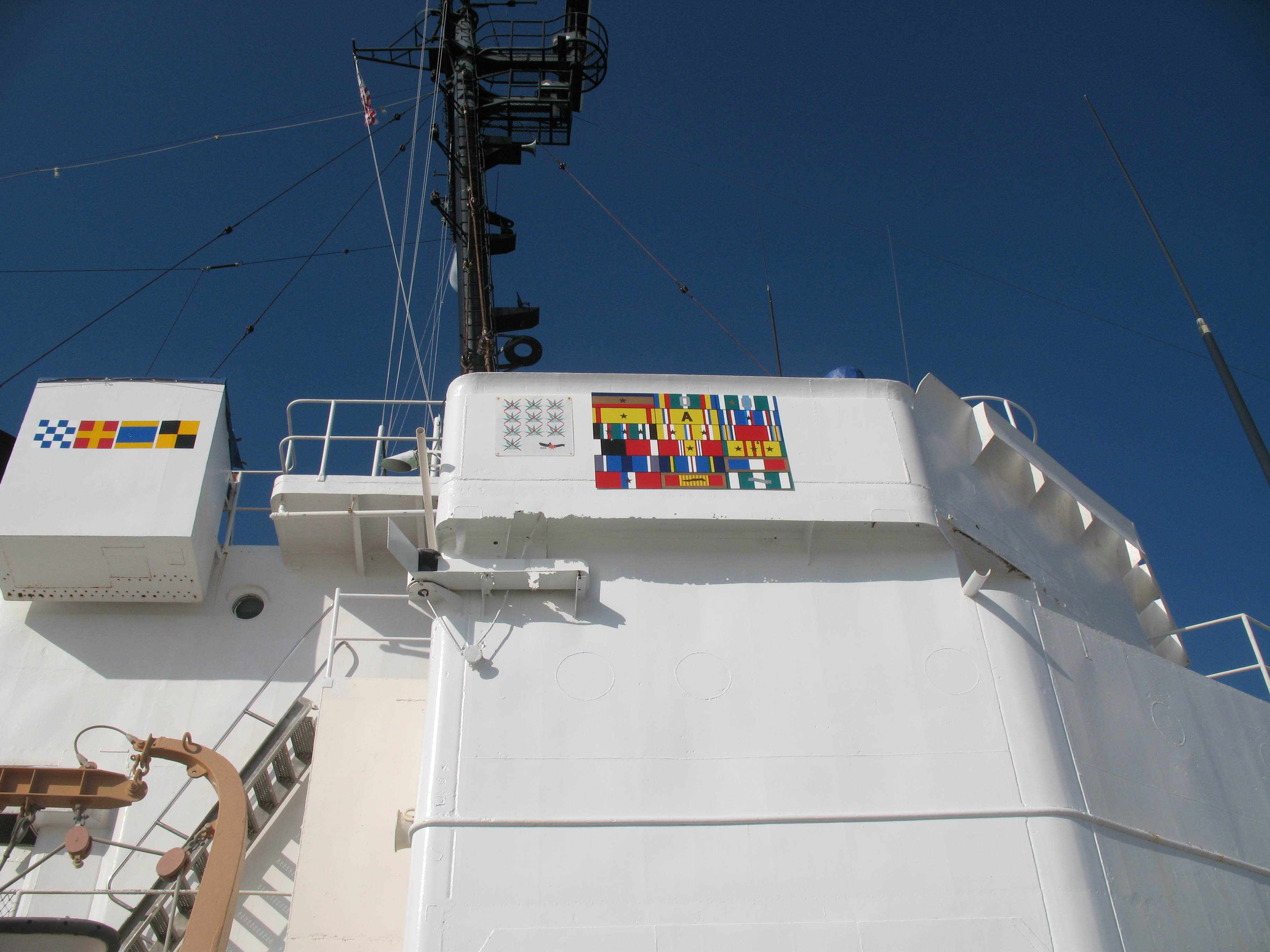
USCGC Ingham (WHEC-35)
Only one ship in the entire United States Coast Guard ever earned two Presidential Unit Citations. She sits today in Key West, Florida, rust-streaked and weathered, her 327 feet of steel holding more combat history than most navies can claim. USCGC Ingham spent fifty-two years in active service, from the convoy lanes of the North Atlantic to the rivers of Vietnam, and every year of it left its mark. Now a museum ship and National Historic Landmark, Ingham is also something more solemn: the Commandant of the Coast Guard has designated her the National Memorial to the 912 Coast Guardsmen killed in action during World War II and Vietnam. Their names are etched on a plaque on her quarterdeck, where the salt wind off the Gulf of Mexico keeps them company.
Born at the Navy Yard
The Treasury Department awarded Ingham's contract on January 30, 1934, and her keel was laid at the Philadelphia Navy Yard on May 1, 1935. She slid into the Delaware River on June 3, 1936, christened by Katherine Ingham Brush, alongside three sister ships. Commissioned on September 12, 1936, she was the fourth Coast Guard cutter to bear the name of Treasury Secretary Samuel D. Ingham. At 327 feet, the Treasury-class cutters were the largest vessels in the Coast Guard fleet, built for long-range ocean patrol. They were fast, well-armed, and designed to endure the worst the North Atlantic could throw at them. That design philosophy would be tested beyond anything their builders imagined.
Hunting U-Boats in the Gray Atlantic
When World War II erupted, Ingham was thrown into the desperate business of convoy escort. The North Atlantic in winter is a punishing place: towering seas, ice forming on rigging, visibility measured in yards. Through that gray chaos, Ingham shepherded merchant ships carrying fuel, food, and ammunition to Britain. She ran the Newfoundland-to-Iceland shuttle, escorting convoys like HX 164 and ON 49 through waters crawling with German U-boats. On December 15, 1942, during a crossing, Ingham's crew detected and engaged the German submarine U-626, sending it and its crew to the bottom of the Atlantic. After 1944, she served as an amphibious flagship in the Pacific Theater, taking part in three campaigns. When she finally returned to peacetime duty, Ingham held a distinction no other ship could match: she was the last active warship in the U.S. fleet with a confirmed U-boat kill.
Two Wars, Two Citations
The Vietnam War brought Ingham back to combat. Deployed from August 1968 to February 1969, she participated in Operation SEA LORDS and Operation SWIFT RAIDER, operations that pushed into the Mekong Delta's narrow waterways to interdict enemy supply lines. The missions were dangerous, close-quarters work, a world away from the open-ocean convoy lanes of the Atlantic. For her performance, Ingham earned two Presidential Unit Citations, making her the only Coast Guard cutter in history to receive that honor twice. Her awards list reads like a catalog of American military engagement across four decades: battle stars from the European, Pacific, and Vietnam theaters, a Philippine Presidential Unit Citation, a Republic of Vietnam Gallantry Cross, and more than a dozen additional decorations. She was, by any measure, the most decorated vessel in the Coast Guard fleet.
Second Oldest and Still Afloat
Ingham served on through the Cold War years, returning to the Coast Guard's core missions of search and rescue, law enforcement, and ocean patrol. When she was finally decommissioned in 1988, she was the second oldest commissioned warship afloat in the United States, younger only than USS Constitution in Boston. Her half-century of service had spanned the Great Depression, a world war, Korea, Vietnam, and the opening of the Space Age. After decommissioning, Ingham was acquired by Patriots Point near Charleston, South Carolina, where she was displayed alongside the aircraft carrier Yorktown. In 2009, she was towed to Key West, arriving on November 24 to begin a new life as the centerpiece of the Key West Maritime Memorial Museum.
A Quiet Berth in Key West
Today, Ingham is moored in Key West's harbor, her gray hull a stark presence among the pleasure boats and charter fishing vessels. Visitors can walk her decks, peer into the cramped quarters where sailors slept in three-high bunks, and stand behind the 5-inch/38-caliber deck gun that once tracked U-boats. The executive officer's stateroom is preserved, a small cabin that housed the second-in-command through war and peace. On the quarterdeck, the memorial plaque bears the names of 912 Coast Guardsmen, a number that gives weight to every rivet and weld in the old cutter's frame. Ingham was declared a National Historic Landmark in 1992, one of only two preserved Treasury-class cutters in existence. She is a reminder that the Coast Guard, often overshadowed by the larger branches, fought and bled in every American conflict of the twentieth century.
From the Air
Located at 24.552N, 81.808W in Key West Harbor, Florida. The 327-foot gray hull is visible moored along the waterfront, distinct among smaller vessels. Best viewed at 1,500-2,500 feet AGL. Key West International Airport (KEYW) is approximately 2 miles east. The Overseas Highway (US-1) bridge chain stretches northeast toward the mainland. Fort Zachary Taylor is visible on the island's western tip. In clear conditions, the ship's deck guns and superstructure are identifiable.