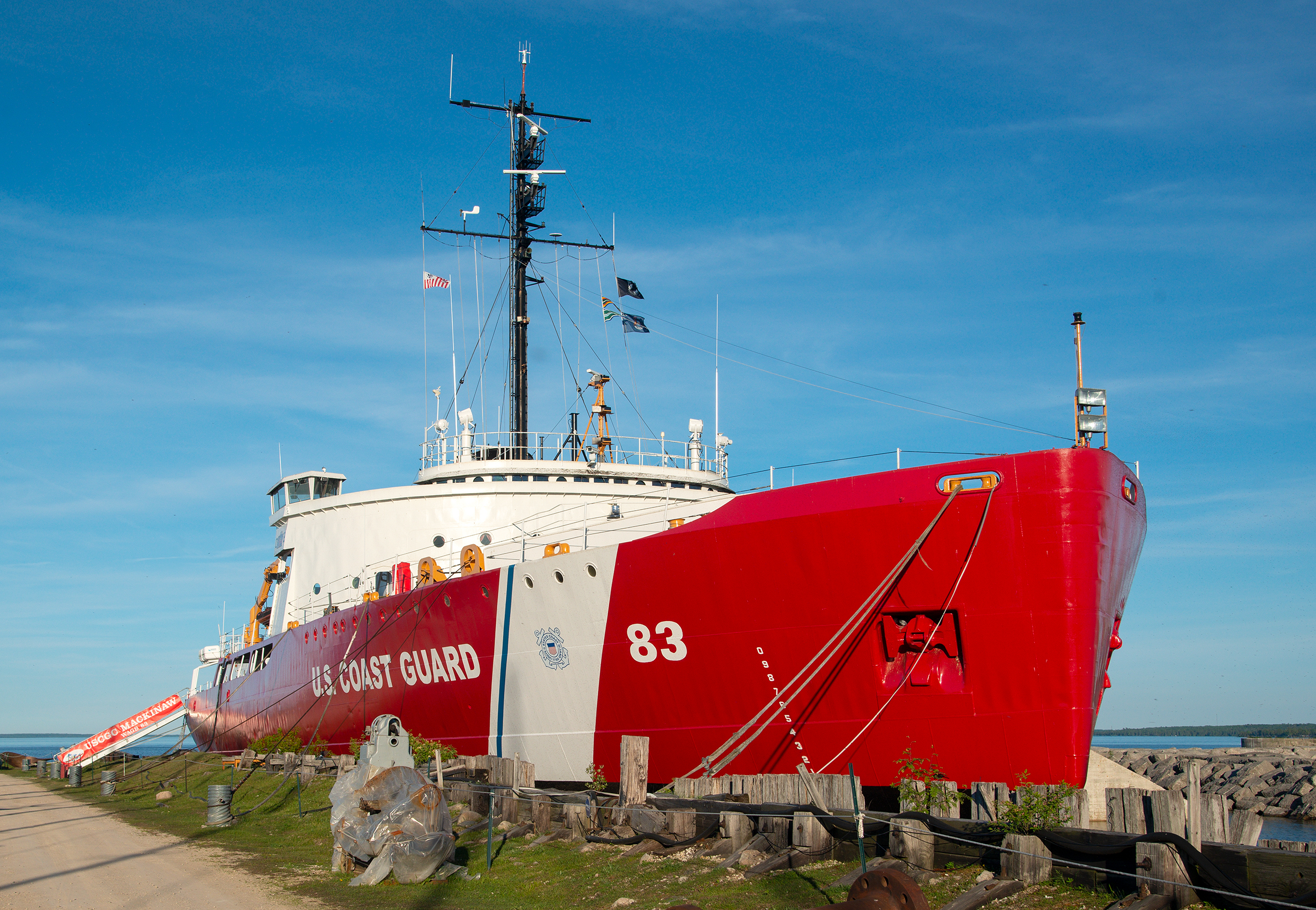
USCGC Mackinaw (WAGB-83)
Captain Charles Roberts described his soldiers as 'debilitated and worn down by unconquerable drunkenness,' but the ship that would one day share his patrol waters was built for a different kind of endurance entirely. Launched in 1944, USCGC Mackinaw (WAGB-83) was the largest icebreaker ever designed specifically for freshwater service, a vessel so essential to Great Lakes commerce that the Coast Guard tried to decommission her three separate times and was overruled each time by Congress and the shipping industry. For 62 years, from the final winter of World War II to the summer of 2006, Mackinaw smashed through ice on Lakes Superior, Huron, Michigan, and Erie, keeping the shipping lanes open for the freighters hauling iron ore, coal, limestone, and grain that fed the American industrial economy.
Born from Three Nations' Secrets
Mackinaw's design was an international affair. In the fall of 1941, the Coast Guard briefly borrowed the Soviet icebreaker Krassin and studied her hull lines. Lieutenant Commander Edward Thiele, who had traveled to Europe on vacation just before America entered the war, brought back knowledge of modern Scandinavian icebreaker designs, particularly the state-of-the-art Swedish vessel Ymer. And engineers studied the railroad ferries that had been fighting heavy ice in the Straits of Mackinac for decades. The naval architects Gibbs and Cox of New York produced the final design, creating a special icebreaker design section just for the project. The result was a vessel built longer and wider than the ocean-going Wind-class icebreakers so she would draw less water in the shallow Great Lakes, with a cooling system that pulled freshwater directly from the lake around her. She was laid down on March 20, 1943, at the Toledo Shipbuilding Company in Ohio -- a firm so overwhelmed by the project's complexity that it went bankrupt from construction delays before the ship was finished.
A Hull That Rocked Itself Free
Mackinaw's engineering was built around one central problem: how to move through ice that could be several feet thick. Her double hull, with frames spaced just 16 inches apart forming a rigid truss, was armored with thick steel plating in an 'ice belt' above the waterline. But the real innovation was in how she moved. Ballast tanks could shift 160 tons of water in 90 seconds, causing the ship to heel from side to side through a 24-degree arc, shoving ice away from her flanks. Her cut-away forefoot allowed the bow to ride up onto the ice surface; then the ship's sheer weight crushed the unsupported ice into the hollow space below. A bow propeller -- unusual for any vessel of that era -- pulled water from beneath the ice ahead, further weakening it. Three Westinghouse DC electric motors, powered by six Fairbanks-Morse diesel generators that could be switched between propellers in different combinations, gave her the raw power to push through. The result: Mackinaw could crack solid 'blue' ice and plow through heaped-up 'windrow' ice that would stop any other vessel on the lakes.
Sixty-Two Winters on the Lakes
Mackinaw's first assignment was unexpected: training 25 Soviet sailors in January 1945 before they took over a Lend-Lease icebreaker. From there, her career became a catalog of Great Lakes emergencies. In 1947, she and USCGC Tupelo freed 87 ships trapped in ice-clogged Buffalo harbor. During the construction of the Mackinac Bridge from 1954 to 1957, Mackinaw spent days at a time clearing ice floes from the massive caissons, allowing the bridge foundations to settle undisturbed. In 1950, she joined the grim search for Northwest Orient Airlines Flight 2501, collecting debris and human remains from Lake Michigan after the plane vanished with 58 people aboard. In 1965, her crew pulled bodies from the water after the Norwegian ship Topdalsfjord collided with the bulk carrier SS Cedarville near the Mackinac Bridge. And in 1984, she led convoys through the 'ice jam of the century' on the St. Clair River, where 87 freighters waited at a cost of $1.7 million per day.
Too Tough to Retire
The Coast Guard scheduled Mackinaw for decommissioning in 1982, 1988, and 1994. Each time, the shipping industry and Congress objected, and the icebreaker kept working. By 2000, her annual maintenance cost had climbed past $4 million. 'She's extremely old, and she's just becoming impossible to operate,' said Coast Guard spokesman Jack O'Dell. 'Ships have a life span, and once they've reached that life span, they break down. This one's reached her life span.' Her final cost of $10 million at commissioning in 1944 -- a $2 million overrun -- had long since been repaid many times over in kept shipping lanes and rescued vessels. In 1998, her white hull was painted the distinctive Coast Guard red, matching the fleet's standard adopted decades earlier. Her first female sailors reported aboard that same period, following an overhaul to the ship's living quarters.
A Museum at the Railroad Dock
On June 10, 2006, Mackinaw was decommissioned in Cheboygan, Michigan, at a ceremony shared with the commissioning of her successor, a smaller combination icebreaker and buoy tender also named Mackinaw. Eleven days later, loaded with civilian passengers, the old icebreaker made her final voyage to Mackinaw City, where she was moored at the former railroad dock for the SS Chief Wawatam ferry. The Icebreaker Mackinaw Maritime Museum opened to visitors in 2007. Today, visitors can walk through the mess deck, captain's quarters, bridge, engine room, wardroom, and sick bay of a ship that spent more than six decades as the undisputed queen of the Great Lakes. Amateur radio operators still transmit from her decks under the call sign W8AGB, and her permanent berth at the tip of Michigan's Lower Peninsula puts her in view of the Mackinac Bridge she helped build and the straits she kept open through 62 winters.
From the Air
Coordinates: 45.780N, 84.720W. USCGC Mackinaw is moored as a museum ship at the old SS Chief Wawatam railroad dock in Mackinaw City, Michigan, at the southern end of the Mackinac Bridge. The ship's distinctive red hull is visible from altitude along the Mackinaw City waterfront. The Mackinac Bridge spans the straits directly to the north, and Mackinac Island is visible to the east. Nearby airports: Pellston Regional (KPLN) approximately 12 miles south, Mackinac Island Airport (KMCD) about 8 miles northeast. Recommended viewing altitude: 2,000-4,000 feet AGL to spot the ship along the dock. The Straits of Mackinac and the bridge provide excellent visual references.