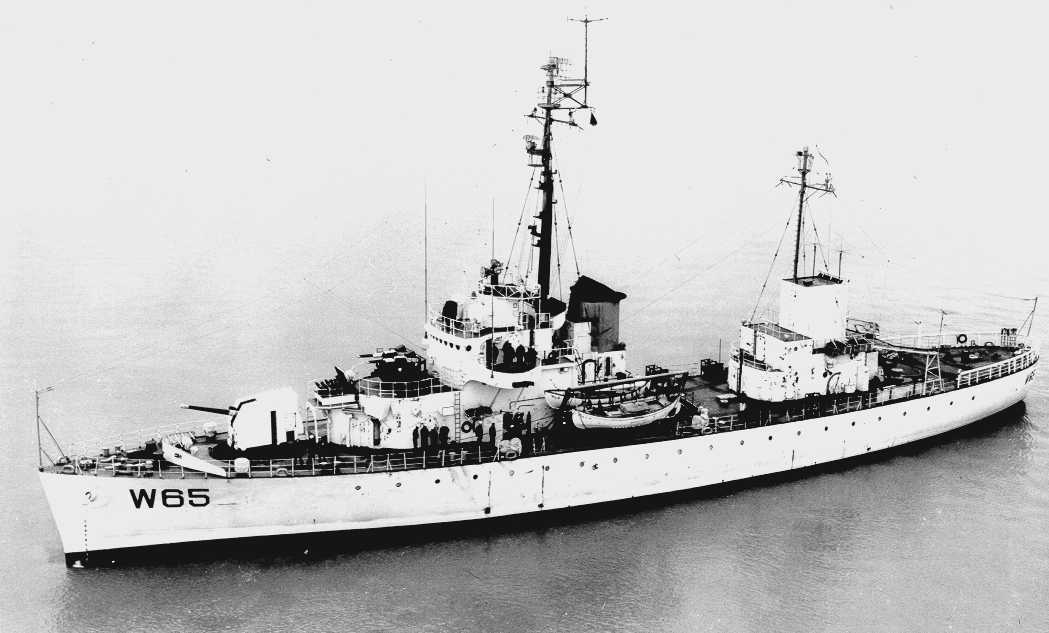
USCGC Winona
She was built for World War II but missed it. Commissioned on April 19, 1946, nearly a year after Japan's surrender, the USCGC Winona arrived too late for the conflict that justified her construction. It was an inauspicious start for a warship -- an Owasco-class high endurance cutter, 255 feet of steel designed for combat, launched into peacetime. Western Pipe & Steel built her at their San Pedro shipyard in Los Angeles, and the Coast Guard named her after Winona Lake, Indiana. For the next 28 years, the Winona would make her career not in battle but in the unglamorous, essential work of ocean rescue: towing disabled vessels, evacuating injured sailors, and standing watch over some of the most dangerous waters in the North Pacific.
The Rescue Ledger
Winona's service log from Port Angeles, Washington -- her homeport from 1947 to 1974 -- reads like a catalog of maritime distress. In November 1948, she towed the disabled MV Herald of Morning. In February 1950, she hauled the MV Edgecombe all the way to Seattle. She escorted a fishing vessel to Ketchikan, Alaska, in 1951, stood by the crippled MV Darton for two days in a March storm in 1952, and spent Christmas of that same year assisting the MV Maple Cove at 48 degrees north, 134 degrees west -- far out in the open Pacific, the kind of position where help is measured in days, not hours. She medevaced a crewman from the MV General Pope in December 1954 and patrolled the Gold Cup Races at Seattle in 1955. Between these events, she ran Bering Sea patrols, watching over the fishing fleets in waters where hypothermia can kill in minutes.
Nine Months Off Vietnam
The war Winona finally fought was not the one she was built for. In January 1968, she was assigned to Coast Guard Squadron Three in South Vietnam, joining the naval effort to intercept arms shipments along the coast. On March 1, she engaged and sank a North Vietnamese trawler designated T-A. Damage controlman first class Thomas Lisk was below decks when a round punched through the hull and ricocheted around the compartment. He and his shipmates escaped without injury -- the kind of improbable luck that becomes legend aboard a ship. Winona served in the combat zone for nearly nine months, from January 25 to October 17, 1968, before returning to the Pacific Northwest and the work she knew best.
Back to the Gray Routine
Peacetime duty resumed immediately. On January 31, 1969, Winona stood by the MV Belmona after a fire broke out 15 miles southwest of Cape Flattery, holding position until commercial tugs could reach the scene. That July, she helped manage the aftermath when a diesel-laden barge sank near Admiralty Inlet, the narrow passage connecting the Strait of Juan de Fuca to Puget Sound. In October 1970, she provided medical assistance to the Urea Maru 300 miles off San Francisco. These incidents never made national news. They rarely do. The Coast Guard's work is defined by its invisibility -- the emergencies that get handled before they become catastrophes, the ships that get towed home instead of sinking, the sailors who survive because someone answered the call.
The Final Watch
Winona was decommissioned on May 31, 1974, at the end of a career that spanned the early Cold War, the Vietnam era, and nearly three decades of Pacific Northwest maritime service. She was laid up at the Coast Guard Base in Alameda, California, and scrapped in late 1976. No museum preserves her hull. No memorial marks her berth. What remains is the service record: hundreds of patrols, dozens of rescues, one war, and the accumulated weight of 28 years spent in the North Pacific. Her coordinates -- 48 degrees north, 134 degrees west -- mark the kind of empty ocean where Coast Guard cutters did their work far from anyone watching, in waters cold enough to kill and rough enough to test any ship that sailed them.
From the Air
The coordinates 48.37°N, 134.43°W place Winona's recorded position far out in the open North Pacific, roughly 350 miles west of the Washington-British Columbia coast. This is deep ocean with no land in sight. Her homeport of Port Angeles, Washington (KNOW/William R. Fairchild International Airport) sits on the Strait of Juan de Fuca. Cape Flattery, mentioned repeatedly in her service record, is the northwestern tip of the contiguous United States, visible as a dramatic headland from altitude. The nearest major airports are KCLM (Port Angeles) and KBLI (Bellingham). Flying over these waters, you see only gray swells -- the same emptiness that Winona patrolled for nearly three decades.