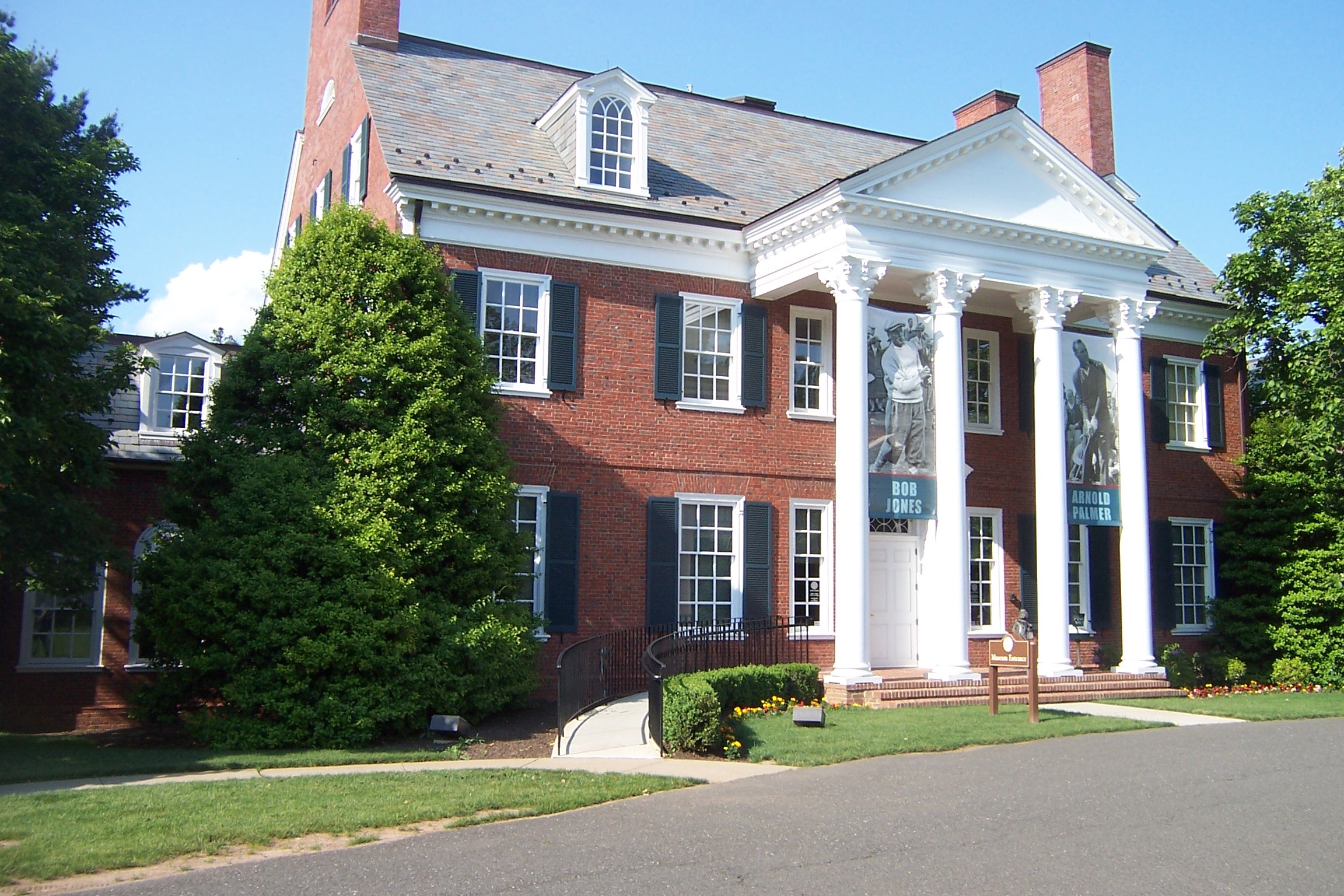
USGA Museum
A thief broke into the USGA Museum in 2012 and walked off with the U.S. Amateur Trophy and a replica of Ben Hogan's 1953 Hickok Belt. It was brazen, and more than a little poetic — the museum had spent decades quietly accumulating the most significant collection of golf artifacts in the United States, and someone finally decided to take some of it back. The museum has since carried on, its oval rotunda still lit by a clerestory, its bronze panels still naming every champion who ever won a USGA title. That's the kind of place this is: unhurried, authoritative, and deeply serious about a game that takes itself very seriously.
A Putter Named Calamity Jane
The origins of the USGA Museum trace to 1935, when a member of the USGA's Executive Committee named George Blossom proposed building a collection of historical golf artifacts. One year later, the USGA Museum and Library Committee was formally created. In 1938, the museum received its first significant donation: Bobby Jones' legendary putter, Calamity Jane II. Jones won 13 major championships using variants of that hickory-shafted putter, including all four Grand Slam titles in 1930. The putter became the soul of the collection — a physical object that connected visitors to greatness in a way that photographs and statistics never quite could. For sixteen years the collection had no permanent home, rotating through USGA offices in New York. It wasn't until 1951, when the USGA purchased space at 40 East 38th Street in Manhattan, that the museum got its first dedicated exhibition gallery.
A Building Worth Visiting On Its Own
In 1972, the USGA moved its headquarters to Liberty Corner, New Jersey — a leafy corner of Somerset County about 35 miles southwest of Manhattan — and the museum moved with it. The building that houses the collection deserves its own attention. Designed in 1919 by John Russell Pope, the same architect who drew the Jefferson Memorial and the National Archives Building in Washington, it carries the formal weight of those civic landmarks into a pastoral New Jersey setting. The contrast is pleasantly disorienting: you expect a courthouse and find a golf museum. Between 2005 and 2008, the museum closed for a major renovation and expansion that added the Arnold Palmer Center for Golf History — 16,000 square feet of new space, including more than 5,000 square feet of exhibition galleries and a research center.
The Hall of Champions
The centerpiece of the renovated museum is the Hall of Champions, an oval rotunda illuminated by clerestory windows. Inside, all 13 USGA national championship trophies are displayed. Bronze panels encircle the room, inscribed with the names of every USGA champion in the history of each event. Bobby Jones and Tiger Woods share the distinction of nine wins apiece. The permanent galleries beyond the rotunda trace the story of American golf from the late 19th century to the present, organized by era rather than by sport. Separate rooms are dedicated to Jones, Ben Hogan, and Arnold Palmer — three figures whose careers collectively shaped everything the modern game became. Outside, the Pynes Putting Course offers a 16,000-square-foot, nine-hole putting experience on the museum grounds.
Guardians of the Game
What makes the USGA Museum different from a hall of fame is the weight of the governing body behind it. The United States Golf Association has regulated the rules of golf in America since 1894, and the museum exists as evidence of that long custodianship. The collection includes equipment, artwork, documents, photographs, and trophies spanning more than a century of organized competition. USA Today once called it the 'Cooperstown of Golf,' and the comparison holds — both are shrines to a sport's official memory, positioned in places most people wouldn't think to look for them. Liberty Corner, New Jersey, isn't a pilgrimage destination. The museum makes it one.
From the Air
Located at 40.666°N, 74.613°W in Bernards Township, Somerset County, New Jersey. The USGA campus sits in the rolling hills of central New Jersey, about 35 miles southwest of Manhattan. Nearest airport is Morristown Municipal Airport (MMU), approximately 12 miles north. Newark Liberty International Airport (EWR) is about 22 miles east. Viewing altitude of 2,500 to 3,500 feet MSL provides a good perspective on the estate grounds and surrounding wooded landscape.