Ushiku Daibutsu
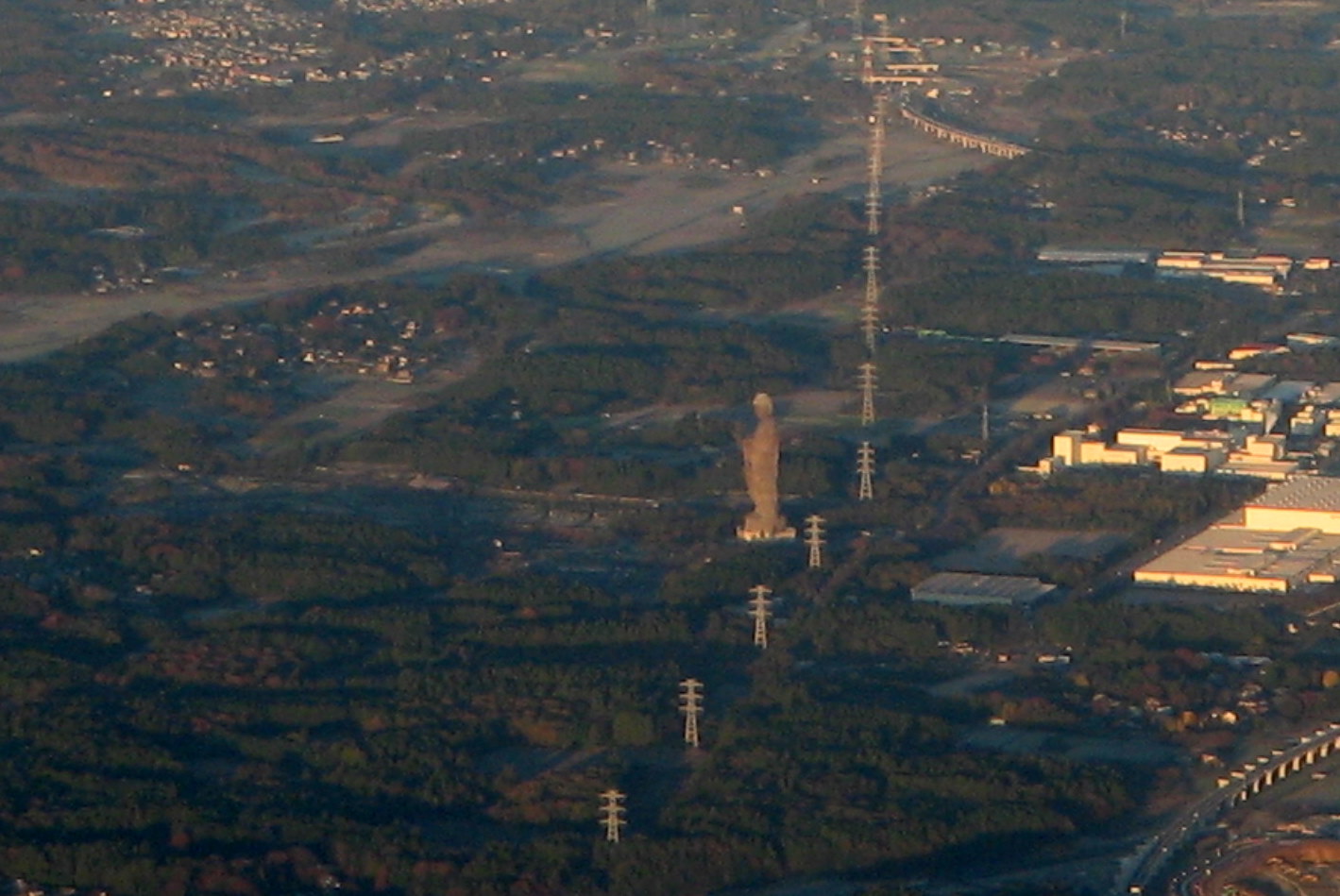
You see it before your brain can make sense of it. Rising from the flat agricultural land northeast of Tokyo, the figure of Amitabha Buddha stands 120 meters tall -- roughly the height of a 30-story building, three times the size of the Statue of Liberty from torch to base. The Ushiku Daibutsu is so large that from the ground it warps your sense of distance. From the air, it casts a shadow across the surrounding flower gardens and fields that seems to belong to a skyscraper, not a religious monument. Completed in 1993, it held the record as the tallest statue in the world for fifteen years.
Branches of Bronze
Building a 120-meter Buddha required rethinking how statues work. Engineers erected a central cast-iron steel column to bear the entire structure's weight -- 4,003 tonnes in total. Around this spine, they assembled a branching steel frame, pre-fitted on the ground block by block before being lifted into position. The statue's 100-meter torso was divided into 20 horizontal tiers, each consisting of roughly 17 blocks. Every block carried nine welded bronze sheets, each about six millimeters thick, mounted on steel frames that connected to the main skeleton like branches of an enormous tree. The result is far lighter than traditional solid-cast bronze: compared to the Great Buddha at Todai-ji temple in Nara, the Ushiku Daibutsu uses its steel frame to carry the load, with the bronze serving as a skin rather than a structure.
A Body of Numbers
The measurements of the Ushiku Daibutsu read like specifications for a building, not a body. The left hand stretches 18 meters long. The face is 20 meters from chin to crown. Each eye spans 2.5 meters, the mouth 4 meters, and each ear 10 meters -- tall enough to park a bus inside. The nose rises 1.2 meters, and the index finger alone measures 7 meters. The total height of 120 meters includes a 10-meter base and a 10-meter lotus platform beneath the figure itself. An elevator carries visitors 85 meters up to an observation floor set within the statue's chest, where windows look out across the surrounding flower gardens and a small animal park.
The World Within
Inside the statue is a four-story museum that transforms the colossal structure into a contemplative journey. The first floor, called Infinite Light and Infinite Life, is deliberately dark. A single shaft of light falls from above onto a cauldron of smoking incense -- a dramatic threshold between the everyday world outside and the sacred space within. The second floor, the World of Gratitude and Thankfulness, houses scriptural studies. The third floor, the World of the Lotus Sanctuary, contains 3,000 small golden Buddha statues arranged in gleaming rows. The fourth floor, the Room of Mount Grdhrakuta, named for the peak where the Buddha is said to have delivered key sermons, offers the observation windows and a chance to look out from the Buddha's chest across the Ibaraki landscape.
Commemorating Shinran
The Ushiku Daibutsu was built to commemorate the birth of Shinran, the 12th-century Buddhist monk who founded Jodo Shinshu -- the True Pure Land School, one of the most widely practiced forms of Buddhism in Japan. Born in 1173, Shinran taught that salvation came through faith in Amitabha Buddha's compassion rather than through monastic discipline or personal merit. The statue's formal name reflects this theology: Ushiku ARCADIA, an acronym for Amida's Radiance and Compassion Actually Developing and Illuminating Area. The choice of Amitabha as the depicted figure connects the monument directly to Shinran's central teaching -- that the Buddha of Infinite Light welcomes all beings into the Pure Land.
A Giant Among Giants
When the Ushiku Daibutsu was completed in 1993, nothing else on Earth stood as tall. It held that record until 2008 and today ranks as the world's tallest bronze statue and the fifth-tallest statue overall. The surrounding grounds include seasonal flower gardens -- lavender, cosmos, poppies -- that create vivid carpets of color around the Buddha's base, along with a small petting zoo and playgrounds that make the site as much a family destination as a place of pilgrimage. From the air, the contrast is striking: the monumental bronze figure standing serene and still amid the quiet greens and browns of the Kanto Plain, visible for miles in every direction.
From the Air
Located at 35.9825N, 140.220E in Ushiku, Ibaraki Prefecture, approximately 50 km northeast of central Tokyo. The 120-meter statue is one of the most visually distinctive landmarks in the Kanto region from the air -- a towering bronze figure rising from flat agricultural and suburban land, visible from considerable distance. Nearest airport: Ibaraki Airport / Hyakuri Air Base (RJAH), approximately 45 km to the northeast. Narita International Airport (RJAA) is roughly 40 km to the southeast. Tokyo's Haneda Airport (RJTT) lies about 70 km to the southwest. Best viewed at 3,000-6,000 ft AGL, where the statue's enormous scale relative to its surroundings is most dramatic. Look for the bronze figure and its surrounding gardens amid the flat terrain west of the Tone River.