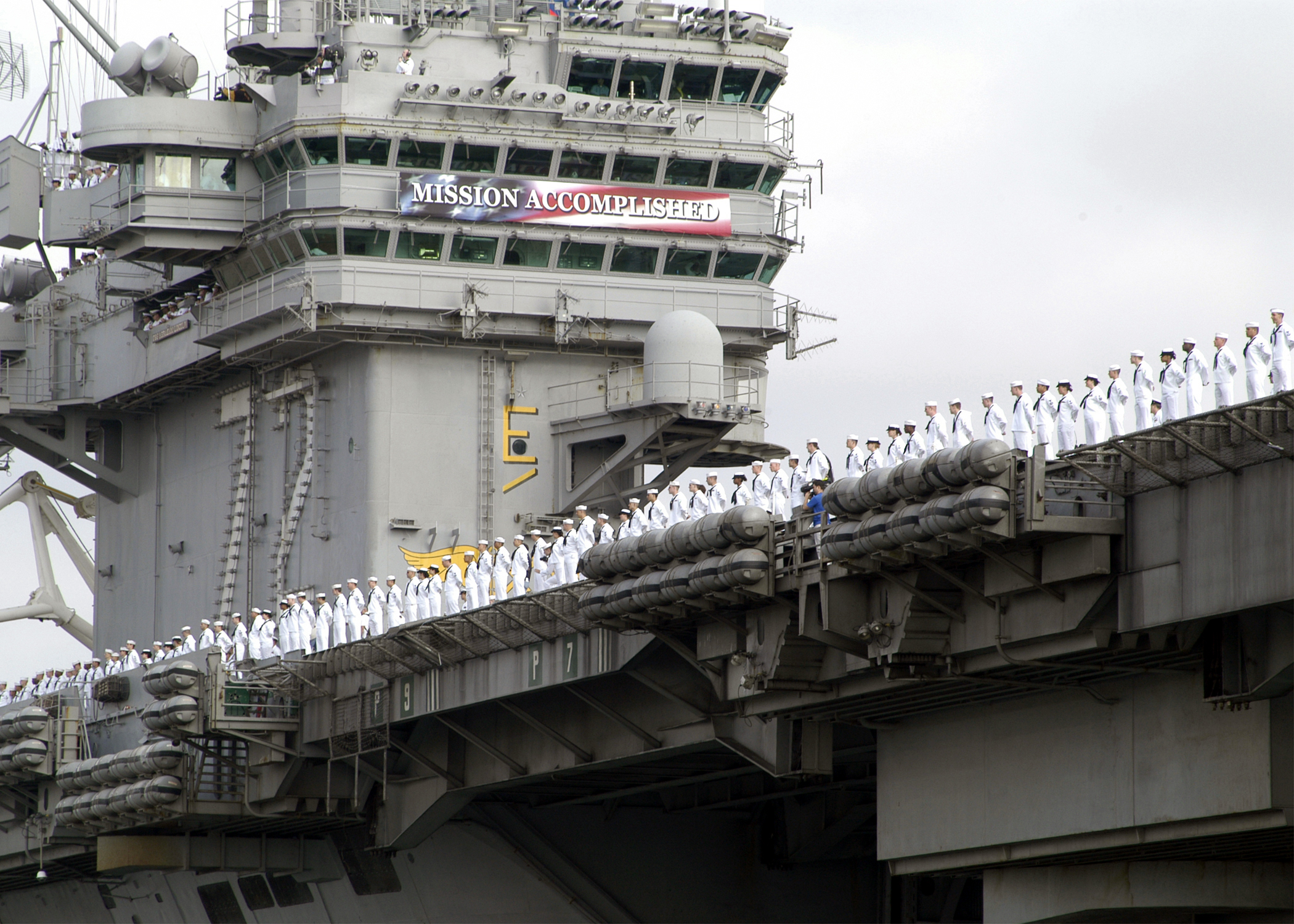
USS Abraham Lincoln (CVN-72)
A baby born during an emergency evacuation was named Abraham Lincoln Prestera. His mother chose the name because the ship that carried her family to safety, away from the volcanic ash choking Luzon Island in 1991, was the aircraft carrier USS Abraham Lincoln. It is that kind of vessel: large enough to reshape events, present enough in crisis that people name their children after it. Commissioned on Veterans Day 1989, the fifth Nimitz-class carrier has spent more than three decades steaming toward whatever the world breaks next, from the Persian Gulf to the coast of Sumatra, from the waters off Somalia to the Red Sea.
Born for the Cold War, Shaped by What Followed
Newport News Shipbuilding laid Abraham Lincoln's keel on November 3, 1984, during the Reagan-era naval buildup. She launched on February 13, 1988, and was commissioned on November 11, 1989, two days after the Berlin Wall fell. The Cold War that justified her construction was ending, but the world she entered had no shortage of work for a nuclear-powered aircraft carrier. Her maiden deployment in May 1991 was supposed to be routine. Then Mount Pinatubo erupted in the Philippines, and Abraham Lincoln led a 23-ship armada that evacuated over 45,000 military personnel and their families from Subic Bay Naval Station to the port of Cebu, the largest peacetime evacuation of its kind in history. From there, she steamed to the Persian Gulf for combat air patrols over Iraq and Kuwait.
Firsts and Losses at Sea
Abraham Lincoln was the first Pacific Fleet carrier to integrate female aviators after the Combat Exclusion Laws were lifted in April 1993. The milestone came with tragedy. On October 25, 1994, Lieutenant Kara Spears Hultgreen, the first female F-14 Tomcat pilot, died when her aircraft suffered a compressor stall on final approach. She fought to keep the jet from hitting the stern of the ship, but the F-14 inverted and struck the ocean. Her radar intercept officer, Lieutenant Matthew Klemish, ejected safely. Hultgreen, ejected automatically a fraction of a second later, was rocketed straight into the water. Her body was recovered 19 days later. In August 2021, five crew members died when an MH-60S Knighthawk helicopter crashed into the Pacific roughly 60 nautical miles off San Diego during routine operations. A sixth crew member was rescued.
The Deployment That Would Not End
In July 2002, Abraham Lincoln put to sea for what became the defining deployment of the Iraq War era. She supported Operation Enduring Freedom, then Operation Southern Watch, then was ordered to the Persian Gulf for the opening strikes of Operation Iraqi Freedom. The Navy extended her deployment repeatedly, pushing her crew's time at sea from months into what felt like an open-ended commitment. The extension was announced on New Year's morning 2003, when the battle group commander told the crew, "We don't need to be home holding our loved ones, we need to be here holding the line. Get over it." The phrase became a bitter joke aboard ship, eventually appearing on an unofficial deployment patch. During the air campaign, Carrier Air Wing Fourteen flew some 16,500 sorties and delivered 1.6 million pounds of ordnance. When the carrier finally headed home in May 2003, President George W. Bush landed aboard to deliver a speech beneath a banner reading "Mission Accomplished," a moment that became one of the most controversial images of the war.
Tsunami, Typhoon, and the Long Reach of a Carrier
On December 26, 2004, Abraham Lincoln was on a port call in Hong Kong when the 9.0-magnitude Indian Ocean earthquake struck. Carrier Strike Group Nine deployed to the devastated western coast of Sumatra, delivering nearly six million pounds of relief supplies, including 2.9 million pounds of food and 748,000 pounds of medical supplies. Sailors from the engineering department designed a portable water manifold to pump fresh water ashore to Aceh Province. Seventeen helicopters flew 1,747 relief missions along the Sumatran coast over 33 days. The humanitarian mission ended only when Indonesia's government refused to allow the carrier's fighter pilots to conduct required training flights, forcing Abraham Lincoln into international waters. She continued supporting relief operations from a distance until February 2005.
Still Steaming
Abraham Lincoln returned to service in May 2017 after a four-year, $3 billion refueling and complex overhaul at Newport News, during which workers logged more than 2.5 million man-hours refueling the reactors and modernizing combat systems. In 2018, she became the first carrier to operate the F-35C Lightning II in integrated cyclic operations. Captain Amy Bauernschmidt took command in August 2021, the first woman to command a U.S. aircraft carrier. By 2019, the carrier had already set the post-Cold War record for longest deployment at 295 days at sea. In August 2024, she was ordered to the Middle East again as tensions escalated between Iran and Israel, and by November her air wing was conducting strikes against Houthi positions in Yemen. Across more than three decades, Abraham Lincoln has been wherever the Navy needed a floating airfield, a pattern unlikely to change before her projected 50-year service life runs out.
From the Air
USS Abraham Lincoln (CVN-72) is currently homeported at NAS North Island, San Diego, California (KNZY), though she was previously homeported at Naval Station Everett, Washington (approximately 47.98N, 122.23W). The Everett location on Puget Sound is where the ship's geohash is pinned. Paine Field (KPAE) is approximately 4 miles south of Naval Station Everett. From the air, the naval station is visible on the western shore of Port Gardner Bay. Nimitz-class carriers are 1,092 feet long and clearly visible from altitude when in port.