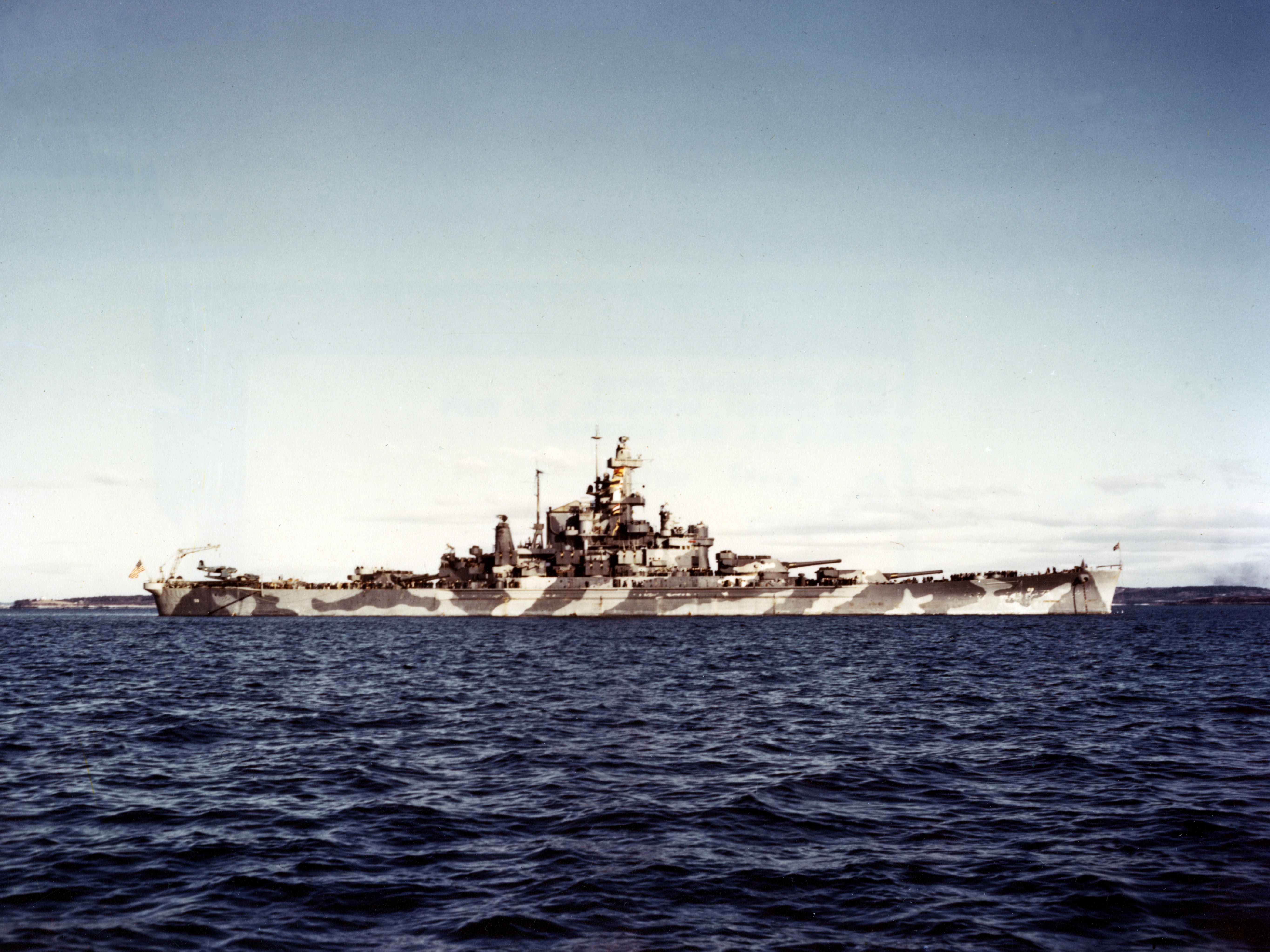
USS Alabama (BB-60)
The schoolchildren of Alabama gave their nickels and dimes -- roughly $100,000 worth -- to keep a warship from the breaker's yard. That fact alone tells you something about what USS Alabama means to her namesake state. But the battleship moored in Mobile Bay earned that devotion across two oceans and three years of almost continuous combat, from the cold gray swells off Norway to the typhoon-battered waters of the Philippine Sea. Commissioned in August 1942, the fourth and final South Dakota-class battleship entered service already crowded, her crew swelling from a peacetime complement of 1,793 to a wartime crush of 2,500 sailors packed into a hull designed before the treaty system collapsed.
Arctic Overture
Alabama's first deployment sent her not toward the Pacific, but to Scotland. In May 1943, she and her sister ship South Dakota steamed to Scapa Flow to reinforce the British Home Fleet, which had been stripped of capital ships for the invasion of Sicily. For three months, the American battleships trained alongside British warships and covered operations in the Arctic, including a reinforcement run to Spitzbergen. The Allies hoped to lure the German battleship Tirpitz out of her Norwegian fjord, but the Germans stayed put. By August, Alabama was heading home to Norfolk for an overhaul, then through the Panama Canal and onward to the South Pacific, where the real fight awaited.
The Eyes of the Fleet
Alabama's defining moment came on 19 June 1944 during the Battle of the Philippine Sea. Her radar operators were the first in the entire American fleet to detect the incoming waves of Japanese aircraft, picking them up at extreme range at 10:06 that morning. That early warning gave the carriers precious minutes to scramble their fighters, helping produce the lopsided aerial massacre that pilots nicknamed the Great Marianas Turkey Shoot. Alabama fought through seven waves of attackers that day, defending her sister ship South Dakota from torpedo bombers and dive bombers. A single Japanese pilot managed to slip through the barrage aimed at Alabama herself, but his bombs missed. Vice Admiral Willis Lee commended the ship's radar team for the detection that helped shape the battle's outcome.
Through Storm and Battle
From the Gilbert Islands to Okinawa, Alabama served as a guardian of the fast carrier task force, shielding the flattops from air and surface attack while adding her own sixteen-inch guns to bombardments of Japanese-held islands. She shelled Nauru, Roi-Namur, and targets along the coast of Japan itself. In December 1944, Typhoon Cobra caught the fleet while refueling, sinking three destroyers and damaging dozens of vessels. Alabama rolled thirty degrees in the mountainous seas and lost both her Kingfisher floatplanes, but emerged with only minor structural damage. She weathered a second typhoon off Okinawa in June 1945 with similarly stoic results. The crew called her Lucky A.
The Longest Tow
Decommissioned in January 1947 and struck from the Naval Vessel Register in 1962, Alabama was headed for the scrapyard when her namesake state intervened. Governor George Wallace signed legislation creating the USS Alabama Battleship Commission in September 1963. The fundraising campaign raised approximately $800,000, with an eighth of that total -- some $100,000 -- coming from the state's schoolchildren. The Navy formally awarded the ship to Alabama on 16 June 1964, and the battleship began her final voyage: a tow from Seattle to Mobile by way of the Panama Canal. One of the tugboats sank en route. The journey covered thousands of miles, the longest tow of a vessel that was not an active warship. Alabama arrived in Mobile on 14 September 1964, and the museum opened on 9 January 1965.
A Berth in Mobile Bay
Today Alabama sits in Battleship Memorial Park on the western shore of Mobile Bay, her gray silhouette a landmark visible for miles across the water. Hurricane Katrina flooded her compartments and gave her a list to port in 2005, but repairs restored her to display condition. She has served as a film set for movies including Under Siege and USS Indianapolis: Men of Courage. Below her decks, visitors walk the same cramped passages where 2,500 sailors once lived, slept, and fought their way across the Pacific. The submarine USS Drum, a fellow National Historic Landmark, rests nearby on shore. Together they form one of the most visited military memorial parks on the Gulf Coast.
From the Air
USS Alabama (BB-60) sits at 30.6818N, 88.0145W in Battleship Memorial Park on the west side of Mobile Bay. The gray hull is clearly visible from altitude against the dark water. Approach from the east over Mobile Bay for the best view. Nearby airports include Mobile Downtown Airport (KBFM, 3 nm southwest) and Mobile Regional Airport (KMOB, 10 nm west). The submarine USS Drum is visible on shore just south of the battleship. Recommended viewing altitude: 1,500-3,000 feet AGL.