USS Atlanta (CL-104)
Margaret Mitchell, author of Gone with the Wind, broke a bottle of champagne across the hull of USS Atlanta on February 6, 1944. It was the second time she had performed this ritual for a Navy ship named Atlanta, and neither vessel would survive the wars that followed. This Cleveland-class light cruiser, built at the New York Shipbuilding Corporation in Camden, New Jersey, would go on to serve in the Pacific during the closing months of World War II, witness Japan's formal surrender in Tokyo Bay, and endure one of the most unusual second acts in naval history before meeting her end in waters just offshore from where she now rests.
Steel and Steam
The Cleveland-class cruisers emerged from the urgent naval expansion of the early 1940s. With the Second London Naval Treaty abandoned after war broke out in Europe, American shipyards adapted existing designs rather than starting from scratch. Atlanta measured just over 600 feet in length, with a beam of roughly 66 feet and a crew of 1,285 officers and enlisted men. Her four General Electric steam turbines, fed by Babcock & Wilcox boilers, could push the ship to speeds exceeding 32 knots. For armament, she carried twelve 6-inch guns in four triple turrets, twelve 5-inch dual-purpose guns, twenty-eight Bofors 40mm anti-aircraft guns, and ten Oerlikon 20mm cannons. Belt armor ranging up to six inches protected her ammunition magazines and machinery spaces.
War's Final Act
Atlanta joined the Pacific Fleet in December 1944, assigned to Task Force 58's carrier screen during operations around Okinawa. The work was dangerous. On June 5, 1945, a major typhoon damaged most ships in the fleet, including Atlanta. After repairs in the Philippines, she returned to action with Task Force 38, participating in strikes against the Japanese home islands. On July 18, she joined a cruiser and destroyer force that swept for Japanese coastal shipping. When Japan announced its surrender on August 15, Atlanta was patrolling off Honshu. Two weeks later, she entered Sagami Bay and then Tokyo Bay, where her crew witnessed the formal surrender ceremony aboard the battleship USS Missouri on September 2, 1945. She earned two battle stars for her brief but eventful wartime service.
Peacetime Wanderer
The postwar years brought Atlanta across much of the Pacific. In 1946, she toured the Far East, visiting Manila, Shanghai, Qingdao, and multiple Japanese ports. A 1947 deployment took her to Sydney, Australia, with stops at Guadalcanal and Tulagi on the return voyage. She sailed to Singapore, Hong Kong, and even Juneau, Alaska over the following years, training reservists and showing the flag in ports from Keelung to Kwajalein. By 1949, the Navy judged her surplus to requirements. Atlanta was decommissioned at Mare Island on July 1, 1949, and joined the Pacific Reserve Fleet, where she would sit in quiet storage for over a decade.
Operation Sailor Hat
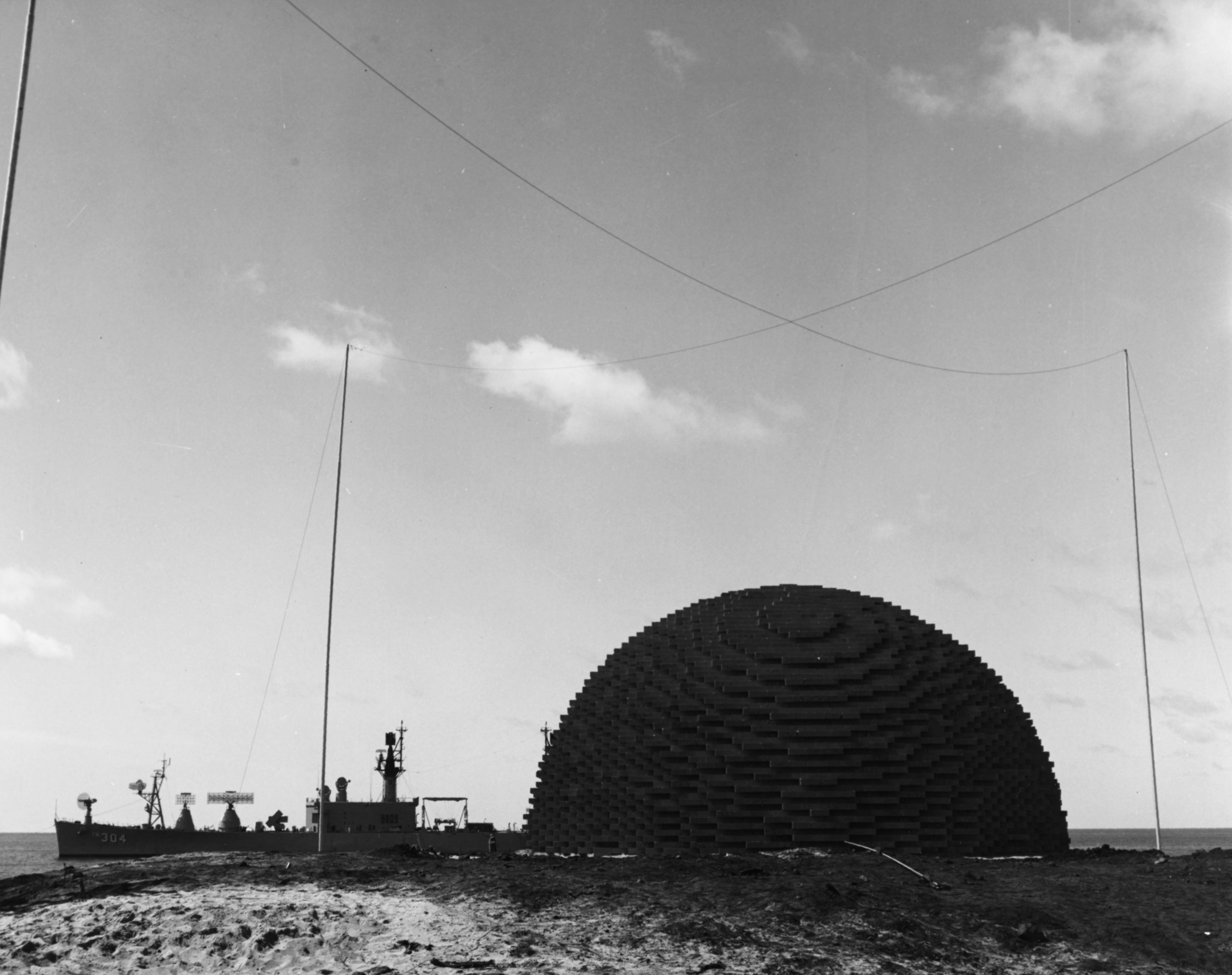
In 1962, the Navy struck Atlanta from the register, but she would not be broken up for scrap. Instead, she was selected for a unique mission: weapons testing. Workers at San Francisco Naval Shipyard stripped her upper works and installed experimental superstructures designed for the next generation of guided-missile destroyers and frigates. Reinstated to the register in 1964 with the new hull number IX-304, she became a floating laboratory for blast resistance testing. In early 1965, Operation Sailor Hat subjected her to three massive explosions designed to simulate nuclear weapon effects on naval vessels. She survived the tests, though damaged, and was laid up in Stockton, California.
Final Position
Atlanta remained at Stockton until 1970, when she was struck from the naval register for the final time. On October 1, 1970, she was towed out to sea and expended as a target off San Clemente Island. The coordinates 32.88 degrees North, 118.51 degrees West mark her final resting place, where she joined the many vessels used for weapons training in these waters. From her christening by a Pulitzer Prize-winning novelist to her use as a blast test platform and eventual sinking as a target, Atlanta's career spanned the full arc of American naval power in the mid-twentieth century.
From the Air
USS Atlanta's wreck site lies approximately 50 nautical miles southwest of Los Angeles at coordinates 32.88N, 118.51W, in deep water off San Clemente Island. The nearest airport is San Clemente Island NALF (KNUC). From cruising altitude, you may spot San Clemente Island as a narrow, 21-mile-long landmass. The wreck itself is not visible, but the waters here were used extensively for naval weapons testing.