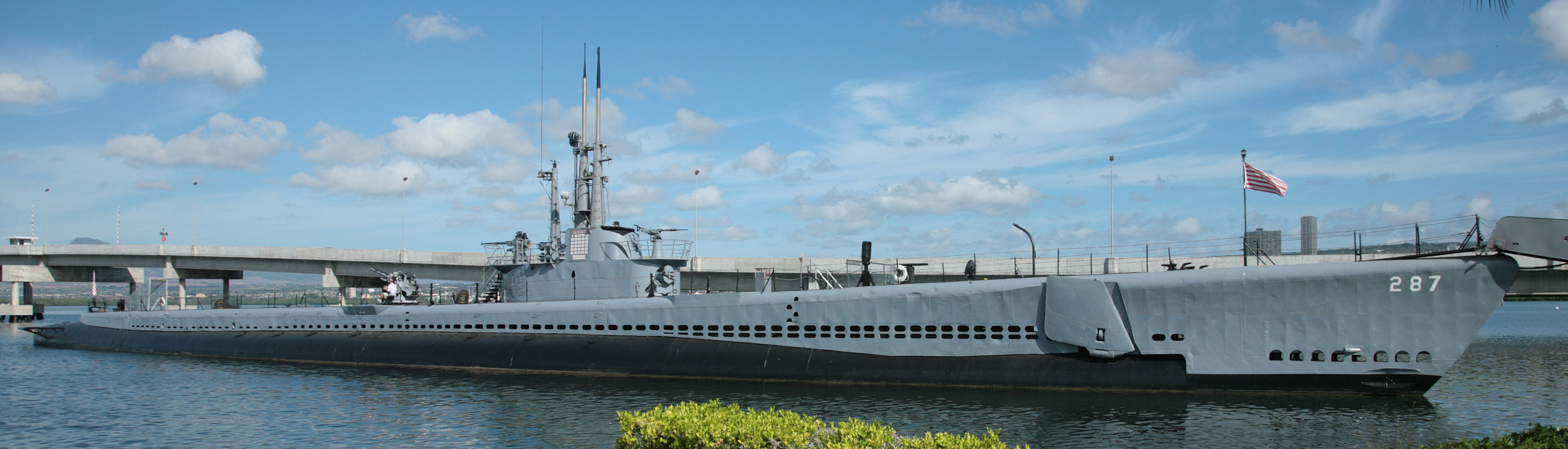
USS Bowfin
She was launched on December 7, 1942 -- exactly one year after the attack that drew America into the war. The timing was deliberate. At Portsmouth Naval Shipyard in Kittery, Maine, Mrs. Jane Gawne broke a bottle across the bow of USS Bowfin as the submarine slid into the water on the anniversary of Pearl Harbor, earning the boat a nickname she would carry through nine war patrols across the Pacific: the "Pearl Harbor Avenger." Today Bowfin floats at a pier in the harbor whose devastation gave her that name, open for tours just steps from the Arizona Memorial Visitor Center.
Nine Patrols Across the Pacific
Commissioned on May 1, 1943, under Commander Joseph H. Willingham, Bowfin transited the Panama Canal and crossed the Pacific to Brisbane, Australia. Her first war patrol brought her to the Mindanao Sea, where she spent three frustrating weeks without finding targets before finally tracking a six-ship convoy on September 25. The chase lasted five hours. When Bowfin attained an attack position, she fired six bow torpedoes, sinking a cargo ship. The pattern was set: long stretches of hunting punctuated by violent engagements at close range. Across nine patrols spanning from 1943 to 1945, Bowfin operated in waters from the South China Sea to the Japanese home islands, disrupting the supply lines that kept Japan's war machine running. Her combat record earned her a Navy Unit Commendation and eight battle stars.
Life Inside a Balao-Class Boat
Walking through Bowfin today, visitors quickly understand what submarine duty demanded. The Balao-class boat stretches roughly 312 feet, with a crew of about 80 men sharing a space designed around torpedoes, diesel engines, and electric motors. Bunks were stacked three high and shared on rotation -- a practice called hot racking because the mattress was still warm from the previous occupant. The diesel engines that powered surface running produced heat and noise that filled every compartment. Submerged, the electric motors offered relative quiet but also stale air. Carbon dioxide scrubbers and oxygen generators were the thin margin between survival and suffocation. Fresh water was rationed, showers were rare, and the galley operated in a space barely large enough to turn around in. Despite these conditions, submarine crews developed a cohesion that few other branches could match, bound by the knowledge that a single depth charge could kill everyone aboard.
The Avenger Comes Home
After the war, Bowfin served in various states of readiness and reserve until she was stricken from the Naval Vessel Register in 1971. A decade later, the submarine was moved to Pearl Harbor and opened to the public as the centerpiece of the USS Bowfin Submarine Museum and Park. The museum sits adjacent to the Pearl Harbor Visitor Center, placing Bowfin within the broader memorial complex that includes the Arizona Memorial and the battleship Missouri. Visitors can trace the path a sailor would have taken during a patrol, from the forward torpedo room to the aft engine compartment. The adjoining museum houses artifacts, photographs, and exhibits on the history of the U.S. submarine force, including a waterfront memorial honoring the more than 3,500 American submariners who lost their lives in World War II -- a casualty rate of roughly 22 percent, the highest of any branch of the U.S. armed forces.
The Boat and the Harbor
Bowfin's story is inseparable from the place where she now rests. Her launch-date symbolism was no accident; the Navy understood that morale required visible acts of response after the devastation of December 7, 1941. But Bowfin was more than a symbol. She was a working warship that spent the war in some of the most dangerous waters on earth, hunting convoys and surviving depth-charge attacks. Positioned between the Arizona Memorial and the harbor entrance where warships still pass, Bowfin connects the story of the attack to the long campaign that followed. Standing in her conning tower, the harbor visible through the hatch above, the distance between a museum and a weapon collapses. This is the actual boat, carried through nine patrols by the skill and nerve of her crews, now resting in the harbor where her war began.
From the Air
Coordinates: 21.3687°N, 157.9394°W. Bowfin is moored at a pier adjacent to the Pearl Harbor Visitor Center on the southeast shore of Pearl Harbor. Visible from low altitude as a dark submarine hull alongside a pier. Nearby airports: Daniel K. Inouye International (PHNL), Joint Base Pearl Harbor-Hickam (PHIK). Ford Island and Battleship Row are directly across the harbor channel. Best viewed from 2,000-3,000 ft AGL.