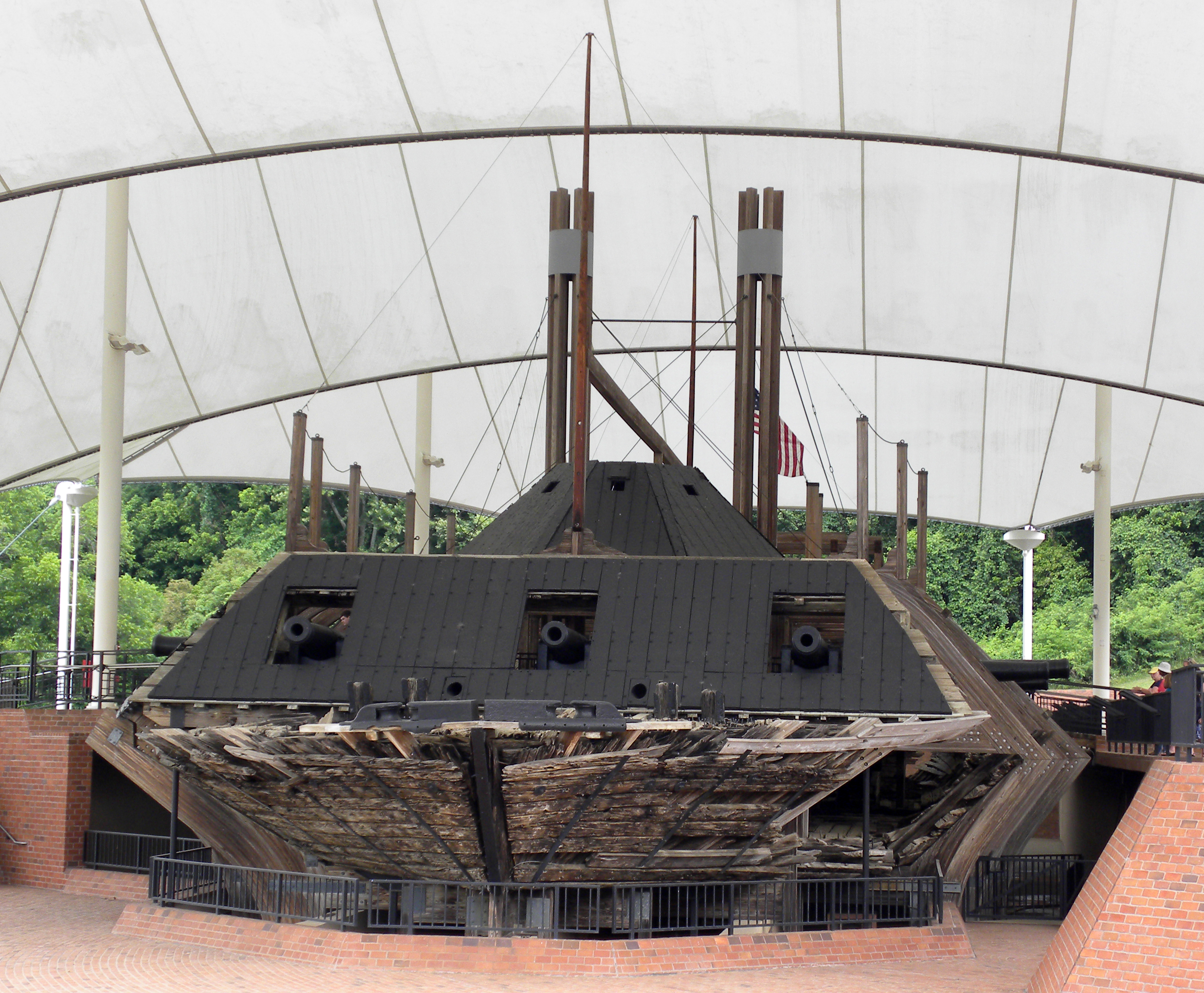
USS Cairo
On December 12, 1862, the ironclad gunboat USS Cairo was clearing mines from the Yazoo River when a jolt ran through her hull. Confederate volunteers hiding behind the riverbank had detonated a torpedo by hand, and the Cairo sank in twelve minutes. No one aboard was killed, but the ship made history: she was the first vessel ever destroyed by a remotely detonated mine. Then the river swallowed her. Silt and sand buried the wreck so completely that within a generation, no one could say exactly where she lay. It took nearly a century, a magnetic compass, and a determined National Park Service historian to bring the Cairo back from the dead.
Built for a River War
James Eads and Company built the Cairo in 1861 at Mound City, Illinois, under contract to the United States Department of War. She was the lead ship of the City-class casemate ironclads, a fleet of armored gunboats designed specifically for the shallow, winding rivers of the Western Theater. Commissioned as part of the Union Army's Western Gunboat Flotilla under the command of Flag Officer Andrew Hull Foote, the Cairo carried a formidable but eclectic arsenal: modern smoothbore Dahlgren guns alongside antiquated 32-pounders and structurally questionable 42-pounder rifles, which were old smoothbores hastily modified into rifled cannons. A 12-pounder howitzer rounded out the armament, intended not for bombardment but for repelling boarding parties in the close-quarters combat of river warfare.
From Memphis to the Yazoo
The Cairo saw action across the Western rivers through 1862. She helped occupy Clarksville, Tennessee, in February and Nashville later that month. In April she escorted mortar boats in the long operations against Fort Pillow, and after Confederate defenders abandoned the fort on June 4, she joined the decisive naval battle off Memphis two days later. Seven Union ships and a tug overwhelmed eight Confederate gunboats; five were sunk or run ashore, two seriously damaged, and one escaped. That night Union forces took the city. The Cairo returned to patrol duty on the Mississippi until November 21, when she joined the Yazoo Pass Expedition. Her mission was to clear mines from the river ahead of an assault on Haines Bluff. She never completed it. The hand-detonated torpedo that sent her to the bottom on December 12 wrote a grim new chapter in naval warfare.
A Century Beneath the Mud
The Yazoo River proved a remarkable preservative. Impacted in mud, the Cairo became a sealed time capsule. Corrosion and biological degradation halted. Weapons, ammunition, personal gear, naval stores -- all were locked in place as if the crew had just stepped away. But the wreck's exact location drifted from memory as crew members died and local residents lost track of the site. In 1956, Edwin C. Bearss of Vicksburg National Military Park set out to find the lost ship. Armed with Civil War-era maps and a simple magnetic compass, Bearss, with assistance from Don Jacks and Warren Grabau, located the gunboat. By 1960, artifacts were being pulled from the mud, including the pilothouse and an 8-inch cannon, all remarkably preserved by the Yazoo's thick sediment.
Raised in Pieces
The dream of lifting the Cairo intact shattered in October 1964 when three-inch cables sliced into her wooden hull during the salvage attempt. The decision was made to cut the ironclad into three sections. By December, the battered remains rode barges to Vicksburg, then continued to Ingalls Shipyard in Pascagoula, where armor was removed and cleaned, engines disassembled and reassembled, and white oak timbers kept under constant sprinklers to prevent warping. The Cairo was listed on the National Register of Historic Places on September 3, 1971. In 1972, Congress authorized the National Park Service to accept the vessel, but funding delays meant she did not reach her permanent home at Vicksburg National Military Park until June 1977. A shelter was completed in October 1980, and the museum opened the following month.
A Time Capsule on Display
The artifacts recovered from the Cairo constitute one of the most complete collections of Civil War naval material in existence. Weapons, ammunition, naval stores, and the personal belongings of ordinary sailors -- including a rope knife found in excellent condition -- now line the display cases of the USS Cairo Museum along the park's tour road. Only three other Civil War-era ironclads survive anywhere in the world. Since salvage, the Cairo has suffered from exposure to weather, bird droppings, and vandalism, and her original space-frame shelter was replaced by a tension-fabric system for better protection. She remains a singular artifact: a vessel that changed the nature of naval combat, then waited a hundred years in the dark to tell her story.
From the Air
Located at 32.376N, 90.867W within Vicksburg National Military Park, Mississippi. The USS Cairo Museum sits along the park tour road near Vicksburg National Cemetery. Nearest airport is Vicksburg-Tallulah Regional Airport (KTVR), approximately 10 nm to the west across the Mississippi River. Jackson-Medgar Wiley Evers International Airport (KJAN) lies about 35 nm east. From the air, the park's rolling terrain and monument-studded ridgelines are visible along the bluffs above the Mississippi River.