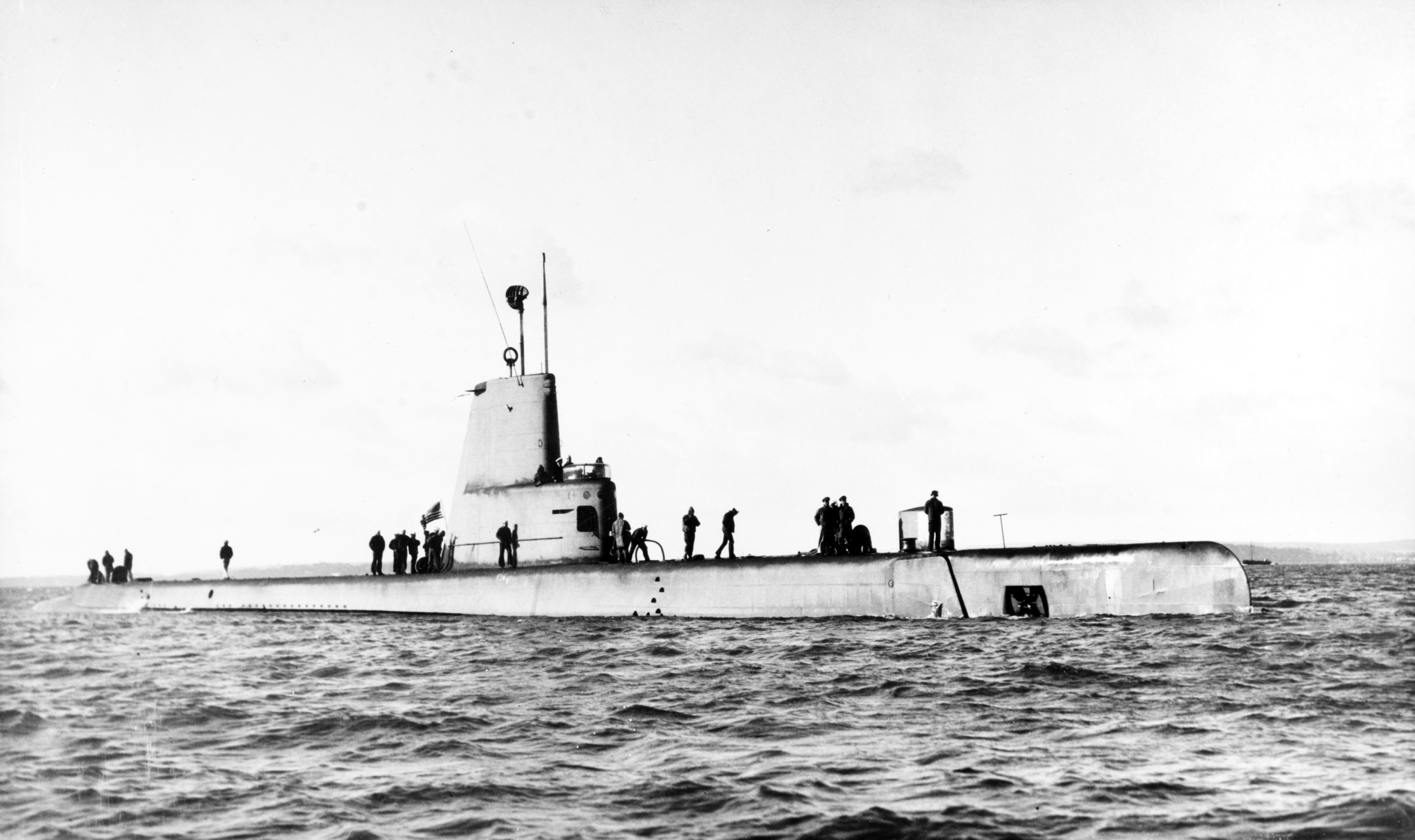
USS Cochino
On the evening of August 25, 1949, the submarine USS Cochino was running on her snorkel in Arctic waters off northern Norway when a polar storm found her. The seas were enormous. Each wave slammed the snorkel with enough force to jolt the entire boat, and somewhere below the waterline, the pounding cracked open a battery compartment. An electrical fire erupted, followed by an explosion, followed by the silent and far more dangerous release of hydrogen gas into the hull. For the next fourteen hours, the crew of the Cochino and sailors from her companion vessel USS Tusk fought to save the boat in conditions so violent that standing upright was an achievement. They failed. Cochino sank on August 26, 1949, taking with her a Cold War secret that would not surface for decades.
Named for a Triggerfish
USS Cochino (SS-345) was a Balao-class submarine built by the Electric Boat Company at Groton, Connecticut. Laid down on April 13, 1944, launched on April 20, 1945, and commissioned on August 25, 1945 -- the day Japan formally agreed to surrender terms -- she was named for the cochino, a triggerfish found in the Atlantic. Her early career was routine Cold War submarine duty: shakedown cruises out of New London, training exercises in the Panama Canal Zone, port calls at Key West, Guantanamo Bay, and Havana. She provided services for fleet operations, conducted simulated attacks, and visited ports from St. Thomas to Galveston. In April 1948 she collided with a fleet tug during a submerged exercise, damaging both periscopes and her radar antenna. The Navy sent her back to Groton for major renovations, converting her into a GUPPY-type snorkel boat -- a modernization that would, within months, play a role in her destruction.
A Secret Mission North
Cochino emerged from the Groton yard in February 1949, newly modernized and capable of extended submerged operations using her snorkel system. By summer she was in European waters for the first time, calling at Derry in Northern Ireland and Portsmouth in England before heading north above the Arctic Circle into the Barents Sea. The stated purpose was routine -- Cold War naval operations in northern waters. The actual mission was something else entirely. Cochino and her escort Tusk were sailing along the Kola Peninsula to determine whether the Soviet Union had detonated an atomic bomb. The intelligence was urgent: the Soviets were known to be pursuing nuclear weapons, and the United States needed to know how close they were. Cochino carried specialized detection equipment and a civilian technician from the Bureau of Ships named Robert W. Philo.
Fourteen Hours in a Polar Storm
The storm struck on August 25. Running on her snorkel to recharge batteries while remaining submerged, Cochino took a beating that exceeded anything her design could absorb. The massive waves hammered the snorkel mechanism with such violence that the shocks traveled through the hull like blows from a giant fist. A battery compartment ruptured. Fire broke out, and the resulting explosion filled sections of the boat with hydrogen gas -- invisible, odorless in its pure form, and catastrophically explosive when mixed with air. In wretched weather conditions, with seas crashing over both submarines, crews from Cochino and Tusk fought to save the stricken boat. The Tusk pulled alongside in mountainous swells to assist, an act of seamanship so dangerous it bordered on reckless courage. For fourteen hours, they fought the fires, ventilated the gas, and tried to keep the Cochino afloat.
Abandon Ship
A second battery explosion on August 26 ended the struggle. The order came: abandon ship. What followed was a rope transfer between two submarines in heavy Arctic seas -- the kind of evolution that no manual covers because no manual assumes conditions this extreme. Cochino's crew crossed to Tusk one by one, hand over hand on lines stretched between the wallowing hulls. The abandoned Cochino sank into the Norwegian Sea. The boat's only fatality was Robert W. Philo, the civilian technician, swept overboard by an icy wave during the battle to save the ship. Tusk lost six of her own sailors the same way -- men washed off the deck by seas that treated a submarine's hull like a piece of driftwood. Seven men died in all, killed not by enemy action but by the Arctic Ocean itself.
Cold War Ghost
Cochino was stricken from the Naval Vessel Register on October 27, 1949. She remains one of only four United States Navy submarines lost since the end of World War II. Her wreck lies somewhere in the deep waters off northern Norway, at coordinates the Navy recorded but has never publicized. The secret nature of her final mission -- monitoring Soviet nuclear testing along the Kola Peninsula -- meant that the full story of her loss remained classified for years. What the public knew was that a submarine had sunk in a storm. What they did not know was that Cochino had been operating at the frontier of Cold War intelligence gathering, carrying equipment and personnel dedicated to answering the most urgent question of the atomic age. The Soviet Union tested its first nuclear weapon on August 29, 1949 -- three days after Cochino went down.
From the Air
Cochino's approximate sinking location is at 71.58N, 23.58E in the Norwegian Sea off the coast of northern Norway, north of Hammerfest. From the air, this is open Arctic Ocean with no visible landmarks at the sinking site. The nearest coast is the Finnmark region of Norway. Nearest airports are Hammerfest Airport (ENHF) and Alta Airport (ENAT). Recommended viewing altitude 5,000-10,000 ft to appreciate the vast, empty expanse of Arctic sea where the submarine was lost. Weather in this area is frequently severe, with polar storms common in late summer and autumn.