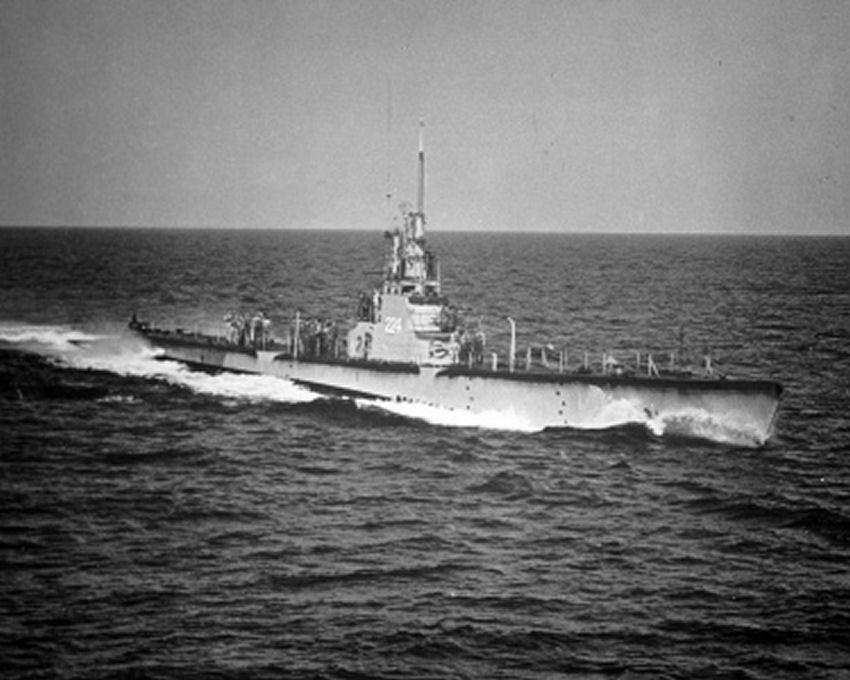
USS Cod: The Submarine That Rescued a Submarine
On her battle flag, painted beneath a martini glass, is the name O-19. It marks the strangest episode of USS Cod's war: the rescue of an entire Dutch submarine crew from a reef in the South China Sea - the only international submarine-to-submarine rescue ever conducted. When Cod returned to port with the Dutch sailors aboard, the crew of the O-19 was waiting to throw a party. During that celebration, word came that Japan had surrendered. The martini glass on the battle flag commemorates both the rescue and the moment the war ended. Today Cod sits permanently moored on Cleveland's North Marginal Road, a National Historic Landmark and the only World War II fleet submarine in America that has never had stairways or doors cut into her pressure hull. Visitors climb through the same hatches and down the same vertical ladders that her crew used.
Born in Two Cities
Cod's keel was laid down on July 21, 1942, at the Electric Boat Company in Groton, Connecticut, but her heart was built in Cleveland. The submarine's four main Cleveland Model 16-248 V16 diesel engines and one auxiliary diesel engine were manufactured by General Motors' Cleveland Diesel Engine Division on the city's west side. She was launched on March 21, 1943, and commissioned three months later on June 21, under Commander James C. Dempsey - an officer who had already won fame for sinking the first Japanese destroyer lost in World War II. From the start, Cod was a warship with a pedigree, built by two American cities and commanded by a proven submarine hunter.
Seven Patrols, Seven Stars
Cod completed seven war patrols across the Pacific, every one classified as successful. She ranged from the South China Sea to the waters off Luzon, from the East China Sea to the Gulf of Siam. Her third patrol was among the most aggressive: on May 10, 1944, she attacked a heavily escorted convoy of 32 ships, sinking the destroyer Karukaya and the cargo vessel Shohei Maru before depth charges drove her deep. On her fifth patrol, she sank the 6,886-ton Tatsushiro Maru, then shadowed a large convoy for an additional day after expending all her torpedoes, reporting its position so others could attack. By war's end, Cod was credited with sinking more than 12 enemy vessels totaling over 37,000 tons and damaging another 36,000 tons of shipping. She earned seven battle stars.
Fire in the Torpedo Room
Cod's closest brush with catastrophe came on April 26, 1945, during her sixth patrol in the East China Sea. A fire erupted in the aft torpedo room - one of the most dangerous emergencies possible aboard a submarine loaded with live warheads. The crew fought the blaze and manually launched a torpedo already in its tube before the fire could detonate it. During the effort to free the torpedo room hatch, two sailors - QM2c Lawrence E. Foley and S1c Andrew G. Johnson - were washed overboard. Foley was recovered the next morning, but Johnson drowned during the night. He was Cod's only fatality across all seven war patrols - a remarkable record for a submarine that spent two years in combat.
The Party at the End of the War
On July 9 and 10, 1945, during her seventh and final patrol in the Gulf of Siam, Cod came upon the Dutch submarine O-19, grounded on Ladd Reef and unable to free herself. Cod took the entire Dutch crew aboard, then destroyed the O-19 to prevent it from falling into enemy hands. It was the only international submarine-to-submarine rescue ever performed. After returning the Dutch sailors to Subic Bay, Cod spent the rest of July making 20 gunfire attacks on the junks, sampans, and barges still supplying Japanese forces at Singapore, sinking 23 vessels. On August 1, an enemy plane strafed Cod, forcing her to dive and leaving a boarding party stranded - the men were rescued two days later. When Cod reached Fremantle on August 13, the crew of the O-19 had organized a celebration. During the party, both crews learned the war was over.
Intact and Unchanged
After postwar mothballing and Cold War NATO exercises, Cod was towed through the St. Lawrence Seaway to Cleveland in 1959. In 1976, a group of Cleveland residents formed a committee to preserve her, and the Navy transferred guardianship. She opened for public tours on May 1, 1976, and in 1986 was designated a National Historic Landmark. What makes Cod unique among surviving World War II submarines is her integrity: she is the only one that has never had stairways or access doors cut into her pressure hull for visitor convenience. Her 5-inch deck gun, Mark IV Torpedo Data Computer, SJ-5 radar, sound-powered telephones, and all five diesel engines have been restored to working condition. In 2021, Cod made her first voyage in 58 years, towed to Erie, Pennsylvania, for a $1.1 million hull restoration. She returned to her Cleveland berth on August 18, 2021 - the same spot she has occupied since 1959.
From the Air
Located at 41.51°N, 81.69°W on Cleveland's North Marginal Road along the Lake Erie waterfront, USS Cod is visible from lower altitudes as a dark submarine shape moored at the lakefront, approximately 0.3 miles east of the Rock and Roll Hall of Fame. Burke Lakefront Airport (KBKL) is immediately nearby, making the sub visible on approach. Cleveland Hopkins International Airport (KCLE) is about 10 miles to the southwest. The submarine sits between the lakefront and the shore road, recognizable by her long, low profile and conning tower. Best viewed at altitudes below 5,000 feet in clear conditions.