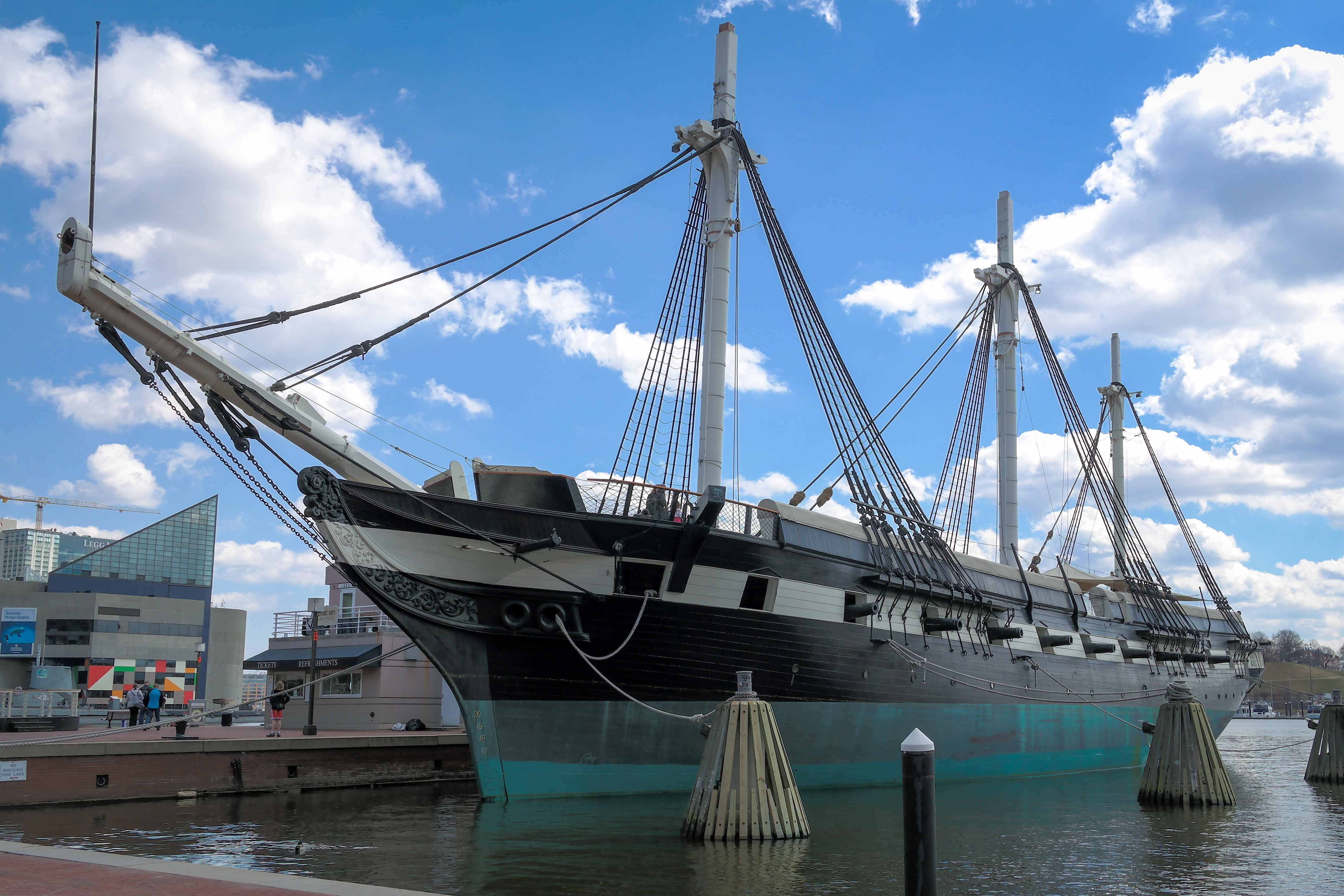
USS Constellation (1854)
For decades, the tall-masted ship moored in Baltimore's Inner Harbor lived a lie. Plaques called her the legendary 1797 frigate Constellation, one of the original six frigates of the United States Navy. Restoration crews even rebuilt her decks and hull to match the older vessel's appearance. It took FBI forensics investigators to sort out the truth: twenty-five to thirty documents supporting the ship's supposed identity were forgeries, created in the 1960s to boost her historical prestige. The ship floating at Pier 1 today is not the 1797 frigate. She is the 1854 sloop-of-war Constellation, built from stockpiled live oak at the Gosport Shipyard in Norfolk, Virginia -- and her real story is far more compelling than the fiction.
Live Oak and the Last Sail Warship
By the early 1850s, the Navy had warehouses full of live oak timber, accumulated since 1816 under the Act for the Gradual Increase of the Navy. Rather than let it rot, they commissioned one final sailing warship. Chief Constructor John Lenthall and Edward Delano of the Gosport Shipyard designed a fast, long-endurance sloop-of-war armed with sixteen shell-firing guns and four 32-pounder long guns. Her keel was laid in 1853, even as the original frigate Constellation was being broken up just nine hundred yards away in the same shipyard. Some salvageable timbers from the old ship -- particularly the ship's knees -- found their way into the new vessel, planting the seed of a confusion that would persist for over a century. Commissioned on July 28, 1855, Constellation entered a Navy already shifting toward steam power. She was, by design, an anachronism -- and she would be the last of her kind.
The Dismal Coast
In June 1859, Constellation sailed for the west coast of Africa as flagship of the Africa Squadron, tasked with intercepting slave ships on the Atlantic. The work was grueling and morally urgent. Patrolling off the mouth of the Congo River, her crew hunted vessels running human cargo under cover of darkness and false papers. On December 29, 1859, they captured the brig Delicia, found rigged to carry enslaved people in her hold with no papers aboard. The following September brought the squadron's most significant action: Constellation intercepted the barque Cora carrying 705 enslaved people. The captives were released in Monrovia, Liberia, and the Cora was impounded and auctioned off. The Navy awarded prize money for each slave ship captured and a twenty-five dollar bounty for every person freed, divided among the crew by rank -- a grim accounting system applied to the work of liberation.
From Warship to Mercy Ship
Constellation's versatility extended well beyond combat. During the American Civil War, she patrolled the Mediterranean hunting Confederate vessels. After the war, she spent twenty-two years as a training ship for midshipmen. In 1878, she carried exhibition materials across the Atlantic for the Exposition Universelle in Paris. But her most poignant humanitarian mission came in 1880, when she was converted to carry famine relief to Ireland. Crews removed some of her guns and ballast to make room for more than 2,500 barrels of flour and potatoes. She departed in March and arrived at Queenstown -- now Cobh -- on April 20, where every barrel was sent ashore. A warship built to carry cannonballs instead delivered food to the starving. By 1893, she had been reduced to a stationary training hulk moored in Newport, Rhode Island. In 1940 she was recommissioned one last time, serving as port flagship for the Atlantic Fleet commander during World War II.
Forgeries, FBI Agents, and a Ship of Theseus
The identity controversy that surrounded Constellation was no casual disagreement. When the ship was transferred to Baltimore in 1955, the organization managing her insisted she was the 1797 frigate, and modified her appearance to match. By the 1960s, forged documents had been created to support the claim. The deception held for decades. In 1991, researchers from the David Taylor Research Center and the Naval Surface Warfare Center published an exhaustive investigation. With assistance from FBI and Bureau of Alcohol, Tobacco, Firearms forensics experts, they determined that the supporting documents were fabrications and concluded definitively that the two Constellations were separate ships. The Dictionary of American Naval Fighting Ships updated its entry accordingly. The old guard at the U.S.F. Constellation Foundation resigned in 1994, replaced by advocates who accepted the evidence. Today, Historic Ships in Baltimore presents the vessel honestly -- not as a Revolutionary War relic, but as the last sail-only warship built by the U.S. Navy, and the last intact naval vessel to have served in the Civil War.
Still Afloat in the Inner Harbor
Keeping a wooden ship from the 1850s alive requires constant intervention. In 1996, Constellation was towed to drydock at Locust Point, near Fort McHenry, for a $7.3 million rebuilding that replaced about half her original but badly rotted timbers. In 2004, she made her first trip out of the Inner Harbor since 1955, an eight-hour tow to the Naval Academy in Annapolis. More rot was discovered in 2011 -- ironically in timbers installed during the 1990s restoration -- leading to another $2 million drydocking at the Coast Guard Yard in 2014. A new education center opened alongside the ship in June 2022, replacing a decrepit building that had been demolished in 2019. Constellation now sits alongside the Coast Guard cutter Taney, the World War II submarine Torsk, the lightship Chesapeake, and the Seven Foot Knoll Light, forming the Historic Ships in Baltimore collection in the city's Inner Harbor.
From the Air
USS Constellation is moored at Pier 1 in Baltimore's Inner Harbor, at 39.286°N, 76.611°W. From the air, the ship is identifiable by her three tall masts and dark hull in the waterfront basin just east of the Harborplace pavilions. Fort McHenry is visible about 1.5 nm to the southwest along the Patapsco River. The nearest major airport is Baltimore/Washington International (KBWI), approximately 9 nm south. Martin State Airport (KMTN) lies about 10 nm to the northeast. Best viewed at low altitude on approach from the south or east, where the ship's rigging stands out against the downtown skyline.