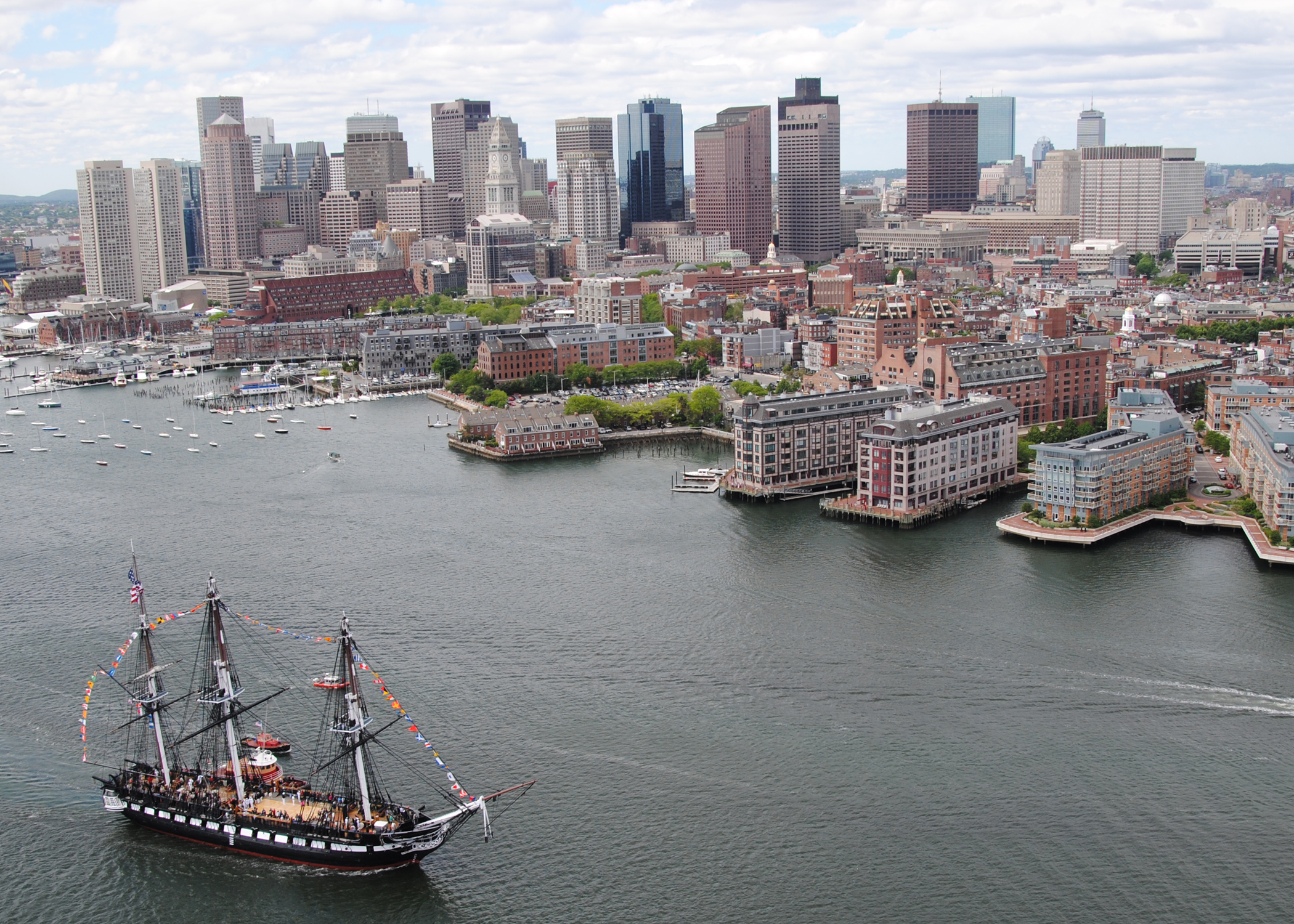
USS Constitution
"This is United States ship Constitution, 44 guns, Edward Preble, an American commodore, who will be damned before he sends his boat on board of any vessel." Captain Preble shouted that defiant challenge into the darkness off Gibraltar in 1803, convinced he was facing an 84-gun British warship. The other ship turned out to be a 32-gun frigate whose captain had been bluffing. That moment -- equal parts bravado, stubbornness, and sheer American nerve -- captures the spirit of the vessel berthed today at Pier 1 of the former Charlestown Navy Yard in Boston. USS Constitution has survived Barbary pirates, the War of 1812, a near-scrapping in 1830, and more than two centuries of ocean, weather, and politics. She remains a fully commissioned warship of the United States Navy, crewed by 75 active-duty sailors, the oldest such vessel still afloat anywhere on Earth.
Born from Piracy and Desperation
Constitution exists because of pirates. In 1785, Barbary corsairs from Algiers began seizing American merchant ships in the Mediterranean, and by 1793, eleven vessels had been captured and their crews held for ransom. Congress responded with the Naval Act of 1794, funding six frigates to defend American trade. Naval architect Joshua Humphreys designed them to be unlike anything else afloat: longer, deeper, and more heavily armed than standard frigates, built to overpower any frigate in combat while fast enough to escape a ship of the line. Constitution's keel was laid on November 1, 1794, at Edmund Hartt's shipyard in Boston's North End. Her hull was constructed from pine and oak, reinforced with southern live oak cut from Gascoigne Bluff near St. Simons Island, Georgia -- a wood so dense it earned her a reputation for near-invulnerability. When she finally slipped into Boston Harbor on October 21, 1797, after two failed launch attempts caused by her massive weight settling the ways into the ground, President John Adams watched from the crowd.
The Cannonballs That Bounced
Constitution fought in the Quasi-War with France and the First Barbary War, but her legend was forged on August 19, 1812, when she met HMS Guerriere south of Halifax. Captain Isaac Hull had spent weeks outrunning a five-ship British squadron in a legendary 57-hour chase, during which his crew towed the becalmed ship with rowboats, used kedge anchors to winch her forward, and pumped fresh drinking water overboard to lighten the load. When Constitution finally caught Guerriere, the battle lasted barely thirty minutes. British sailors watched in disbelief as their cannonballs appeared to bounce off Constitution's thick oak sides. An American sailor reportedly cried out, "Huzza! Her sides are made of iron!" The nickname stuck. Guerriere was so shattered she had to be burned at sea the next day. Constitution went on to capture four more British warships during the war, a record unmatched by any other American frigate.
Saved by a Poem
By 1830, Constitution was old and deteriorating. The Navy proposed scrapping her. When the Boston Daily Advertiser published the news, a 21-year-old Harvard student named Oliver Wendell Holmes wrote a poem titled "Old Ironsides" in a burst of indignation. Its opening lines -- "Ay, tear her tattered ensign down! / Long has it waved on high" -- spread through newspapers across the country and ignited a wave of public outrage that forced the Navy to restore the ship instead. It was one of the first great preservation campaigns in American history, and it set a pattern that would repeat. Constitution has been saved from destruction multiple times by public affection, most dramatically in 1934 when she completed a three-year, 90-port tour of the nation that allowed millions of Americans to walk her decks for the first time.
A Ship That Still Sails
Constitution is not a static relic. In 1997, for her 200th birthday, she sailed under her own power for the first time in over a century, her restored sails catching the wind off Marblehead as tugboats stood by. She sailed again in August 2012 to mark the 200th anniversary of her victory over Guerriere. Between voyages, she is turned periodically at her berth in Charlestown so that her wooden hull weathers evenly. Every gun on board is a replica cast during her 1927-1931 restoration, but the hull timbers, the deck planking, and the rigging hardware carry the memory of the original ship. Her crew -- all active-duty Navy personnel on a posting considered special duty -- conduct free tours year-round, lead educational programs, and fire her cannons on national holidays. She sits at one end of the Freedom Trail, a few hundred yards from the Bunker Hill Monument, where visitors walk from the birth of a revolution to the ship that defended the nation it created.
Iron Will on the Waterfront
What makes Constitution remarkable is not just longevity but continuity. She has been in continuous commission since her launch, a thread of service stretching from George Washington's presidency to the present day. She carried American artwork to the Paris Exposition of 1878, trained Naval Academy midshipmen during the Civil War, and circumnavigated the globe in the 1840s under Captain "Mad Jack" Percival. Her career spans every era of American naval power, from wooden sailing ships to nuclear submarines. Standing on her gun deck today, looking out through the open ports at the Boston skyline, the distance between 1797 and the present collapses. The oak planking underfoot was shaped by hands that knew nothing of electricity. The ship that those hands built is still here, still commissioned, still afloat -- the oldest warship in the world that can still claim to be alive.
From the Air
USS Constitution is berthed at Pier 1 of the former Charlestown Navy Yard at 42.372N, 71.057W, at the northern end of Boston's Freedom Trail. The three-masted ship is visible from low altitude alongside the Charlestown waterfront, near the Bunker Hill Monument's 221-foot granite obelisk. Best viewed at 1,500-2,500 feet AGL on approach to or departure from KBOS (Boston Logan International Airport), located 2nm east across the harbor. The Tobin Bridge, Zakim Bridge, and Charles River provide visual orientation. The Charlestown Navy Yard's dry dock and pier structures are distinctive landmarks.