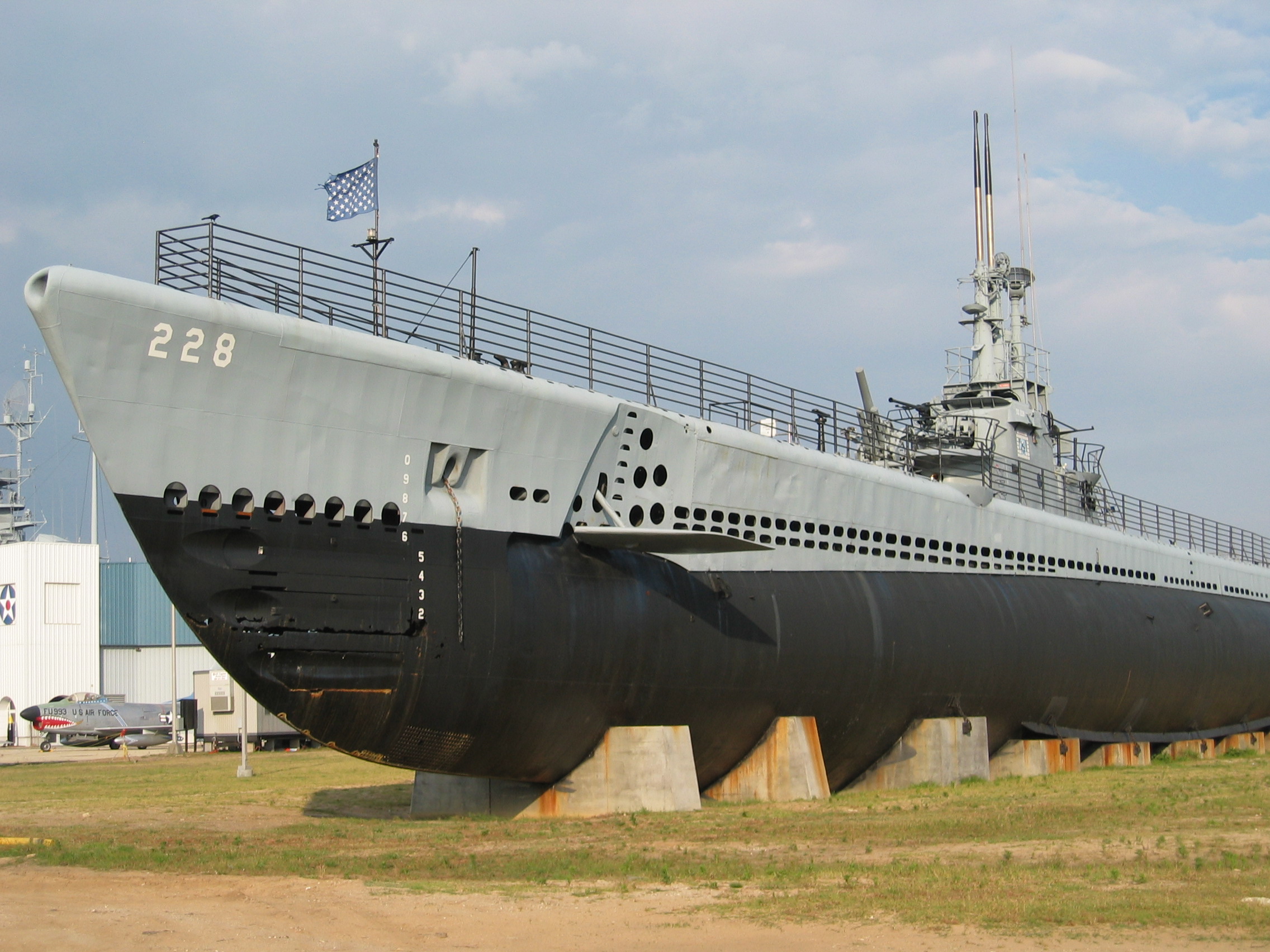
USS Drum (SS-228)
Fifteen ships and 80,580 tons of enemy shipping sent to the bottom -- that is the cold arithmetic of USS Drum's war. But numbers cannot capture what it felt like inside her steel hull on 2 May 1942, when the crew endured sixteen straight hours of depth charging after sinking the Japanese seaplane tender Mizuho. Commissioned just five weeks before Pearl Harbor, this Gato-class submarine was the first of her class to be completed and the first to draw blood in combat. She completed fourteen war patrols across nearly four years of continuous service, surviving depth charges, friendly fire, typhoons, and a conning tower so badly damaged it had to be cut out and replaced.
First of Her Kind
Drum was laid down on 11 September 1940 at Portsmouth Naval Shipyard in Kittery, Maine, the twelfth Gato-class boat ordered but the first to slide down the ways. She launched on 12 May 1941 and was commissioned on 1 November -- barely a month before Japan attacked Pearl Harbor. Commander Robert H. Rice took her through shakedown and headed for the Pacific, but the war nearly found her first: an Allied aircraft mistook Drum for a German U-boat during her transit to the Panama Canal and attacked. She arrived at Pearl Harbor on 1 April 1942, and within two weeks she was heading for her first war patrol off the coast of Japan.
The Hunter's Toll
Drum's combat record reads like a catalog of calculated aggression. On her first patrol, she sank four ships off the Japanese coast, including the seaplane tender Mizuho, then survived the punishing depth charge retaliation. Her third patrol off Kyushu yielded three more kills despite relentless air cover protecting the convoys. But it was her fourth patrol that tested the crew's nerve most severely. Tasked with planting mines in the heavily trafficked Bungo Suido strait, Drum spotted the Japanese aircraft carrier Ryuho fully loaded with planes. Despite taking water forward through faulty valves, the submarine launched torpedoes and scored two hits, causing the carrier to list dramatically. A destroyer bore down on the submarine, and splashes around the periscope showed she was under direct fire. As Drum dove, she lost depth control and her port shaft stopped turning. The crew made emergency repairs while enduring two waves of depth charges.
Fourteen Patrols
From the Gilberts to the South China Sea, Drum ranged across the Pacific for nearly the entire war. She photographed Nauru for intelligence, provided lifeguard duty for aviators during raids on Yap and Palau, and patrolled the waters around Iwo Jima and the Bonin Islands. Her most devastating single action came during the Battle of Leyte Gulf in October 1944, when she intercepted a thirteen-ship convoy carrying Japanese reinforcements to the Philippines. In two days of attacks, Drum sank four vessels totaling over 24,000 tons, including the transport ships Taihaku Maru, Taisho Maru, and Tatsura Maru. By war's end, her fourteen patrols had earned twelve battle stars and placed her eighth among all American submarines in total enemy tonnage destroyed.
Scars That Show
The submarine's eighth patrol, coordinated with the landings at Cape Torokina in November 1943, pushed Drum to her structural limits. After sinking the 11,621-ton submarine tender Hie Maru and attacking a four-ship convoy, the escorts delivered three successive depth charge attacks that left the boat heavily damaged. Inspection at Pearl Harbor revealed the conning tower needed complete replacement, requiring the submarine to sail all the way to the West Coast for repairs. It was a testament to both her construction and her crew that Drum returned to service and completed six more war patrols before the Japanese surrender on 15 August 1945 cut short her fourteenth run.
High and Dry on the Gulf
Decommissioned in February 1946, Drum spent two decades in reserve service for the Naval Reserve in Washington, D.C., before being donated to the USS Alabama Battleship Commission on 14 April 1969. She was towed to Battleship Memorial Park in Mobile, Alabama, and opened to the public that Fourth of July. The submarine was designated a National Historic Landmark in 1986. Hurricane Georges in 1998 inflicted enough storm surge damage that Drum was moved permanently onto dry land, where she now rests on shore behind the battleship Alabama. Restoration work continues, including rebuilt bow and stern sections and new I-beams inside the ballast tanks to support the aging hull. Visitors who squeeze through her narrow hatches and peer into the forward torpedo room walk the same claustrophobic spaces where a crew of roughly seventy men once hunted across the Pacific.
From the Air
USS Drum (SS-228) sits at 30.6811N, 88.0167W at Battleship Memorial Park in Mobile, Alabama, on shore just south of the battleship USS Alabama. The submarine is on dry land and visible as a dark cylindrical shape beside the larger battleship hull. Approach from the east over Mobile Bay. Nearby airports include Mobile Downtown Airport (KBFM, 3 nm southwest) and Mobile Regional Airport (KMOB, 10 nm west). Recommended viewing altitude: 1,000-2,500 feet AGL for detail on both the submarine and battleship.