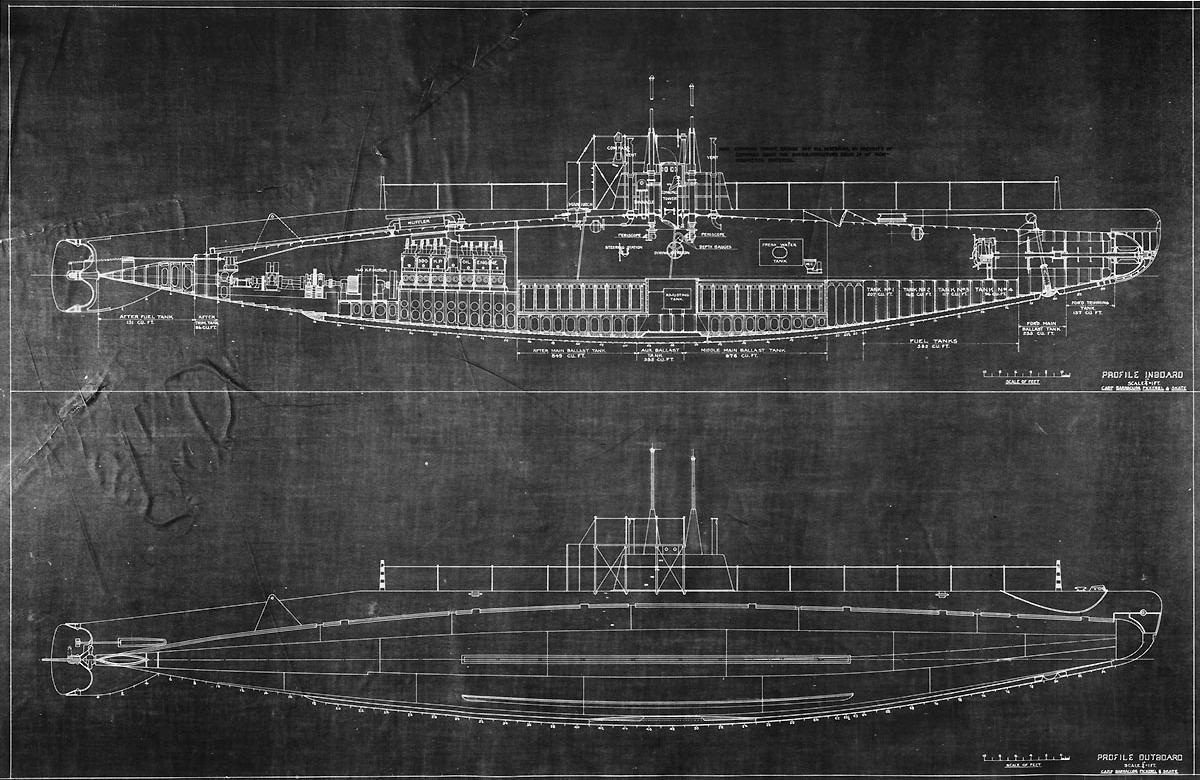
USS F-4
On the morning of March 25, 1915, the submarine USS F-4 submerged during a routine training exercise off the entrance to Honolulu Harbor and never came back up. She settled on the ocean floor at a depth of 306 feet -- 51 fathoms -- becoming the first commissioned submarine of the United States Navy to be lost at sea. All 21 men aboard perished. The effort to raise her would push the boundaries of what was then possible in deep-water salvage, and the wreck itself still lies buried in the mud of Pearl Harbor's Magazine Loch today, one of the harbor's oldest and least-known graves.
Hawaii's First Submarines
F-4 began life as USS Skate, her keel laid down in August 1909 at the Moran Company shipyard in Seattle. Renamed before her January 1912 launch, she was commissioned in May 1913 and joined the First Submarine Group of the Pacific Torpedo Flotilla. The F-class boats were small: a crew of one officer and 21 enlisted men, four 18-inch torpedo tubes in the bow with no reloads, and twin diesel engines for surface running. In August 1914, all four F-class submarines were transferred to the Territory of Hawaii -- the first submarines ever to operate from the islands. Pearl Harbor's facilities were still under construction, so the boats were based at rented pier space in downtown Honolulu, towed to their new home by armored cruisers. It was a modest beginning for submarine operations in what would become one of the Navy's most important Pacific bases.
The Only Survivor Stayed Ashore
The morning F-4 went down, Electrician's Mate 3rd Class James Morton Hoggett was standing duty as a pier watchman. His job was to receive any news that arrived while the submarine was at sea and relay it to the commanding officer upon return -- a common assignment in the era before shipboard radios. Hoggett became F-4's only survivor by the simple accident of duty rotation. Aboard the submarine, something had gone catastrophically wrong beneath the surface. When F-4 failed to return on schedule, Navy authorities began a search. Chief Gunner's Mate Jack Agraz, a diver from one of F-4's sister ships, made repeated deep dives during the search without a diving suit or weights, wearing only a diving helmet and breastplate balanced on his shoulders. Searchers eventually located F-4 on the bottom and confirmed the pressure hull had imploded.
Raising the Dead
The Navy resolved to raise F-4 to recover her crew and investigate the cause of loss. What followed was a five-and-a-half-month engineering effort that set new precedents in deep-water salvage. Divers slung lifting chains under the wreck and attached them to six specially built pontoons. Naval Constructor Julius A. Furer and Rear Admiral C. B. T. Moore led the operation, with Navy diving expert Chief Gunner George D. Stillson surveying the site. Among the divers was John Henry Turpin, believed to be the first African American to qualify as a U.S. Navy Master Diver. On August 29, 1915, the submarine was raised and brought to dry dock in Honolulu -- upside down, in the same position she had been found on the ocean floor. Only four of the 21 dead could be identified. The remaining seventeen were buried together at Arlington National Cemetery.
Battery Acid and Tar Pitch
Investigators pieced together a grim chain of failures. Battery acid had gradually leaked onto the steel pressure hull beneath the forward battery well, weakening the plating and the rivets that held it together. Seawater forced its way in under submerged pressure. When the crew tried to pump the flooding out, they found the bilge suction valves had been accidentally fouled by tar pitch used to seal the battery well, rendering the pumps useless. With buoyancy control lost, F-4 sank past her crush depth, and the hull imploded in the torpedo room. After the investigation, useful equipment was stripped from the wreck, and F-4 was stricken from the Naval Vessel Register on August 31, 1915. Her remains were moved to Pearl Harbor's Magazine Loch, where she settled into the mud. In 1940, when the submarine base needed to expand its pier facilities, the wreck was shifted a few yards west and reburied in a trench near mooring S14. She lies there still, an unseen relic of the Navy's earliest submarine days beneath one of the most important submarine bases in the Pacific.
From the Air
Coordinates: 21.3581°N, 157.9418°W. The wreck of USS F-4 is buried in the mud of Magazine Loch at Naval Submarine Base Pearl Harbor -- nothing is visible at the surface. The loch is on the southeast side of the harbor complex. Nearby airports: Daniel K. Inouye International (PHNL), Joint Base Pearl Harbor-Hickam (PHIK). The submarine base piers are visible from 1,500-3,000 ft AGL.