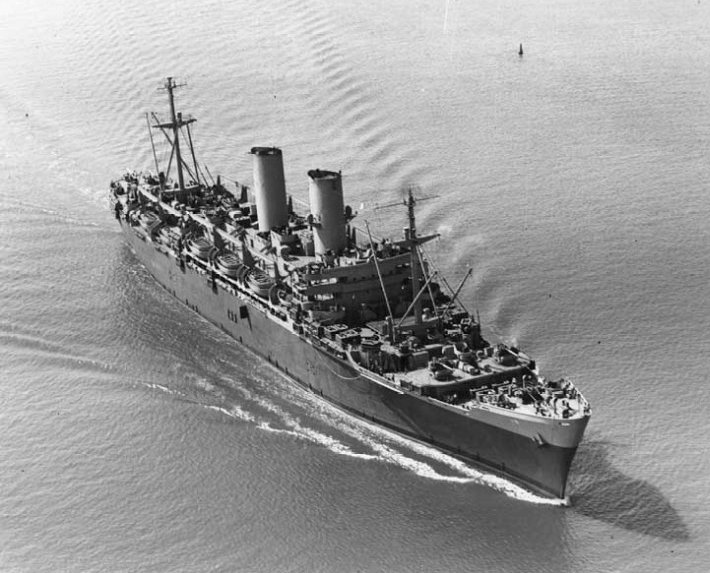
USS General M. C. Meigs
The last voyage of the USS General M. C. Meigs was supposed to be uneventful. In 1972, the retired troop transport was under tow to a layup facility in Suisun Bay, California, when a storm snapped her towline off the Washington coast. Without power or crew to save her, the ship drifted onto the rocks and grounded. Over the next four years she broke apart, leaking 440,000 liters of heavy fuel oil into the Pacific. It was an ugly end for a vessel that had spent three decades hauling soldiers across the world's oceans -- from the beaches of Italy to the ports of Korea, through some of the most consequential troop movements of the twentieth century.
Built for Speed and Bodies
General M. C. Meigs was launched on March 13, 1944, from the Federal Shipbuilding and Drydock Company in Kearny, New Jersey, under a Maritime Commission wartime contract. She was a General John Pope-class transport, designation AP-116, designed for one purpose: moving troops fast. Capable of twenty-one knots with 5,200 soldiers packed aboard, she was commissioned at Bayonne, New Jersey, on June 3, 1944, crewed by United States Coast Guard personnel rather than Navy sailors. Her namesake was Montgomery C. Meigs, the Quartermaster General who had kept the Union Army supplied during the Civil War -- an apt patron for a ship whose entire career would be defined by logistics rather than combat.
Brazil to the Front
After two round-trip voyages carrying troops between Newport News, Virginia, and Naples, Italy, General Meigs received an unusual assignment. She sailed to Rio de Janeiro, where Brazilian President Getulio Vargas came aboard to inspect the ship. She then embarked 5,200 troops of the Brazilian Expeditionary Force -- the first Brazilian soldiers to be carried by an American transport to the European theater. She delivered them to Italy, where they joined the Allied campaign pushing north through the peninsula. On the return leg from Naples, she carried a mixed cargo that illustrated the war's human complexity: American troops, civilians, and 460 German prisoners of war, with additional stops at Bizerte, Tunisia, and Oran in French Algeria to collect more homebound soldiers.
Nineteen Cruises to Korea
Decommissioned in San Francisco in 1946 and briefly operated as a civilian passenger ship by American President Lines, General Meigs was recalled when war broke out in Korea in 1950. Assigned to the Military Sea Transportation Service and crewed by civilians rather than military personnel, she made nineteen cruises from the West Coast to ports in Japan and South Korea. Each crossing carried thousands of American soldiers toward the fighting or rotated weary troops home. After the armistice of July 27, 1953, she continued support cruises through 1954, maintaining the American military presence that the uncertain peace demanded. For her Korean War service, General Meigs received six service stars.
Oil on the Rocks
By 1955, General Meigs was placed in Reduced Operational Status. In 1958, she was transferred to the Maritime Administration and mothballed in the National Defense Reserve Fleet at Olympia, Washington -- one of hundreds of aging vessels kept in reserve against a future need that never came. Fourteen years she sat there, her hull deteriorating, her fuel tanks still heavy with oil that no one had bothered to pump out. The 1972 tow south to Suisun Bay was meant to consolidate the reserve fleet. Instead, it became an environmental disaster. When the towline parted in the storm, the ship was helpless. She grounded on the Washington coast and began to break apart. The 440,000 liters of heavy oil that leaked from her ruptured tanks contaminated shoreline and marine habitat for years. Interagency investigations documented the persistent pollution. The ship that had carried Brazilian soldiers to their first foreign war and American GIs to Korea left its final mark not as a monument but as a cautionary tale about what happens when nations forget about the ships they no longer need.
From the Air
The wreck site of USS General M. C. Meigs is located at approximately 48.29°N, 124.69°W, along the rugged Pacific coast of the Olympic Peninsula near Neah Bay on the Makah Reservation. From altitude, the coastline here is rocky and exposed, with the wreck site now largely dispersed after decades of wave action. The nearest community is Neah Bay, visible as a small harbor settlement along the Strait of Juan de Fuca. Nearest airports: William R. Fairchild International (KCLM) in Port Angeles, approximately 65 nm east; Quillayute Airport (KUIL) near Forks, approximately 45 nm south. The area experiences frequent overcast conditions, strong winds, and rough seas, especially from autumn through spring.