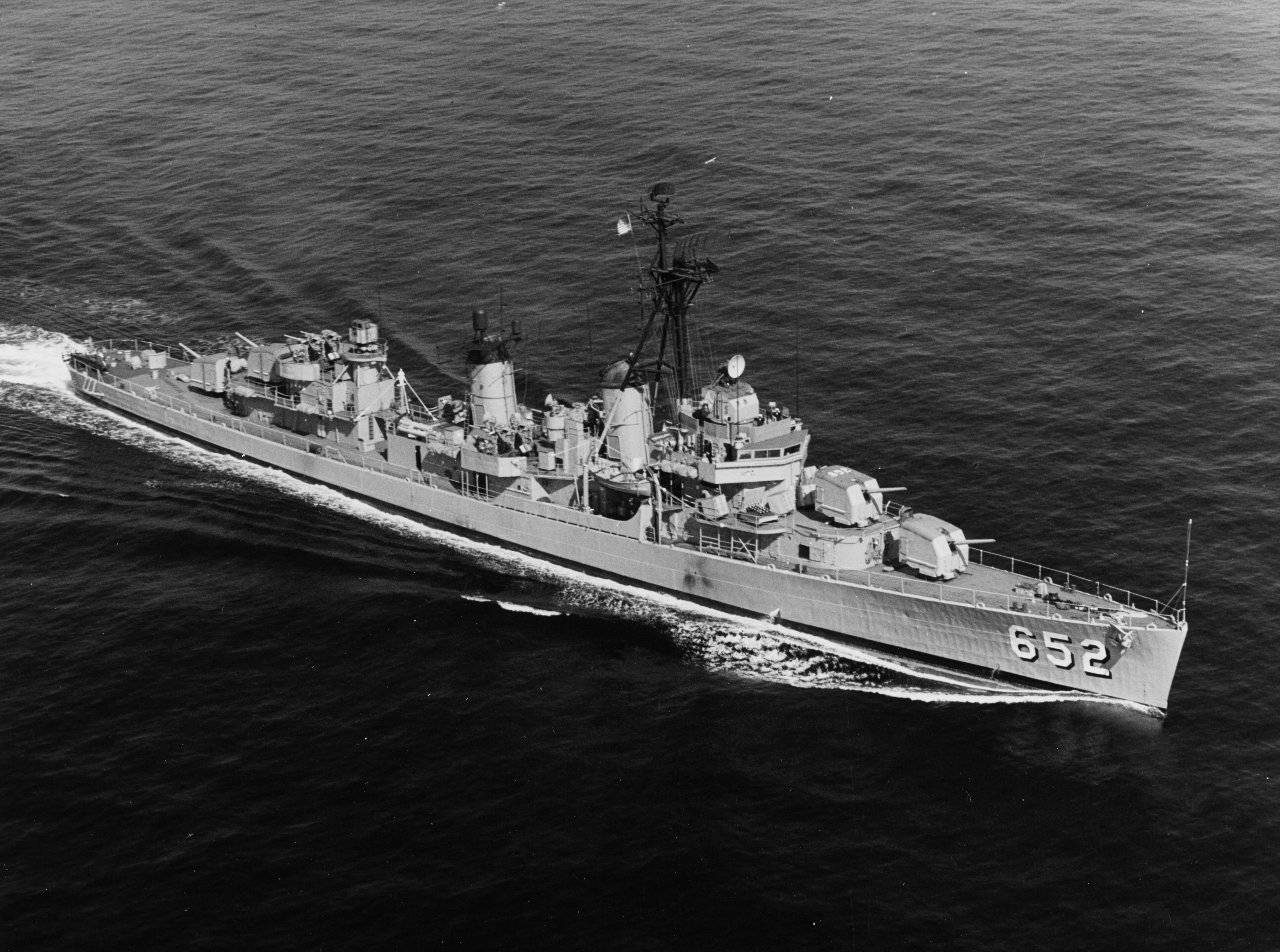
USS Ingersoll (DD-652)
Lieutenant Royal R. Ingersoll II died at the Battle of Midway on June 4, 1942, killed not by Japanese fire but by the guns of a crippled American fighter making an emergency landing on the carrier Hornet. The wounded pilot could not, or failed to, cut off his F4F Wildcat's guns, and the strafing bullets killed Ingersoll and four enlisted men while wounding twenty more. A year later, the Navy launched a destroyer bearing his name and that of his grandfather, Rear Admiral Royal R. Ingersoll. At the commissioning ceremony, the dead lieutenant's widow stood alongside his young daughter to christen the ship.
Three Generations at Sea
USS Ingersoll carried the weight of naval tradition from her first day. Rear Admiral Royal R. Ingersoll had served as Chief of Staff of the Atlantic Fleet in the early twentieth century. His son, Admiral Royal E. Ingersoll, commanded that same fleet during World War II. His grandson, Lieutenant Royal R. Ingersoll II, had graduated from the Naval Academy in 1934, served on a battleship and destroyer, and reported aboard the carrier Hornet during its fitting-out period in 1941. He was there for the Doolittle Raid on Tokyo in April 1942. Two months later, he was dead. When Ingersoll embarked on a fleet review on November 10, 1943, Admiral Royal E. Ingersoll came aboard, standing on a ship named for both his father and his son.
Island Hopping
Ingersoll joined Task Force 58 at Pearl Harbor in December 1943, beginning a relentless campaign across the Pacific. She provided fire support for the Marshall Islands invasion, starting with pre-assault bombardment of Kwajalein on January 30, 1944. She screened the fast carriers during their devastating raid on Truk in February, then supported strikes against the Palaus and Hollandia. At Peleliu in September, she delivered pre-invasion bombardment. In October, off Formosa, her guns helped repulse Japanese air attacks while American planes reduced the island's value as a base. At the Battle of Leyte Gulf, Ingersoll joined the pursuit of the fleeing Japanese fleet, firing a long-range torpedo during the stern chase.
Okinawa to Tokyo Bay
The war's final months brought Ingersoll to the waters around Okinawa, serving patrol and picket duty during the bloodiest naval campaign of the Pacific war. On May 24, 1945, she engaged a Japanese suicide boat. The next day, she shot down two aircraft during an air raid. On May 28, she downed two more. When the fighting shifted to the Japanese home islands, Ingersoll joined the bombardment of the iron works at Kamaishi on July 15, 1945, one of the first surface ship operations against the Japanese mainland. After Japan's surrender, she anchored in Tokyo Bay on September 2 for the formal ceremony aboard the battleship Missouri, then assisted with the occupation before returning home. She earned two battle stars for her World War II service.
Cold War Warrior
Decommissioned in 1946, Ingersoll returned to service in 1951 as the Korean War demanded more destroyers. She circled the globe in 1953-54, sailing from Newport to Yokosuka, supporting the Korean armistice, then steaming westward through Singapore and the Suez Canal to return via the Mediterranean. Later deployments took her to the Tachen Islands evacuation in 1955, to Formosa Strait patrols during tensions between Chinese Nationalists and Communists, to Laos in 1960-61 as American involvement in Southeast Asia deepened, and to waters off South Vietnam in 1962. When the Cuban Missile Crisis erupted in October 1962, she sailed with an amphibious group to the Canal Zone in case additional troops were needed.
Vietnam and Beyond
Ingersoll deployed to Vietnam in 1965, conducting Market Time coastal surveillance patrols and firing 24 gunfire missions against 116 targets along the Vietnamese coast. Three missions took her 12 kilometers up the Saigon River. In 1966, she participated in Operation Sea Dragon, engaging North Vietnamese coastal batteries and silencing enemy guns with counter-battery fire. Her final combat deployment came in 1968, interdicting supplies bound from North to South Vietnam. It was the last time her guns fired in anger. Decommissioned in January 1970, Ingersoll received numerous awards for service across three wars. On May 19, 1974, she was sunk as a target in the waters off Southern California, not far from where her namesake's widow had once broken champagne across her bow.
From the Air
USS Ingersoll's wreck site lies at approximately 33.57N, 118.57W, in waters southwest of Los Angeles near San Clemente Island. The nearest airports are Catalina Airport (KAVX) on Santa Catalina Island and San Clemente Island NALF (KNUC). From cruising altitude, these waters appear as open Pacific, part of the naval training ranges where many decommissioned vessels were expended as targets. The wreck itself is not visible from the surface.