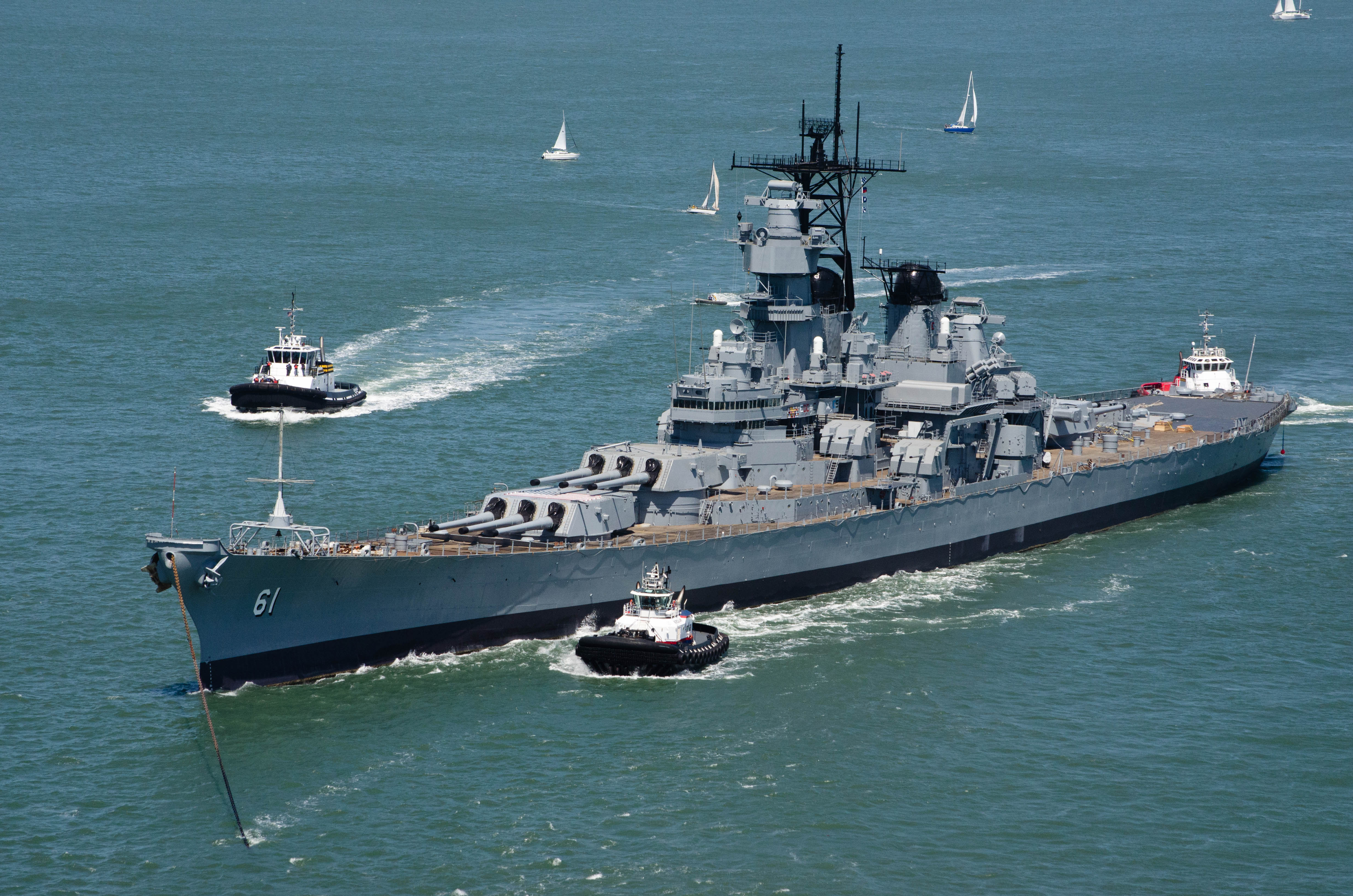
USS Iowa (BB-61)
On November 14, 1943, somewhere in the waters east of Bermuda, a torpedo streaked toward the USS Iowa. President Franklin D. Roosevelt was aboard, bound for Tehran to meet Churchill and Stalin. The destroyer USS William D. Porter, part of Iowa's anti-submarine screen, had accidentally fired a live torpedo during a drill. Iowa's lookouts spotted the incoming weapon; the battleship turned hard, and the torpedo detonated in her wake, 1,200 yards astern. Iowa trained her nine 16-inch guns on the smaller ship, briefly fearing an assassination plot before realizing the truth: the most important naval escort mission of the war had nearly ended in catastrophe through sheer accident. Roosevelt, who required a bathtub installed aboard Iowa because his paralysis prevented him from using showers, completed his journey. The incident was classified for years. Such was life aboard the last lead ship of any class of American battleships.
The President's Bathtub
USS Iowa was commissioned on February 22, 1943, at the New York Naval Shipyard. She was the fourth ship to bear the name Iowa, and she would become the most consequential. Her main battery consisted of nine 16-inch/50 caliber Mark 7 guns capable of hurling armor-piercing shells over twenty miles. But her first major mission required different modifications: a bathtub for a president. In November 1943, Iowa carried Roosevelt, Secretary of State Cordell Hull, Army Chief of Staff George Marshall, and the top military leadership across the Atlantic to Mers El Kebir, Algeria. From there, they traveled to the Tehran Conference, where the Allied leaders planned the invasion of Western Europe. Iowa completed her presidential escort on December 16, 1943, returning Roosevelt safely to American shores.
Pacific Thunder
In January 1944, Iowa transited the Panama Canal for the Pacific Theater. She supported carrier air strikes against Kwajalein and Eniwetok, shelling Japanese positions before Allied amphibious landings. At Truk, the major Japanese naval base in the Caroline Islands, Iowa and her sister ship New Jersey sank the light cruiser Katori as she attempted to escape. During the Battle of Leyte Gulf in October 1944, Iowa was part of Task Force 38 pursuing the Japanese Northern Force off Cape Engano. When word came that Japanese warships were attacking American escort carriers off Samar, Iowa reversed course to assist, but the battle was already won by the time she arrived. On December 18, 1944, a violent typhoon overtook the task force; three destroyers capsized and sank, and Iowa lost a floatplane and damaged a shaft. She survived to fly Admiral William Halsey's flag at the Japanese surrender ceremony in Tokyo Bay on September 2, 1945.
Cold War Warrior
Iowa served in the Korean War, shelling North Korean coastal positions and destroying a major ammunition dump while General Mark Clark observed from her bridge. She was decommissioned in 1958, then reactivated in 1984 as part of the Reagan administration's 600-ship Navy plan. She became a test platform for the RQ-2 Pioneer drone, an unmanned aerial vehicle designed to spot for her guns without risking pilots. In July 1986, President Ronald Reagan and First Lady Nancy Reagan boarded Iowa for the International Naval Review in the Hudson River. She escorted Kuwaiti tankers during the Iran-Iraq War's Tanker War phase, the reflagged vessels bearing American names to satisfy laws prohibiting military escort of foreign civilian ships. Iowa operated in the Baltic Sea, fired her guns at Cape Wrath in Scotland, and visited ports from Norway to Germany to Central America.
Turret Two
At 9:55 AM on April 19, 1989, an explosion ripped through Iowa's Number Two gun turret during a gunnery exercise. Forty-seven sailors died instantly. A gunner's mate in the powder magazine quickly flooded the compartment, likely preventing catastrophic damage to the entire ship. The Navy's initial investigation accused a dead crewman, Clayton Hartwig, of detonating an explosive device in a suicide attempt. The claim relied on questionable evidence and was challenged by Congress. Independent testing at Sandia National Laboratories found that powder from the same lot, originally milled in the 1930s and improperly stored, could achieve spontaneous combustion when over-rammed. Admiral Frank Kelso, the Chief of Naval Operations, publicly apologized to the Hartwig family. The incident changed the Navy's powder-handling procedures, but the damaged turret sealed Iowa's fate.
The Battleship of Presidents
Iowa was decommissioned for the final time on October 26, 1990, after 19 total years of active service. She had earned nine battle stars in World War II and two in Korea. Congress, concerned about losing naval gunfire support capability, required that Iowa be maintained in a state of readiness for potential reactivation. The battleship spent years in the Reserve Fleet at Newport, Rhode Island, and Suisun Bay, California. In 2011, the Pacific Battleship Center won the right to berth Iowa as a museum ship. On June 9, 2012, four tugboats positioned her at Berth 87 in the Port of Los Angeles, directly south of the World Cruise Center. The USS Iowa Museum opened to the public on July 7, 2012. Visitors can now stand where Roosevelt required a bathtub, where Halsey accepted Japan's surrender, and where 47 men died in a turret that remains frozen at the moment of explosion.
From the Air
USS Iowa is berthed at 33.74N, 118.28W at Berth 87, Port of Los Angeles, in San Pedro. The 887-foot battleship is clearly visible from low altitude along the Main Channel, south of the World Cruise Center. Nearest airports include Long Beach (KLGB), Los Angeles International (KLAX), and John Wayne-Orange County (KSNA). Torrance Airport (KTOA) and Zamperini Field are closer general aviation options. The ship's distinctive profile, with its three main gun turrets and superstructure, is unmistakable from the air.