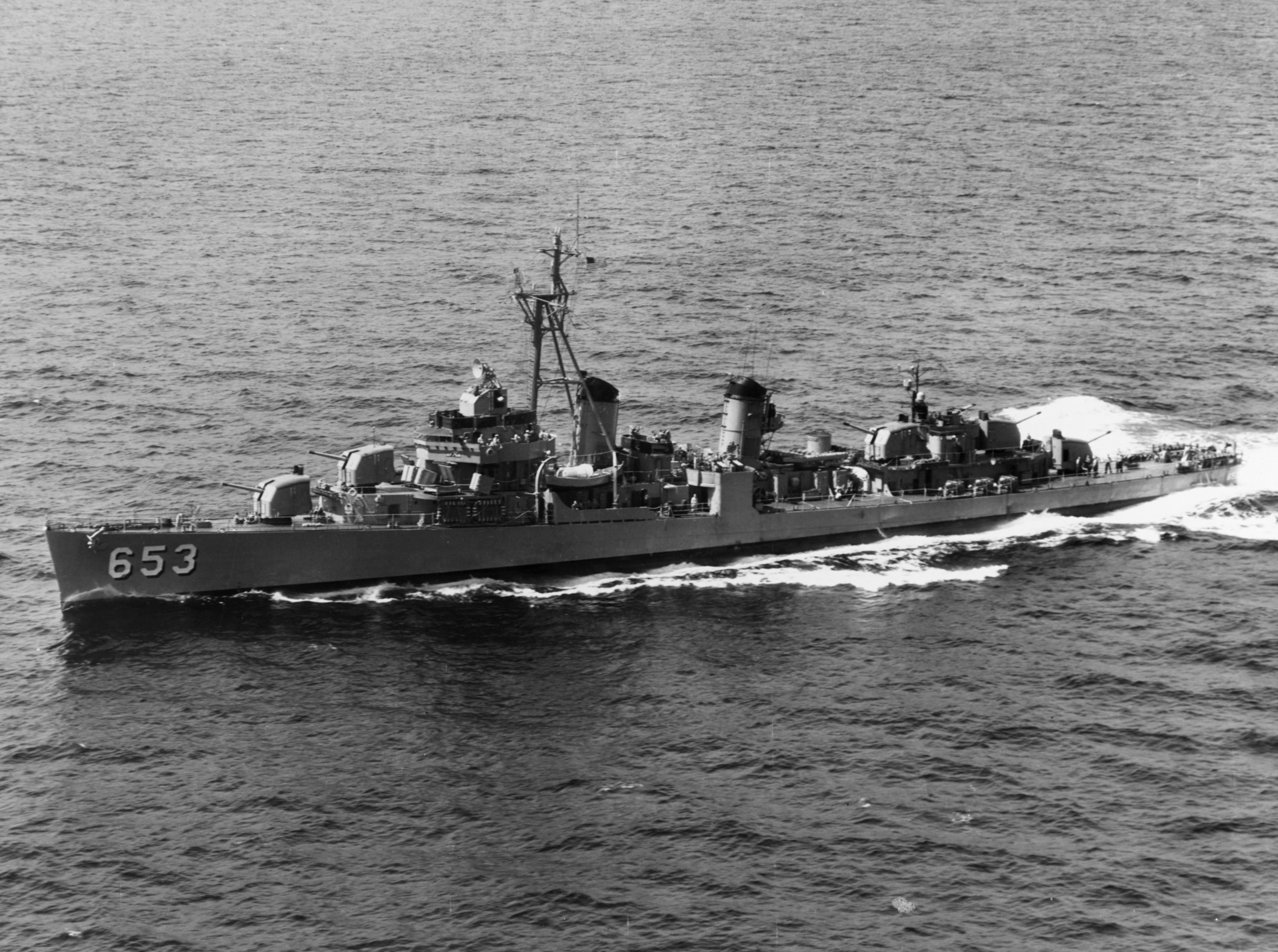
USS Knapp: Eight Stars and a Bridge in Astoria
On September 2, 1945, the USS Knapp sat in Tokyo Bay while the Japanese surrender was signed aboard the USS Missouri. She had earned the right to be there. Over the previous two years, Knapp had screened carriers from the Marshalls to the Philippines, fought through the Battle of the Philippine Sea, guarded crippled ships under kamikaze attack, and served as a radar picket off Okinawa - the most dangerous assignment a destroyer could draw. Eight battle stars testified to her service. Today, the only piece of Knapp that survives is her bridge, displayed at the Columbia River Maritime Museum in Astoria, Oregon, roughly 5,000 miles from the nearest island where she once traded gunfire with the Japanese Navy.
Bath-Built, Pacific-Bound
Knapp's keel was laid at Bath Iron Works in Maine on March 8, 1943. She was a Fletcher-class destroyer - the workhorse of the U.S. Navy's Pacific war, fast enough to screen carriers and heavily armed enough to engage surface targets. Launched on July 10, 1943, and sponsored by Margaret L. and Mary C. Knapp, she was named for Vice Admiral Harry Shepard Knapp, who had served as Military Governor of Santo Domingo. Commissioned on September 16, she completed her shakedown off Bermuda and departed Boston for the Pacific on November 26. By December 21, she was at Pearl Harbor. By mid-January 1944, she was at sea with Admiral Marc Mitscher's Task Force 58, heading for the Marshall Islands. The transition from shipyard to combat took less than five months.
Island by Island
Knapp's war was the Pacific island campaign compressed into a single ship's log. She shelled Kwajalein during the Marshalls invasion in January 1944, screened carrier raids on Truk and the Marianas in February, and covered the seizure of Emirau Island in March. In April, she supported the Hollandia landings in New Guinea. By June, she was guarding carriers during the Battle of the Philippine Sea - the engagement that shattered Japanese naval aviation so thoroughly that American pilots called it the Great Marianas Turkey Shoot. Through the summer, Knapp screened raids on Palau, Ulithi, Yap, Iwo Jima, and Chichi Jima, and her guns helped sink several ships from a Japanese convoy that carrier aircraft had already mauled. The names in her log read like a geography of the Pacific war: each atoll and island another step toward Japan.
Guarding the Wounded
As the war moved to the Philippines, Knapp's role evolved from screening to escort and rescue. During the Formosa air battle in October 1944, she guarded the withdrawal of a cruiser struck by an aerial torpedo. She screened airstrikes on Luzon and was present during the Battle of Surigao Strait, one phase of the massive Battle of Leyte Gulf. In November, after a carrier was damaged by two torpedoes, Knapp guarded her retreat. In January 1945, she escorted yet another carrier crippled by kamikaze attack back to Ulithi. Protecting damaged ships was unglamorous but essential - it meant staying close to a vessel that was listing, on fire, or both, while enemy aircraft still circled. Knapp returned to the West Coast in February for overhaul, then sailed back to the Pacific in April. Off Okinawa, she served as a radar picket - the destroyers stationed farthest from the fleet, first to detect incoming kamikazes and first to absorb their attacks.
Cold War Wanderer
Decommissioned in July 1946, Knapp returned to service in May 1951 when the Korean War demanded more ships. She joined the Atlantic Fleet out of Newport, Rhode Island, and for the next six years lived a destroyer's peacetime life: Caribbean cruises, NATO exercises in European waters, Mediterranean deployments. In 1953, she embarked on a world cruise with Destroyer Division 182 that took her from the Korean coast through Hong Kong, Singapore, Colombo, Aden, the Suez Canal, and across the Mediterranean before arriving in Massachusetts. Later deployments sent her to the Western Pacific, where she patrolled the East China Sea and the Formosa Strait during the tense years of Chinese Nationalist-Communist standoff. Knapp was decommissioned for the last time on March 4, 1957, and assigned to the Pacific Reserve Fleet at Long Beach.
The Bridge That Survived
The ship is gone, scrapped like most of the 175 Fletcher-class destroyers the Navy built during World War II. But Knapp's bridge - the nerve center where her captain directed operations from the Marshalls to Tokyo Bay - was preserved and installed at the Columbia River Maritime Museum in Astoria, Oregon. It sits thousands of miles from the waters where Knapp earned her eight battle stars, in a town better known for salmon fishing and Victorian architecture than for naval warfare. Visitors can stand where a watch officer once scanned the horizon for incoming aircraft, where orders were shouted during surface engagements, where radar contacts were plotted during lonely picket duty off Okinawa. The bridge is a fragment, but it carries the weight of the whole ship's story.
From the Air
Located at 46.19°N, 123.82°W at the Columbia River Maritime Museum in Astoria, Oregon. The Knapp's bridge is an indoor exhibit, not visible from the air, but the museum complex on Astoria's waterfront is identifiable by its location on the south bank of the Columbia River, with the lightship Columbia moored alongside. Nearest airport is Astoria Regional Airport (KAST), approximately 3 miles southeast. The Astoria-Megler Bridge is a prominent landmark crossing the Columbia to Washington. Best viewed at 1,500-3,000 feet AGL for the waterfront museum area. The Columbia River Bar, visible to the west, is one of the most dangerous river entrances in the world - a fitting final station for a warship's surviving fragment.