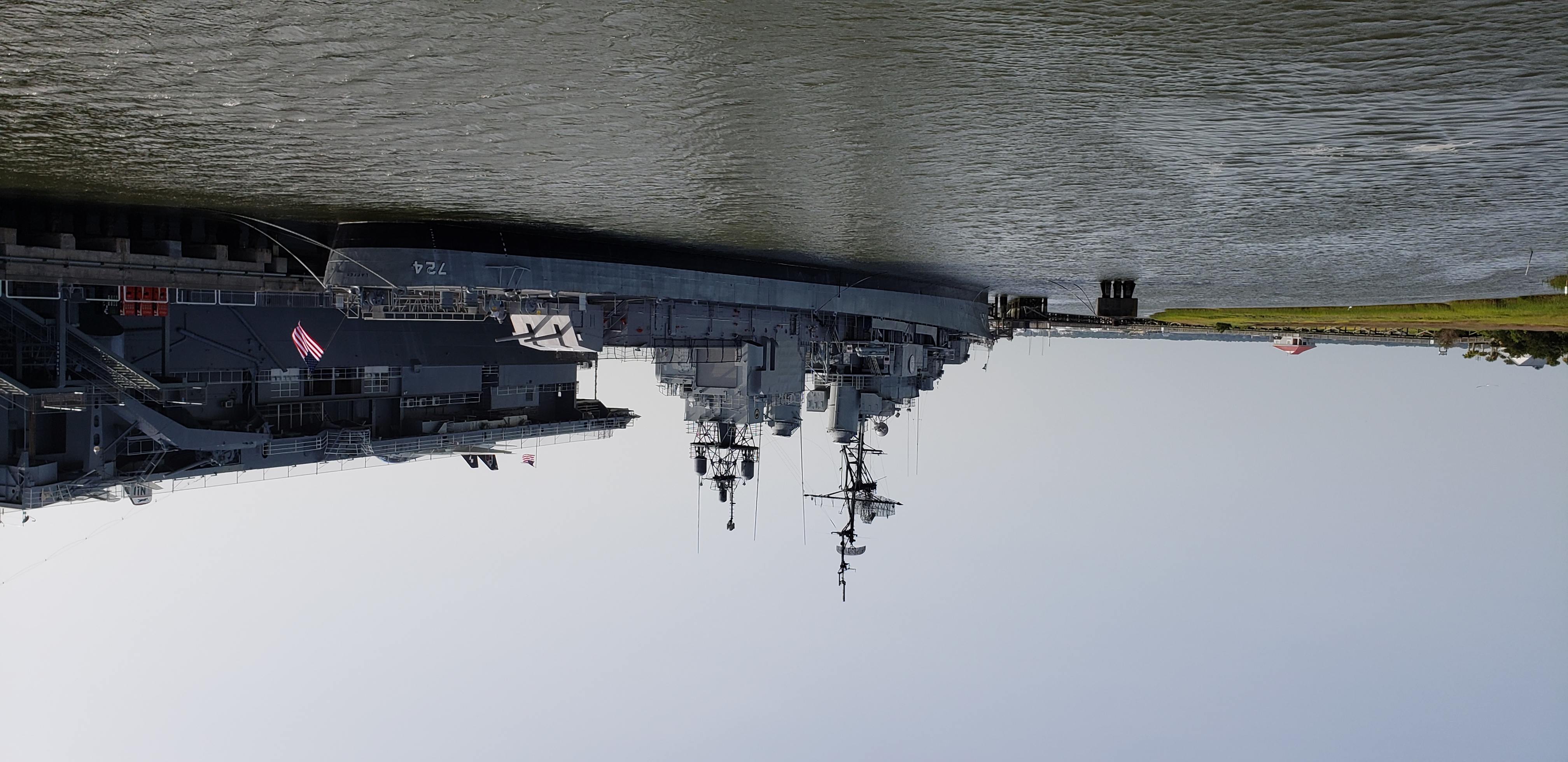
USS Laffey (DD-724)
When Lieutenant Frank Manson asked Captain Frederick Becton if they would have to abandon ship, Becton snapped back: "No! I'll never abandon ship as long as a single gun will fire." A nearby lookout, surveying the carnage on the destroyer's shattered deck, quietly added: "And if I can find one man to fire it." It was April 16, 1945, and USS Laffey was enduring the most sustained kamikaze attack any single warship would face during the entire Pacific War. By the time it was over, the destroyer had been struck by six suicide planes and four bombs, her rudder was jammed, her aft gun turret was a burning wreck, and thirty-two of her crew were dead. She was still afloat.
Named for a Medal of Honor
USS Laffey was the second Navy ship named for Seaman Bartlett Laffey, an Irish immigrant who earned the Medal of Honor for his actions during the Civil War. Built at Bath Iron Works in Maine, she was laid down in June 1943, launched in November, and commissioned on February 8, 1944, under the command of Commander Frederick Becton. She was an Allen M. Sumner-class destroyer - 376 feet long, armed with six 5-inch guns, twelve 40mm anti-aircraft guns, and eleven 20mm guns. Her first test came not in the Pacific but off the coast of France. On D-Day, June 6, 1944, Laffey escorted landing craft to Utah Beach and screened the invasion fleet. On June 12, she broke up a formation of German E-boats that had torpedoed a fellow destroyer. On June 25, she joined the bombardment of Cherbourg, taking a hit from a ricocheting shell that failed to explode. By July, she was heading home for overhaul, bound for the Pacific and a rendezvous with a far deadlier enemy.
Eighty Minutes at Radar Picket Station One
On April 16, 1945, Laffey was stationed at radar picket station one, roughly thirty miles north of Okinawa. Her job was to detect incoming Japanese air attacks and provide early warning to the fleet. At 8:30 a.m., a lone Aichi D3A dive bomber appeared, jettisoned its bomb under fire, and fled. Then the sky filled with aircraft. Approximately fifty Japanese planes descended on the destroyer in waves. Four D3As dove simultaneously from different directions. Laffey's gunners knocked down two, then a third. Then the hits started coming. At 8:42, a D3A made a glancing blow against the deck, spraying burning aviation fuel. Three minutes later, another crashed directly into a 40mm gun mount, killing three men and setting the magazine on fire. Seconds after that, a dive bomber smashed into the aft 5-inch gun mount, detonating the powder magazine and destroying the turret entirely. Another bomb jammed the rudder twenty-six degrees to port. The ship could no longer steer.
Wildcats and Corsairs
While Laffey fought for survival, help arrived from above. Four FM-2 Wildcats from the escort carrier Shamrock Bay dove into the kamikaze formations. Pilot Carl Rieman destroyed three enemy aircraft in rapid succession - a D3A, a B5N torpedo bomber, and then another B5N, expending all his ammunition in seconds. Out of rounds, Rieman continued making diving passes at incoming kamikazes, using his aircraft as a bluff to force them off their attack runs. When twelve Marine Corps F4U Corsairs arrived, they tore into the remaining attackers. One Corsair pilot chased a kamikaze so close to the Laffey that he clipped the ship's radar antenna and crashed into the water alongside; the pilot was later rescued. By the time the attack ended, Laffey's crew and their air support had destroyed or driven off all fifty aircraft. The tally was staggering: six kamikaze crashes, four bomb hits, and continuous strafing fire across eighty minutes. Thirty-two sailors were dead and seventy-one wounded.
Three Wars and an Atomic Test
Laffey was towed off the picket station, patched up at Okinawa, and limped across the Pacific to the Todd Shipyards in Tacoma, Washington for full repairs. Her war was over, but her service was not. In 1946, she participated in Operation Crossroads, the atomic bomb tests at Bikini Atoll, collecting scientific data close enough to the blasts to require complete decontamination - sandblasting of all underwater surfaces, acid washing, and replacement of contaminated piping. Decommissioned in 1947, she was recalled for the Korean War in 1951, screening carriers and participating in the blockade of Wonsan. During the Cold War, she deployed to the Mediterranean during the Suez Crisis, conducted NATO exercises off Scotland, transited the Suez Canal to the Persian Gulf, and made surveillance runs monitoring Soviet naval forces in the Mediterranean. She was the last Allen M. Sumner-class destroyer to be decommissioned when she was finally stricken on March 9, 1975.
The Ship That Would Not Die
In 1986, Laffey was declared a National Historic Landmark - recognized as the only remaining U.S.-owned Sumner-class destroyer and for the sheer tenacity of her survival off Okinawa. She was berthed at Patriots Point in Mount Pleasant, South Carolina, alongside the aircraft carrier USS Yorktown. In 2008, the old destroyer nearly faced an enemy she could not fight: over one hundred leaks were discovered in her hull, and officials feared she would sink at her mooring. She was towed to Detyens Shipyards in 2009, where her corroded hull was repaired with thicker plating and miles of welding. When Laffey returned to Patriots Point in January 2012, more than a dozen former crew members were in the crowd to greet her. The repair bill was $1.1 million - a modest price for a ship that earned the Presidential Unit Citation, five battle stars for World War II, two battle stars for Korea, and the name that history gave her: The Ship That Would Not Die.
From the Air
Located at 32.79N, 79.91W at Patriots Point Naval and Maritime Museum in Mount Pleasant, South Carolina, on the east side of Charleston Harbor. From the air, Laffey is berthed alongside the much larger aircraft carrier USS Yorktown (CV-10), making the pair easy to spot on the waterfront. The Cooper River Bridge (Arthur Ravenel Jr. Bridge) spans the harbor just to the south. The Charleston peninsula with its church steeples lies across the harbor to the west. Charleston Executive Airport (JZI) is approximately 6 miles to the southwest; Charleston International Airport (KCHS) is 8 miles to the northwest. Best viewed at 1,000-2,000 feet to distinguish the destroyer from the carrier alongside.