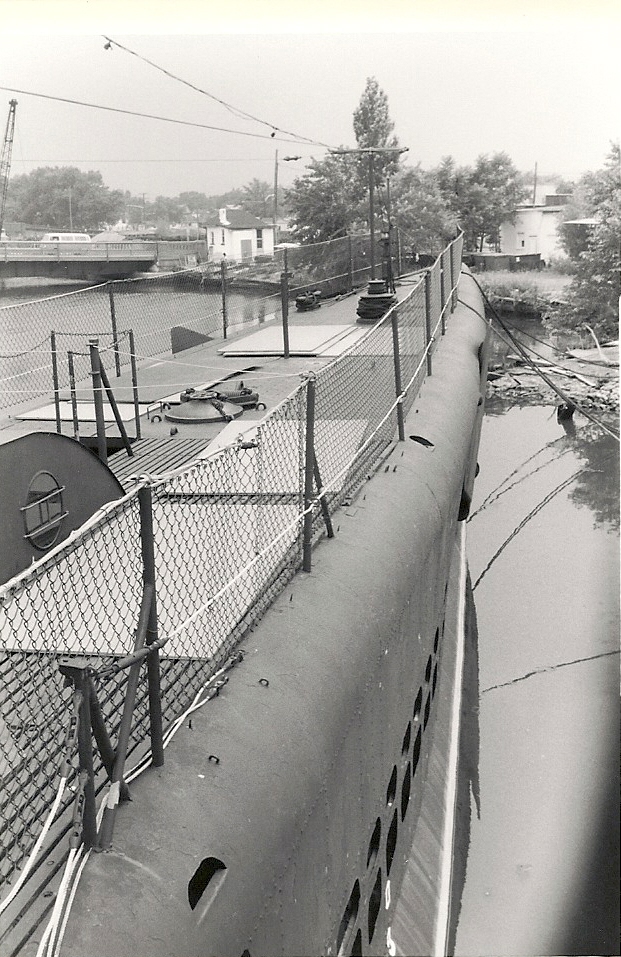
USS Ling
She was built to fight a war that ended before she could reach it. USS Ling (SS-297), a Balao-class submarine, was laid down on November 2, 1942, at the Cramp Shipbuilding Company in Philadelphia and launched on August 15, 1943. But two years and seven months passed between keel-laying and commissioning on June 8, 1945 -- an unusually long gestation for a wartime submarine -- and by the time Ling headed out to sea for equipment trials on September 15, 1945, Japan had formally surrendered thirteen days earlier. She spent sixteen months in commission, sailed to the Panama Canal Zone and back, then was decommissioned at New London on October 26, 1946. Her active career was over before it began. What happened next, over the course of eighty years, turned out to be a stranger story than any combat patrol could have written.
A Submarine Without a War
Ling's brief active service earned her two decorations -- the American Campaign Medal and the World War II Victory Medal -- but no battle stars. After decommissioning, she entered the Atlantic Reserve Fleet, one of hundreds of warships mothballed against the possibility of future need. In March 1960, she was towed to the Brooklyn Navy Yard and converted into a training ship, simulating submarine operations for a new generation of sailors. She was reclassified as an Auxiliary Submarine (AGSS-297) in 1962, then reclassified again as a Miscellaneous Unclassified Submarine (IXSS-297) before being struck from the Naval Register on December 1, 1971. The Navy had no further use for her. The scrap yard beckoned.
Seventy-Eight River Street
Six months after being stricken, Ling was saved by the Submarine Memorial Association, a nonprofit formed in 1972 with the explicit purpose of rescuing her from the cutter's torch. They petitioned the Navy to bring the boat to Hackensack, New Jersey, "to perpetuate the memory of our shipmates who gave their lives in the pursuit of their duties while serving their country." She arrived in January 1973 and was restored to near-mint condition -- compartments refurbished, authentic World War II gear installed, hull scrubbed and painted. At the New Jersey Naval Museum on River Street, visitors could climb through her hatches and imagine life inside a steel tube 312 feet long. In 2006, an eight-time world champion locksmith named Jeff Sitar cracked the submarine's five safes using only his fingers and a sound amplifier. Inside he found a dozen pennies, two .45-caliber bullets, a ring of keys, maintenance manuals from the 1940s and 1950s, and two quart cans of 190-proof ethanol.
Storm, Vandals, and Silt
The museum paid one dollar per year for its riverside site. In 2007, the landowner announced the property would be sold for redevelopment. Then Hurricane Sandy struck in 2012, damaging the museum and forcing it to close. It reopened, closed again for emergency repairs in 2015, and expected to vacate by August 2018. That same month, vandals cut locks on Ling's interior doors and opened hatches, flooding the submarine with up to fourteen feet of water. Memorial plaques were stolen from a shoreside monument. Volunteers pumped out the water and used compressed air to refill her ballast tanks, refloating the boat. Plans to relocate Ling to Louisville, Kentucky, fell through amid allegations of financial mismanagement and a serious injury to a volunteer aboard the vessel.
Trapped in the Hackensack
Here is the cruelest twist: Ling cannot leave. The Oradell Dam has reduced freshwater flow in the Hackensack River, and the navigable channel has been maintained only as far north as the Riverbend in Hudson County. Silt -- laced with industrial toxins -- has filled in the formerly navigable waterway. The river is now too shallow for the submarine to move downstream, and there are no funds or plans to dredge it. Four bridges south of her position do not open or move: two vehicular, two rail (operated by New Jersey Transit and Amtrak). Even if the river were deep enough, the bridges would block her. So she sits in Hackensack, inaccessible to the public since 2016, a warship that missed its war now marooned in a river that has forgotten it was ever navigable. Volunteers remain committed to her preservation. No one has agreed to let her be scrapped. Her final chapter has not been written.
From the Air
Located at 40.880N, 74.041W on the Hackensack River in Hackensack, New Jersey. The submarine is visible from the air as a long dark shape in the river, just north of several bridges. Nearby airports include KTEB (Teterboro, 3 nm south) and KCDW (Essex County, 12 nm west). Best viewed at 1,000-2,000 ft AGL. Look for the narrow Hackensack River winding through the suburban grid of Bergen County, with the Manhattan skyline visible to the southeast.