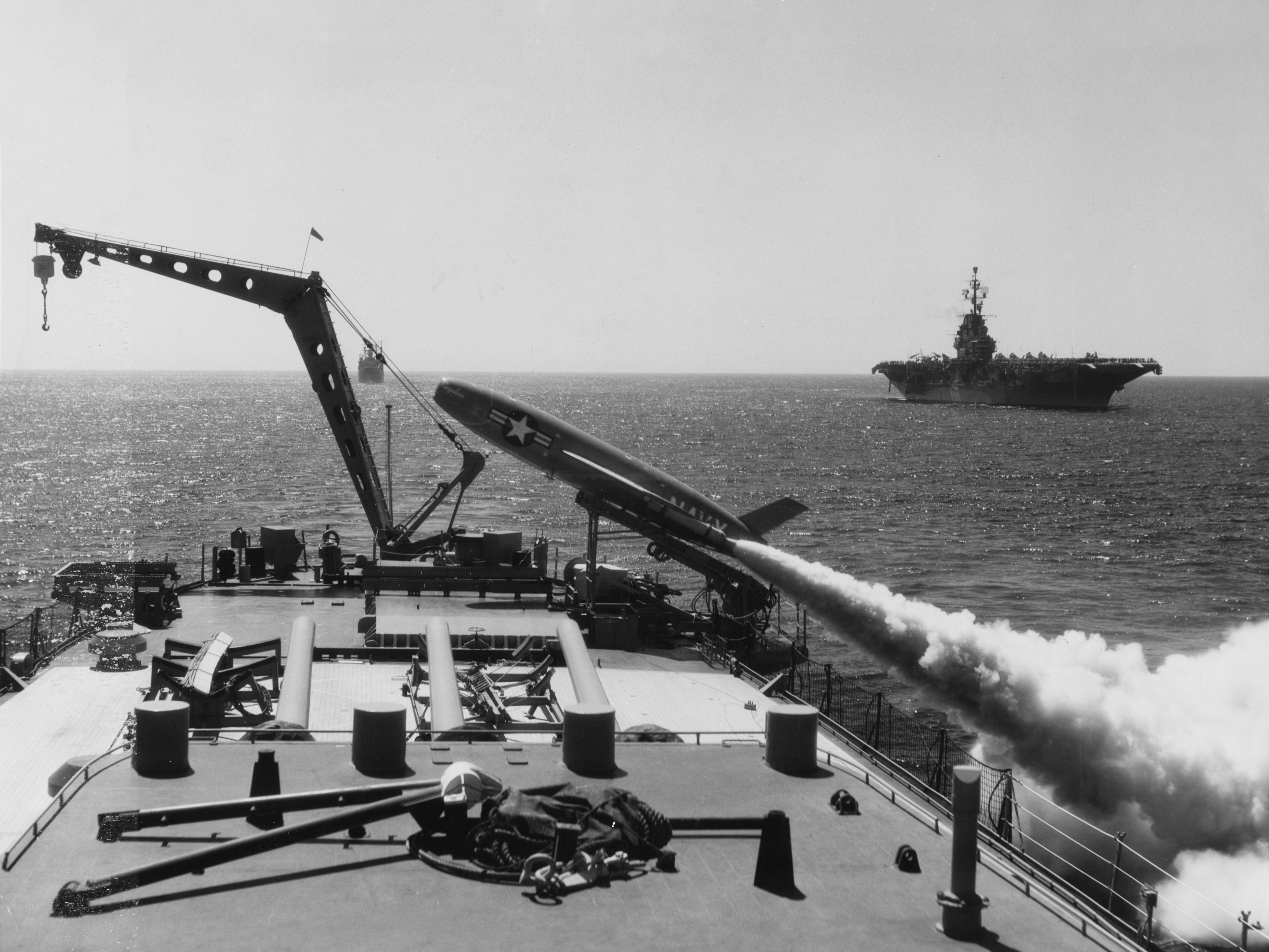
USS Los Angeles (CA-135)
On a spring day in 1951, Rear Admiral Arleigh Burke stood on the bridge of his new flagship as it steamed toward the Korean coast. The USS Los Angeles, a Baltimore-class heavy cruiser, would spend the next six months pounding enemy positions from Hungnam to Haeju, her eight-inch guns speaking with authority across the peninsula's contested shores. This was no ordinary warship. The third vessel to carry the name of California's largest city, she would earn five battle stars in Korea and later patrol the Taiwan Strait during the Cold War's tensest moments.
From Philadelphia to the Pacific
The Los Angeles took shape at the Philadelphia Navy Yard, her keel laid on July 28, 1943, as World War II raged. Launched on August 20, 1944, she was sponsored by Mrs. Fletcher Bowron, wife of the Los Angeles mayor. By the time she was commissioned on July 22, 1945, under Captain John A. Snackenberg, the war in Europe had ended and Japan's surrender was weeks away. After shakedown in Guantanamo Bay, she sailed west, reaching Shanghai on January 3, 1946, to begin what would become eighteen years of Pacific service.
Burke's Flagship
When North Korea invaded the South in 1950, the Los Angeles sat in mothballs at Hunters Point. By January 1951, she was back in commission and headed for war. As flagship of Cruiser Division 5 under the legendary Arleigh Burke, she ranged the entire Korean coastline, her guns providing crucial fire support for ground troops. In October 1952, she participated in a concentrated shelling of enemy bunkers at Koji-ni. During the bombardment of Wonsan in spring 1953, North Korean shore batteries scored minor hits on the cruiser, but she continued operations until sailing home that April.
Cold War Sentinel
Between November 1953 and June 1963, the Los Angeles made eight more Western Pacific deployments. When Communist China threatened the islands of Quemoy and Matsu in 1956, she patrolled the Taiwan Strait to deter invasion. Her operations took her from the Sea of Japan to the South China Sea, touching ports in Japan, the Philippines, Okinawa, Hong Kong, Australia, and Taiwan. For a decade, she served as a visible symbol of American commitment to allies across the Pacific.
Final Days and Living Memory
The Navy considered converting the Los Angeles into a Talos missile cruiser, but funding never materialized. She was decommissioned at Long Beach on November 15, 1963, and struck from the register on January 1, 1974. In May 1975, the National Steel Corporation purchased her for $1,864,380.21 and began scrapping in San Pedro. But the old cruiser did not disappear entirely. Her flying bridge and a section of her bow survive today at the Los Angeles Maritime Museum in San Pedro, where they stand as monuments to a ship that earned its battle stars.
From the Air
Located at 33.74N, 118.28W in San Pedro, Los Angeles. The Los Angeles Maritime Museum sits along the waterfront. Best viewed at 2,000-3,000 feet AGL. Nearby airports include Long Beach (KLGB) and Los Angeles International (KLAX). The Port of Los Angeles and Vincent Thomas Bridge provide visual references.