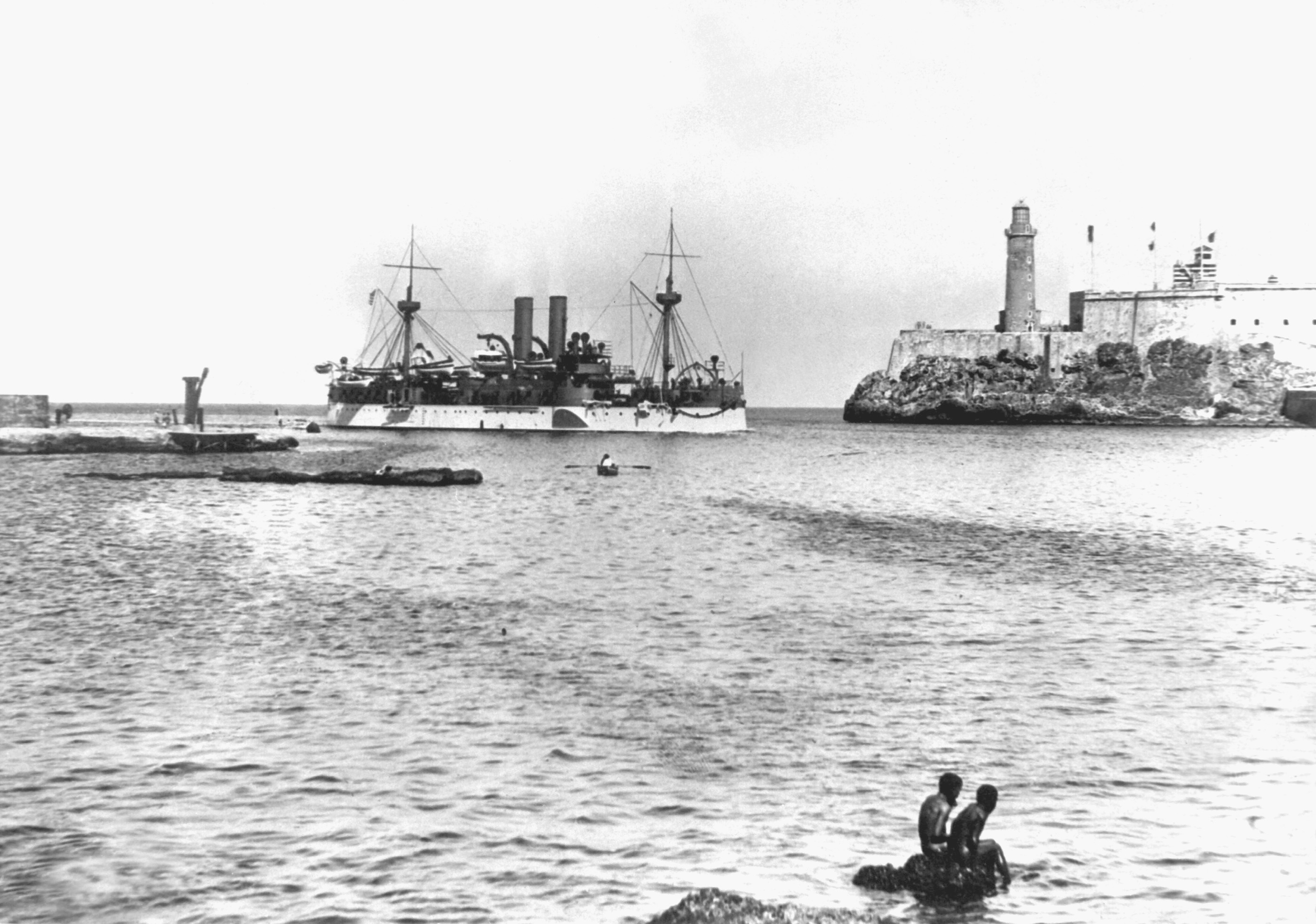
USS Maine (1890)
At 9:40 on the evening of February 15, 1898, most of the 355 men aboard USS Maine were asleep in their forward berths. The explosion, when it came, detonated the ship's powder magazines and obliterated the entire forward third of the hull. The remaining wreckage settled to the bottom of Havana Harbor within minutes. Of the crew, 261 died -- killed instantly by the blast, drowned in the flooding compartments, or succumbing to injuries in the days that followed. Captain Charles Sigsbee survived only because the officers' quarters were in the stern. The cause of the explosion has been debated for more than a century, but what happened next was immediate and irreversible: "Remember the Maine! To hell with Spain!" became the rallying cry that helped drive the United States into the Spanish-American War.
Nine Years in the Making
Maine was already obsolete before she ever left port. Congress authorized her construction on August 3, 1886, and her keel was laid at the Brooklyn Navy Yard on October 17, 1888 -- making her the largest vessel built in a U.S. Navy yard at that time. But naval technology was advancing faster than American shipyards could build, and the nine-year gap between authorization and completion rendered her outdated. Her main armament of four 10-inch guns was mounted in twin turrets staggered en echelon -- the fore turret sponsoned to starboard, the aft turret to port -- an arrangement that proved problematic. Both turrets pointed the same direction caused the ship to heel, and cross-deck firing damaged her own superstructure. Her nickel-steel armor, cutting-edge when specified, was outclassed by the Harvey and Krupp steel appearing by 1893. Her coal capacity was so low it limited her time at sea, and her overhanging turrets made coaling at sea nearly impossible except in dead calm. She was launched on November 18, 1890, sponsored by Alice Tracy Wilmerding, granddaughter of Navy Secretary Benjamin F. Tracy.
The Explosion That Changed Everything
Maine had been sent to Havana in January 1898, officially as a friendly visit but actually to protect American interests during Cuba's war for independence from Spain. On that February night, the forward magazines -- containing powder charges for the six-inch and ten-inch guns -- detonated with catastrophic force. The 94 survivors included only 16 who were uninjured. The American merchant steamship City of Washington helped rescue crewmembers from the dark harbor waters. The cause was immediately contested. Commander Francis W. Dickins woke President McKinley calling it an "accident." Commodore George Dewey initially feared Spanish responsibility, which "of course meant war." Navy Captain Philip R. Alger, an ordnance and explosives expert, posted a bulletin the next day attributing the blast to spontaneous combustion in the coal bunkers. But measured analysis never had a chance against the fury already building in the American press.
"Nobody Outside a Lunatic Asylum"
William Randolph Hearst's New York Journal and Joseph Pulitzer's New York World weaponized the tragedy. For a week after the sinking, the Journal devoted an average of eight and a half pages daily to the event, dispatching a full team of reporters and artists to Havana -- including the painter Frederic Remington. Hearst posted a $50,000 reward for the conviction of those responsible. The World insisted Maine had been bombed or mined and demanded Cuban independence as Spain's only acceptable "atonement." Privately, Pulitzer admitted that "nobody outside a lunatic asylum" believed Spain had sanctioned the destruction. It did not matter. The coverage whipped an already agitated American public into hysteria. Hearst quoted unnamed officers declaring an internal accident "preposterous." The Sampson Board, the U.S. Navy's official inquiry, concluded that a mine had destroyed the ship -- a finding later contradicted by Admiral Hyman Rickover's 1974 private investigation, which pointed to spontaneous combustion of volatile bituminous coal in a bunker adjacent to the ammunition magazines. A 1998 National Geographic study using computer modeling found the evidence inconclusive either way.
War, Wreck, and Memory
The Spanish-American War began on April 21, 1898, two months after the sinking. The McKinley administration never cited the explosion as a formal cause for war, but the atmosphere it created made peaceful resolution impossible. Maine's wreck sat in Havana Harbor for years, taking up valuable space and threatening to create a navigational hazard as silt built up around the hull. In 1910, Congress authorized removal. The Army Corps of Engineers built a cofferdam around the wreck and pumped it dry, revealing the full extent of the devastation: everything forward of frame 41 was a twisted mass of unrecognizable steel. The remains of 66 additional men were found, of whom only one -- engineering officer Harry J. Keys -- could be identified. In total, 229 Maine crew are buried at Arlington National Cemetery. The salvaged after-section was towed out to sea on March 16, 1912, and deliberately sunk in 600 fathoms of water with an American flag flying from a jury mast and flowers covering the deck.
Scattered Relics
Maine's physical remains are dispersed across the country and beyond. Her main mast stands at Arlington as part of the USS Maine Mast Memorial, dedicated by President-elect Woodrow Wilson in 1915. In Havana, the Cuban government erected a memorial on the Malecon in 1926 featuring two of the ship's 10-inch guns -- a monument damaged during post-Bay of Pigs unrest in 1961 and restored in 2013. Columbus Circle in New York City holds a grand memorial topped by the gilded sculpture Columbia Triumphant. Six-inch guns from Maine stand in Portland, Maine; Alpena, Michigan; and the National Museum of the United States Navy in Washington, D.C. Shells, portholes, torpedo tube hatches, and fragments of the hull are scattered from Reading, Pennsylvania, to Oakland, California. The ship's conning tower base rests in Canton, Ohio -- hometown of President McKinley, whose administration she pushed toward war. Each fragment carries the same unanswered question: what actually happened at 9:40 on the night of February 15, 1898?
From the Air
The site where USS Maine sank is in Havana Harbor at approximately 23.14N, 82.33W, on the southern side of the harbor near the main anchorage. The narrow harbor entrance between Morro Castle and La Punta fortress is the key landmark. The wreck was removed in 1911-1912, so nothing remains on the harbor floor. Best viewed from 2,000-4,000 feet AGL. The Malecon memorial with the ship's 10-inch guns is on the north shore of Havana near the Hotel Nacional. Jose Marti International (MUHA) is approximately 10 nm southwest.