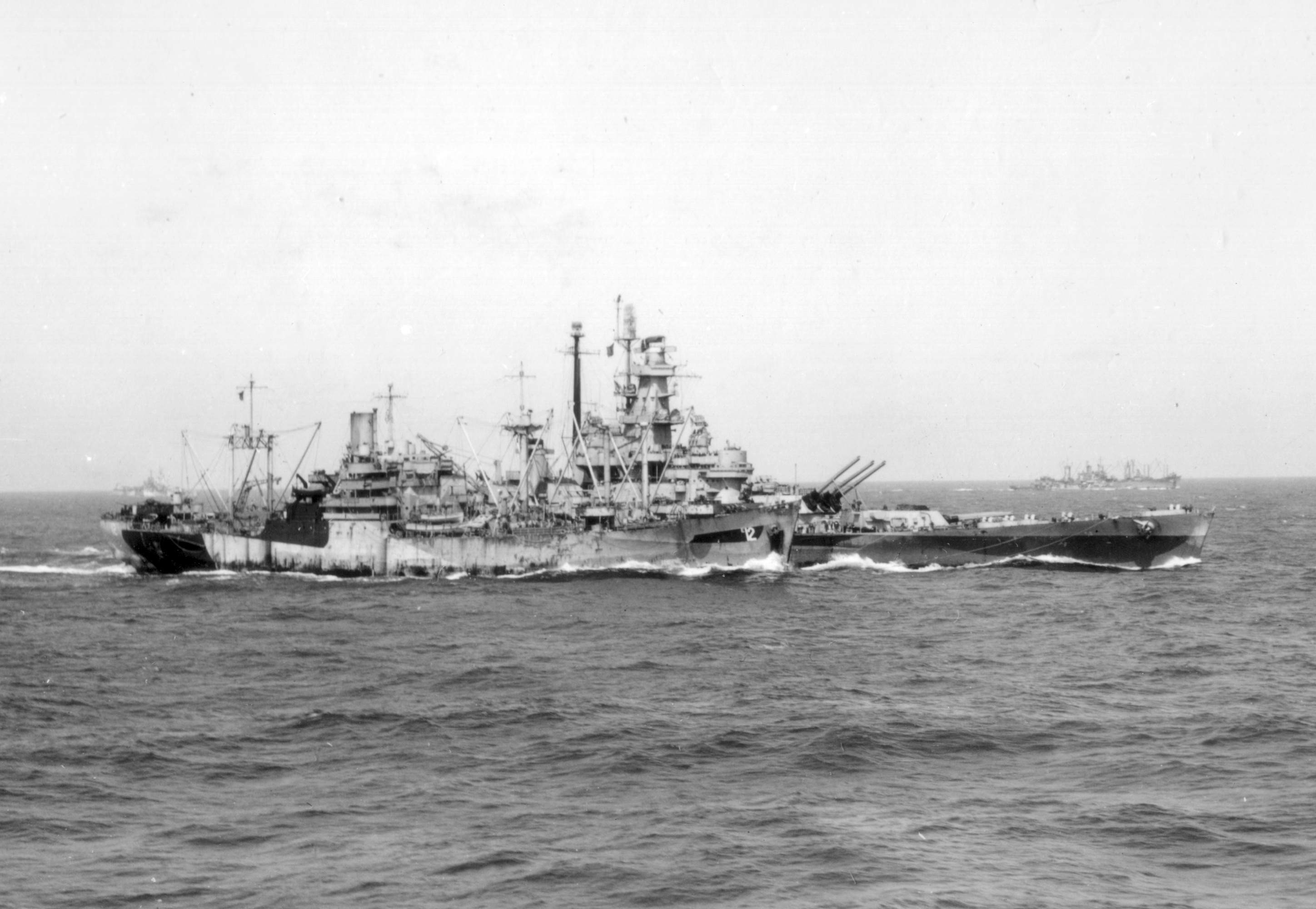
USS Massachusetts (BB-59)
She fired America's first naval shots of the Atlantic war and among the last against the Japanese Home Islands. Between those bookend salvos, USS Massachusetts (BB-59) steamed more than 225,000 miles, fought from North Africa to the Philippines, and survived typhoons, kamikaze attacks, and one of the most controversial naval decisions of World War II. Today she sits in the Taunton River at Fall River, Massachusetts, her nine 16-inch guns silent but still trained outward, a 35,000-ton monument to the war that defined a century. The children of Massachusetts helped buy her from the Navy. She has been waiting for visitors ever since.
Baptism at Casablanca
Commissioned on May 12, 1942, at Bethlehem Steel's Fore River Shipyard in Quincy, Massachusetts raced through sea trials and into her first combat assignment: Operation Torch, the Allied invasion of French North Africa. On the morning of November 8, 1942, she opened fire at 07:04 on the incomplete French battleship Jean Bart, which lay at anchor in Casablanca harbor with only half its main battery operational. Jean Bart fired back. For the next several hours, Massachusetts pounded the French ship, scoring five hits that disabled its only working turret. She then shifted fire to coastal batteries, an ammunition dump, and merchant shipping. One of her 16-inch shells struck a floating dry dock holding the submarine Le Conquerant, sinking the dock. By November 11, the French defenders had agreed to a cease-fire. Massachusetts headed home to prepare for a very different ocean.
Shield of the Fast Carriers
Massachusetts reached the Pacific in March 1943 and spent most of the war doing a job that sounds routine but was anything but: escorting the fast carrier task force. Her role was to screen aircraft carriers from surface ships and throw up walls of anti-aircraft fire against Japanese air attacks. This took her through the Gilbert and Marshall Islands campaign, where she bombarded Kwajalein alongside the battleships Washington, North Carolina, and her sister ship Indiana. She participated in Operation Hailstone, the devastating carrier raid on Truk, and supported landings at Hollandia in New Guinea. Her anti-aircraft battery grew steadily through the war, eventually bristling with seventy-two 40mm barrels and dozens of 20mm guns. Her peacetime crew of 1,793 swelled to 2,500 as the guns multiplied.
The Battle That Almost Was
During the Battle of Leyte Gulf in October 1944, Massachusetts came within hours of a decisive surface engagement that never materialized. When Admiral Kurita's Center Force was detected in the San Bernardino Strait, Admiral Marc Mitscher's chief of staff, Arleigh Burke, proposed sending Massachusetts and South Dakota ahead of the carriers to fight a night action. Mitscher agreed and ordered Rear Admiral Forrest Sherman to execute the plan. But Admiral Halsey overruled the order, keeping the battleships with the main fleet. Later, when Kurita's force slipped through the strait and attacked the escort carriers of Taffy 3 off Samar, Halsey rushed the battleships south to intervene. Delays in detaching the ships and refueling destroyers meant Massachusetts and the rest of Task Force 34 arrived too late. Historians have speculated that a prompt departure could have placed the radar-directed guns of six fast battleships squarely in Kurita's path.
The Last Salvos
In July 1945, Massachusetts was detached from carrier escort duty for a mission with no precedent: bombarding the Japanese Home Islands. On July 14, she led a force of battleships against the Kamaishi industrial complex on Honshu, Japan's second-largest iron and steel manufacturing center. It was the first time Allied warships had bombarded mainland Japan. She returned to Kamaishi twice more, the final bombardment coming on August 9, the same day the atomic bomb fell on Nagasaki. Six days later, Japan surrendered. Massachusetts had fired some of the first and last American naval shots of the war without losing a single crewman to enemy action.
A Battleship Saved by Schoolchildren
Decommissioned in 1947 and stricken from the Naval Vessel Register in 1962, Massachusetts faced the scrapyard. But former crewmen formed the Massachusetts Memorial Committee and launched a fundraising campaign that included donations from schoolchildren across the state. On June 8, 1965, the Navy transferred the ship, and by August 14 she was anchored at Battleship Cove in Fall River. Declared a National Historic Landmark in 1986, she remains largely in her wartime configuration. The Navy did cannibalize some engine room parts in the 1980s to reactivate the Iowa-class battleships, and her aircraft catapults were removed while still in naval custody, but her nine 16-inch guns, her armored belt, and her cramped crew quarters still tell the story of what it meant to serve aboard a fast battleship in the Pacific war. Battleship Cove has grown around her, adding the destroyer Joseph P. Kennedy Jr., the submarine Lionfish, and a pair of PT boats.
From the Air
Located at 41.706°N, 71.163°W in Fall River, Massachusetts, on the Taunton River at Mount Hope Bay. From altitude, the battleship is clearly visible as a large gray vessel moored alongside the waterfront, dwarfing surrounding structures. The Braga Bridge (I-195) crosses the Taunton River nearby and serves as a useful navigation reference. Fall River's old textile mill buildings are visible along the waterfront. T.F. Green Airport (KPVD) in Warwick, Rhode Island, is approximately 15 nautical miles northwest. New Bedford Regional Airport (KEWB) is about 10 nautical miles to the southeast. Best viewed at 2,000-3,000 feet AGL for the ship's full profile against the river.