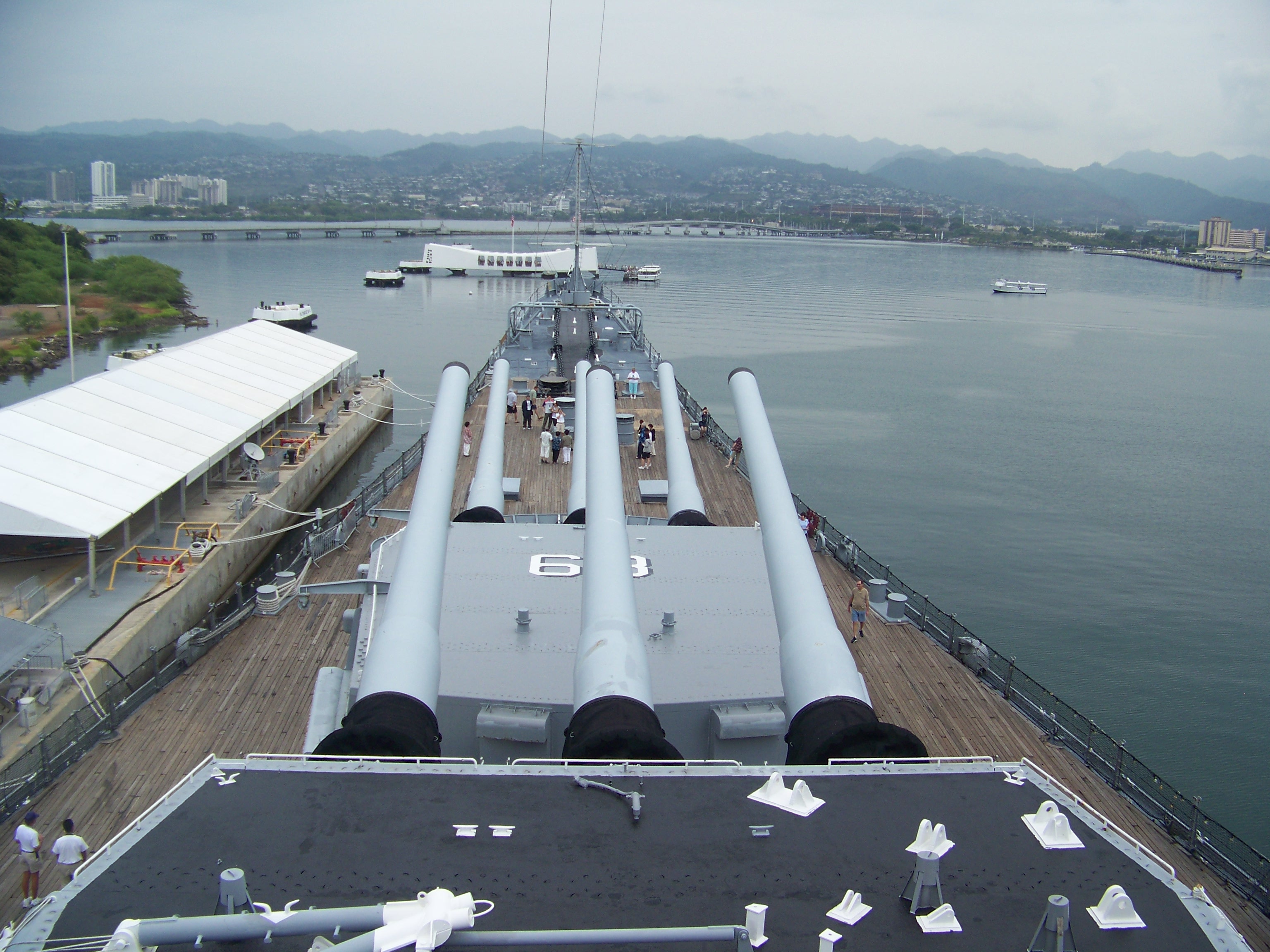
USS Missouri (BB-63)
At 9:04 a.m. on September 2, 1945, Japanese Foreign Minister Mamoru Shigemitsu signed the Instrument of Surrender on the quarterdeck of USS Missouri in Tokyo Bay. General Douglas MacArthur stood at a microphone. Representatives from nine Allied nations followed. When the last signature dried, MacArthur spoke six words: "These proceedings are closed." The spot where Shigemitsu sat is marked on Missouri's teak deck with a brass plaque. The pen MacArthur used is preserved behind glass. And the ship herself -- the last battleship the United States ever commissioned -- now floats in Pearl Harbor, her bow pointed toward the sunken Arizona, bookending the war from both sides.
Built for a War Already Changing
Missouri was an Iowa-class battleship, laid down at the New York Navy Yard in Brooklyn on January 6, 1941, and launched on January 29, 1944. Completed in June 1944, she carried a crew of roughly 2,700. By the time she reached the Pacific, the nature of naval warfare had shifted decisively toward aircraft carriers. But Missouri and her sisters still brought enormous firepower: nine 16-inch guns in three triple turrets, capable of hurling 2,700-pound armor-piercing shells over twenty miles. She also mounted twenty 5-inch dual-purpose guns and dozens of anti-aircraft weapons, with an armor belt over twelve inches thick. Assigned to the fast carrier task forces, Missouri provided anti-aircraft screening and shore bombardment rather than the ship-to-ship duels her designers had imagined.
The Kamikaze and the Captain's Order
Missouri saw action at Iwo Jima and Okinawa, where kamikaze attacks reached their peak intensity. On April 11, 1945, a Japanese Zero dove toward the ship at deck level. Its wing clipped Missouri's side, and the plane crashed into the hull below the main deck, starting a small fire. The pilot's body was recovered. What happened next became one of the ship's most remembered moments: Captain William Callaghan ordered the young Japanese aviator buried at sea with full military honors the following day. Some crew members objected, but Callaghan insisted the pilot had shown courage deserving of respect. Missouri also shelled the Japanese home islands in July and August 1945, her 16-inch guns striking industrial targets along the coast of Honshu. When Japan announced its intention to surrender, Missouri was chosen as the ceremony site -- in part because she bore the name of President Truman's home state.
Three Wars and a Grounding
After the surrender ceremony, Missouri's service was far from over. She carried midshipmen on training cruises and made a high-profile visit to Istanbul in 1946, a diplomatic signal underscoring American commitment to Turkey during early Cold War tensions. In January 1950, she ran aground in Chesapeake Bay -- an embarrassment that required two weeks and multiple tugboats to resolve. Recommissioned for the Korean War, she fired her 16-inch guns against North Korean positions at Chongjin and Wonsan. She was decommissioned again in 1955 and spent nearly three decades in mothballs before President Reagan's naval buildup brought her back. Modernized with Tomahawk cruise missiles and Harpoon anti-ship missiles alongside her original 16-inch guns, Missouri served during the Gulf War in 1991, launching Tomahawks at Iraqi targets and bombarding positions in Kuwait -- the last time a battleship ever fired its main guns in combat.
The Final Berth
Missouri was decommissioned for the last time on March 31, 1992, and struck from the Naval Vessel Register in 1995. Three years later, she was donated to the USS Missouri Memorial Association and towed to Pearl Harbor, arriving on June 22, 1998. She opened as a museum ship on January 29, 1999. Her placement was carefully considered: Missouri was positioned behind the sunken Arizona, perpendicular to the Arizona Memorial, her bow facing the memorial. Arizona Memorial staff had worried the massive battleship would overshadow the smaller structure, but the arrangement created something more powerful than either site alone. The ship that marks where the war began for America and the ship that marks where it ended, separated by a few hundred yards of harbor water. Visitors can walk Missouri's teak decks, stand at the surrender plaque, peer into the 16-inch gun turrets, and look across the harbor to the white memorial floating above the Arizona.
From the Air
Coordinates: 21.3637°N, 157.9521°W. Missouri is berthed at Ford Island in Pearl Harbor, easily identifiable from the air as a massive gray battleship with triple gun turrets. The USS Arizona Memorial is visible nearby in the water. Best viewed at 2,000-3,000 ft AGL. Nearest airports: Daniel K. Inouye International (PHNL), Joint Base Pearl Harbor-Hickam (PHIK). The Admiral Clarey Bridge connects Ford Island to the mainland.