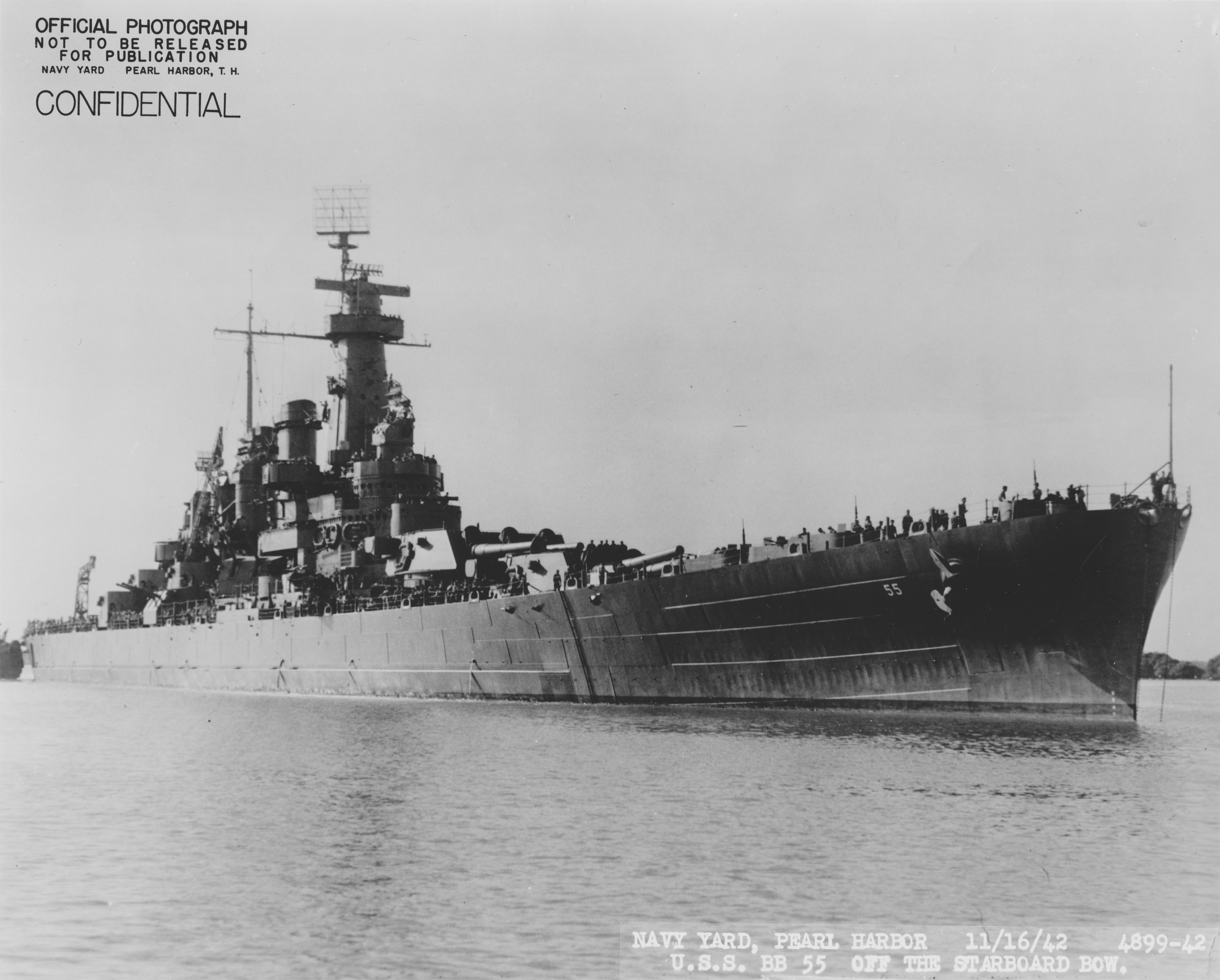
USS North Carolina (BB-55)
On October 2, 1961, nine tugboats lost control of a 728-foot battleship on the Cape Fear River, and she crashed into a floating seafood restaurant. It was, improbably, one of the gentler episodes in the life of the USS North Carolina. BB-55 had earned fifteen battle stars across the Pacific -- more than any other American battleship -- survived a torpedo hit, kamikaze attacks, and a typhoon, and shot down enough Japanese aircraft that Admiral Nimitz personally praised her gunnery. Now she rests permanently across the river from downtown Wilmington, North Carolina, a 45,000-ton monument to the state's war dead and one of the best-preserved warships of her era.
Treaty Steel, Wartime Thunder
The North Carolina was born of diplomacy and built for a war no one yet admitted was coming. Laid down at the New York Naval Shipyard on October 27, 1937, she was the lead ship of her class and the first American fast battleship -- designed not to hold a battle line but to keep pace with aircraft carriers. The Washington Naval Treaty and the Second London Naval Treaty constrained her design, but when Japan refused to sign, the United States invoked an escalator clause and upgraded her main battery from twelve 14-inch guns to nine massive 16-inch guns in triple turrets. Commissioned on April 9, 1941, eight months before Pearl Harbor, she displaced over 44,000 tons at full load and carried a crew that would swell to more than 2,100 during wartime. Her armor was designed to stop 14-inch shells -- a known shortcoming given the treaty system's collapse -- yet she proved more successful in service than the heavier, more cramped South Dakota class that followed her.
From Guadalcanal to Tokyo Bay
North Carolina's war began in earnest in the South Pacific, screening carriers during the bloody Guadalcanal campaign of 1942. At the Battle of the Eastern Solomons on August 24-25, her air-search radar was the first to detect incoming Japanese aircraft, and her anti-aircraft guns helped defend the carrier Enterprise against waves of dive bombers. On September 15, a torpedo from the Japanese submarine I-19 punched a hole in her port side, killing five men and causing a 5.5-degree list. Counter-flooding corrected the lean, and she stayed on station. The carrier Wasp, struck by the same torpedo spread, was not so fortunate -- she had to be scuttled that evening. After repairs at Pearl Harbor, North Carolina returned to the fight and spent 1943 and 1944 screening carriers across the Gilbert and Marshall Islands campaigns, bombarding Roi-Namur during the Battle of Kwajalein, and raiding the Japanese stronghold at Truk during Operation Hailstone.
The Bloodiest Year
The final year of the war tested the ship and her crew relentlessly. During the Battle of the Philippine Sea in June 1944, North Carolina and Washington were the first battleships to open fire on approaching Japanese aircraft in what became one of the most lopsided carrier engagements of the war. After a lengthy refit, she returned to the front lines for the Philippines campaign, surviving Typhoon Cobra in December 1944 when three destroyers were not so lucky. She provided fire support at Iwo Jima and Okinawa, shot down kamikazes in the furious air battles over the fleet, and was accidentally struck by a 5-inch shell from a friendly ship during an anti-aircraft barrage, killing three of her crew and wounding forty-four. By war's end, her total casualties stood at ten dead and sixty-seven wounded -- remarkably light for a ship that had been in harm's way across the entire Pacific theater.
Saved by Schoolchildren and Nickels
Decommissioned in 1947 and stricken from the Naval Vessel Register in 1960, North Carolina was headed for the scrapyard when James Craig, a North Carolina citizen, launched a campaign to save her. Modeled on the effort that had preserved the battleship Texas, the drive raised over $330,000 -- much of it in small donations -- with help from WRAL television's 'Save Our Ship' campaign. Wilmington was chosen as the ship's permanent berth, protected from hurricanes by its inland location. Opened as a memorial on April 29, 1962, the ship honors more than 11,000 North Carolinians killed in World War II. She was designated a National Historic Landmark in 1982. By 2022, the museum drew nearly 250,000 visitors annually. Today, the site faces a new adversary: rising sea levels caused 200 days of flooding in 2022 alone, and a $4.1 million project is replacing concrete barriers with a living shoreline of native plants and restored wetlands -- adapting to the water rather than fighting it.
From the Air
Located at 34.236N, 77.954W, berthed on the west bank of the Cape Fear River directly across from downtown Wilmington, NC. The battleship is unmistakable from the air -- a 728-foot warship with three gun turrets visible along the centerline. Best viewed at 1,000-2,000 ft AGL. Nearest airport: Wilmington International Airport (KILM), approximately 5 nm northeast. The ship sits near the confluence of the Cape Fear River and the Atlantic Intracoastal Waterway.