USS Oriskany
Thirty-seven minutes. That is how long it took the USS Oriskany to slip beneath the Gulf of Mexico on May 17, 2006 - stern first, settling upright on the sandy bottom as if she intended to keep sailing. The 888-foot aircraft carrier had survived the Korean War, seven Vietnam deployments, and a catastrophic fire that killed 44 of her crew. She had been sold for scrap, repossessed, towed 15,000 miles around South America, and used as a movie set for Hell itself. Now, resting 24 miles south of Pensacola in about 212 feet of water, she serves the most peaceful mission of her 56-year existence: a reef teeming with amberjack, barracuda, and the occasional diver brave enough to descend to her flight deck.
Born Twice
The Oriskany was laid down on May 1, 1944, at the New York Naval Shipyard, one of the last Essex-class carriers built for a war that ended before she was finished. Construction halted in August 1946 with the hull 85 percent complete. She might have rotted at the pier, but the Navy had other plans. Beginning in 1947, workers tore the nearly finished ship back down to 60 percent and rebuilt her as the prototype for the SCB-27 modernization program - stronger flight deck, more powerful catapults, new arresting gear, redesigned island structure. The blisters added to her hull increased both buoyancy and aviation fuel capacity, critical for a ship carrying the heavier jet aircraft of the Cold War era. She was commissioned on September 25, 1950, the final Essex-class carrier completed, and the template that 14 of her sister ships would follow into the modern era.
From Korea to Tonkin
Oriskany wasted no time. By October 1952 she was off the Korean coast with Task Force 77, her pilots downing two MiG-15 jets on November 18. She earned two battle stars in Korea, then spent the mid-1950s bouncing between San Francisco overhauls and Western Pacific deployments. She even moonlighted in Hollywood, standing in as the fictional USS Savo Island during production of The Bridges at Toko-Ri. Another modernization in 1957 gave her an angled flight deck and steam catapults. By 1965 she was deep in the Vietnam War, her Air Wing 16 flying over 12,000 combat sorties in a single deployment and earning a Navy Unit Commendation. In total, Oriskany completed seven Vietnam combat tours and earned ten battle stars - but the war exacted a terrible price. During her 1967-68 deployment alone, Carrier Air Wing 16 lost half its planes and had 20 pilots killed, nine captured.
Forty-Four Lost
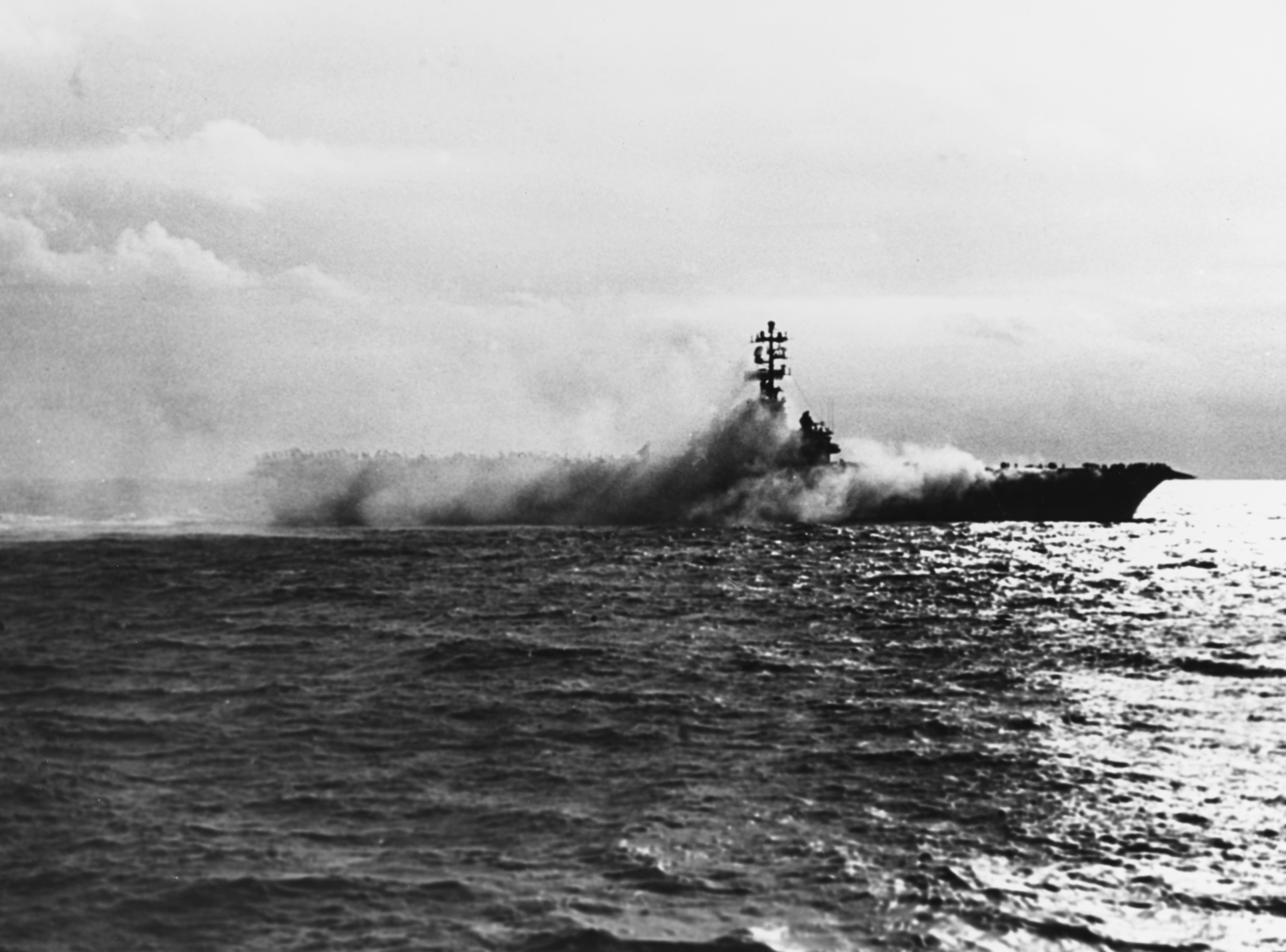
The morning of October 26, 1966, began like any other on Yankee Station in the Gulf of Tonkin. Then a young seaman accidentally ignited a magnesium parachute flare. In a moment of panic, instead of throwing it overboard, he tossed it into the flare locker in Hangar Bay 1. The resulting explosion sent fire racing through five decks. Many of the 44 men who died were veteran combat pilots who had flown raids over Vietnam just hours earlier. For three hours, crewmen fought the blaze - jettisoning bombs within reach of the flames, wheeling aircraft to safety, pulling survivors from smoke-filled compartments. Investigation later revealed that roughly one in every thousand flares could ignite from simple jarring. The Navy redesigned the flares entirely. On that same date one year later, Lieutenant Commander John McCain flew his 23rd bombing mission from Oriskany's deck. He was shot down and spent more than five years as a prisoner of war.
A Long Road to the Bottom
Decommissioned in 1976, Oriskany spent the next three decades in a strange limbo. Japanese businessmen tried to buy her for a Tokyo Bay exhibit - Congress considered the deal, but financing collapsed. The Navy sold her for scrap in 1995 to a startup at Mare Island, but nothing happened and the contract was terminated. While rusting at the old shipyard, she was drafted for one last performance: the set for Robin Williams' 1998 film What Dreams May Come, her decaying hulk standing in as part of the afterlife's vision of Hell. The Navy repossessed her and towed her 15,000 miles via the Strait of Magellan to Beaumont, Texas, where she sat in the reserve fleet until Florida came calling. In 2004, the Navy announced Oriskany would become the first American warship purposely sunk as an artificial reef. Environmental remediation took two years - removing an estimated 750 pounds of PCBs embedded in electrical cable insulation, passing the first prospective risk assessment model the EPA had ever required for a ship reefing project.
The Great Carrier Reef
On May 17, 2006, a Navy explosive ordnance disposal team detonated approximately 500 pounds of C-4 charges placed on 22 sea connection pipes deep inside the hull. Oriskany sank stern first and came to rest upright, her flight deck at a depth reachable by advanced recreational divers, her island structure accessible to those with less experience. Hurricane Gustav shifted her ten feet deeper in 2008, but she remains intact and colonized. Corals, sponges, and algae coat her surfaces. Schools of amberjack circle the island. Goliath grouper patrol the hangar bays. The Times of London named her one of the world's top ten wreck diving sites. She is the largest vessel ever intentionally sunk as an artificial reef - a record she has held for two decades. From the air, the site is marked by nothing but open Gulf water 24 miles south of Pensacola. Beneath the surface, an aircraft carrier stands at attention, still serving.
From the Air
Located at 30.04N, 87.01W in the Gulf of Mexico, approximately 24 nautical miles south of Pensacola, Florida. The reef site is not visible from the surface - look for dive boats clustered in open water south of Pensacola Beach. The nearest major airport is Pensacola International (KPNS). Naval Air Station Pensacola (KNPA) lies on the mainland shore. Pensacola Beach and the Gulf Islands National Seashore barrier islands are prominent visual landmarks along the coast. Recommended viewing altitude: 2,000-5,000 feet for the coastline; the reef site itself is submerged in approximately 212 feet of water. Clear Gulf waters may occasionally reveal a shadow of the wreck from very low altitude on calm days.