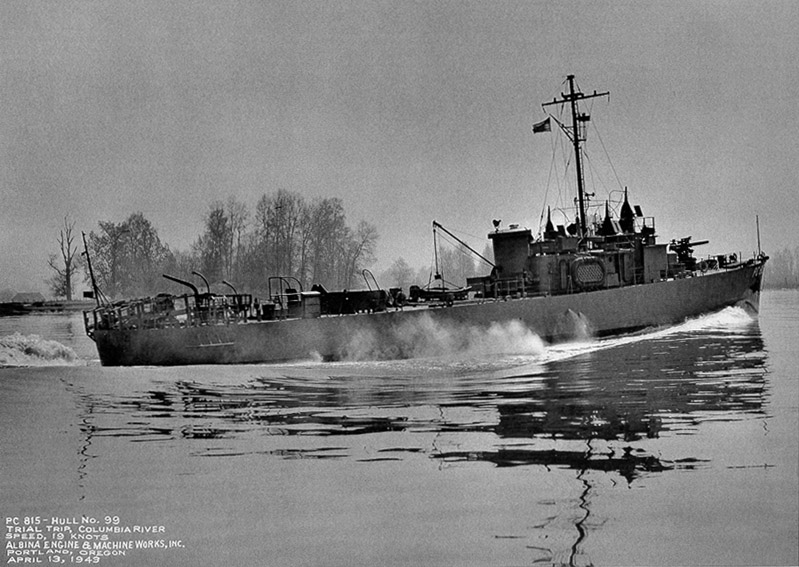
USS PC-815
For sixty-eight hours in May 1943, a small patrol craft off the Oregon coast expended thirty-seven depth charges in battle against Japanese submarines. Or so its commander claimed. The USS PC-815 entered naval history not for enemy contacts confirmed but for an elaborate engagement that, according to every other ship involved, never occurred. That commander was Lieutenant (junior grade) L. Ron Hubbard, who would later found Scientology. The 'Jinxed Sub-Chaser' packed more controversy into its brief existence than vessels that served decades, its short career marked by phantom battles, unauthorized shelling of Mexican territory, and a fatal collision in harbor fog.
Birth of a Sub-Chaser
PC-815 began as steel and ambition at the Albina Engine and Machinery Works in Portland, Oregon. Laid down on October 10, 1942, she was one of hundreds of PC-461-class submarine chasers rushing to production as German U-boats ravaged Atlantic shipping and Japanese submarines prowled the Pacific. Two diesel engines producing 1,440 horsepower each would drive her through coastal waters. She was fitted out beginning in December 1942 and commissioned on April 20, 1943, with Hubbard taking command. A few weeks later, she sailed down the Columbia River to Astoria to take on supplies. Her journey to her assigned homeport of San Diego would prove anything but routine.
The Battle That Wasn't
On May 18, PC-815 departed Astoria bound for Bremerton to receive radar and depth charge launchers. Soon after, Hubbard reported submarine contact. What followed was a sixty-eight-hour depth charge barrage that summoned Navy blimps, Coast Guard patrol boats, and two additional subchasers as reinforcements. In his eighteen-page after-action report, Hubbard claimed to have 'definitely sunk, beyond doubt' one submarine and critically damaged another. Vice Admiral Frank Jack Fletcher, investigating, was unimpressed. Every other commanding officer reported no evidence of submarines. Fletcher noted that a known magnetic deposit in the area had likely triggered false readings, suggesting Hubbard's crew had simply operated their sonar incorrectly. After the war, captured Japanese Navy records confirmed no submarines had been lost off Oregon. The battle had been fought against the seafloor.
Mexican Complications
The phantom submarine battle might have been forgotten had PC-815's troubles ended there. They did not. In late June 1943, with San Diego now her homeport, Hubbard conducted unauthorized gunnery practice in Mexican territorial waters, shelling South Coronado Island. This violation of international law ended his command. Hubbard was relieved, and PC-815 was relegated to shore patrol duties in San Diego Harbor. She appears to have been mostly inactive for the remainder of the war, occasionally conducting offshore patrols, participating in training exercises, and escorting submarines in and out of the harbor. The sub-chaser that had fought imaginary enemies settled into unglamorous routine.
Fog and Fire
World War II ended in August 1945, and PC-815 was restored to active duty in September. It would be her last month afloat. On the morning of September 11, 1945, dense fog blanketed San Diego Harbor. At 6:47 AM, PC-815 collided with the destroyer USS Laffey. Fire erupted aboard the patrol craft, and she sank within five minutes. One crewman was listed as missing, presumed drowned. The Laffey suffered significant damage as flames spread into one of her compartments. The 'Jinxed Sub-Chaser' had earned her nickname. Built in 1942, commissioned in 1943, removed from her commander's control after just eighty days, and resting on the bottom of San Diego Harbor by September 1945, PC-815 had lived a brief and troubled life.
The Commander's Later Claims
L. Ron Hubbard never accepted that his submarine battle had been imaginary. Years later, he told Scientologists elaborate stories about sinking the Japanese submarine I-76 at the mouth of the Columbia River, claiming the wreck was still tearing fishermen's nets. The tale had problems. The mouth of the Columbia lies seventy-five miles north of Cape Lookout, where his naval reports placed the action. The I-76, which had been renamed I-176 by then, was based in Truk and operating only in the South Pacific during Hubbard's command. That submarine was sunk off Buka Island in the Solomon Islands in May 1944, a year after Hubbard left PC-815. The wreck he claimed to have made does not exist. But the story persisted, one more chapter in the strange legacy of a very small warship.
From the Air
USS PC-815 sank in San Diego Harbor near coordinates 32.63N, 117.24W. The wreck site lies in the shipping channel approaches to the harbor. Nearby airports: San Diego International (KSAN) 3nm northeast, North Island NAS (KNZY) 2nm north. The Coronado Islands, site of the unauthorized shelling incident, are visible 8nm south across the Mexican border. The ship was a PC-461 class patrol craft, only 173 feet long, and no surface trace remains.