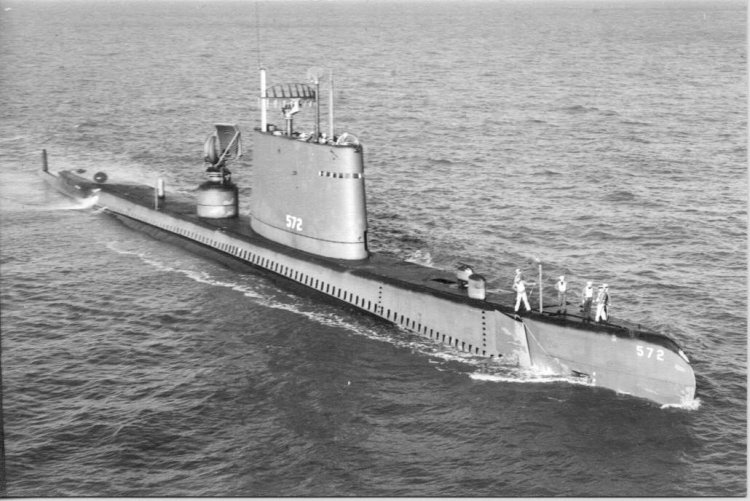
USS Sailfish (SSR-572)
The deep-fat fryer nearly killed her. Over Thanksgiving weekend in 1961, a grease fire aboard USS Sailfish at a Rhode Island pier burned through nearly every cable in the after battery compartment, threatening to sideline the submarine for months. Instead, her entire crew worked around the clock for five straight days, rewiring the compartment by hand, and Sailfish got underway just six days after the fire to complete her assigned exercise. It was the kind of stubborn, improvised survival that defined the ship's entire career -- a submarine built for a mission the Navy abandoned, repeatedly refitted for new roles, and kept in service long after her original purpose had vanished.
Built Obsolete
Sailfish was laid down on December 8, 1953, at the Portsmouth Naval Shipyard in Kittery, Maine -- the first submarine built expressly for radar picket duty. The concept was straightforward: station a large submarine with powerful search radar well ahead of a carrier battle group, where it could detect incoming aircraft and relay early warning. She and her sister ship were the largest conventionally powered submarines in the U.S. Navy since 1928, equipped with BPS-2 and BPS-3 radars mounted in and behind the sail. But the design failed to deliver on its central promise. Sailfish's surface speed was not significantly faster than converted World War II submarines already doing the same job, and the whole radar picket concept was being overtaken by technology. By the time she was commissioned on April 14, 1956, the Grumman WF-2 Tracer -- an airborne early warning aircraft -- was making submarine pickets redundant. On February 3, 1961, the Navy officially ended the mission and reclassified Sailfish as an attack submarine, SS-572.
Three Oceans, Two Decades
Stripped of her original purpose, Sailfish adapted. She spent her first years with the Atlantic Fleet -- shakedown cruises in the Caribbean, deployments with the Sixth Fleet in the Mediterranean, NATO exercises off New England. After the 1961 reclassification, she entered the Philadelphia Naval Shipyard for a 13-month FRAM II conversion that transformed her silhouette. The big search radar came off, replaced by the deck-mounted fins of the PUFFS passive sonar system. These fins echoed the shape of her conning tower on a smaller scale, giving her the dorsaled profile of the fish she was named for. In 1969, the Navy sent her to the Pacific. Sailfish transited the Panama Canal, stopped in Acapulco, and made Pearl Harbor her new home. From there she deployed three times to the western Pacific -- operating out of Yokosuka, Japan, running antisubmarine exercises off Taiwan, Okinawa, and Korea, training with the Japan Maritime Self-Defense Force and the Philippine Navy, and putting into Brisbane, Australia.
The Sale That Never Was
Sailfish was decommissioned on September 29, 1978, and stricken from the Naval Vessel Register the following day. What should have been a routine disposal became an unlikely geopolitical footnote. The submarine was earmarked for sale to Bolivia -- a landlocked country with a small naval force on Lake Titicaca and the rivers of the Amazon basin. The deal was arranged through the Security Assistance Program, but before the transfer could happen, Bolivia's government fell. The Torrelio regime collapsed in August 1982, and the sale died with it. Sailfish sat at the Naval Inactive Ship Maintenance Facility in Bremerton, Washington, rusting at the pier for another quarter century, a submarine without a navy and without a purpose.
1,451 Fathoms
In May 2007, the Navy decided how Sailfish would end. She was towed out into the Pacific, 121.2 nautical miles off the coast of Washington, for a SINKEX -- a fleet training exercise in which decommissioned ships serve as live-fire targets. A Mark 48 ADCAP torpedo, fired from a submarine prowling beneath the surface, struck the old radar picket and sent her to the bottom. She sank in 1,451 fathoms of water, more than 8,700 feet deep. The submarine that had been built to scout for threats ahead of the fleet, that had survived a galley fire, crossed three oceans, and waited 25 years in Bremerton for a buyer who never came, ended her story as a target -- a final service rendered to the Navy that built her, training the next generation of submariners in the waters where she now rests.
From the Air
Sailfish's final position is approximately 47.10°N, 127.39°W, roughly 121 nautical miles off the Washington coast in the open Pacific. She rests at a depth of 1,451 fathoms (approximately 8,706 feet). The nearest coastal landmark is the mouth of the Columbia River to the south, and the Olympic Peninsula coastline to the northeast. Nearest airports are KUIL (Quillayute State Airport) on the Olympic Peninsula coast and KAST (Astoria Regional Airport) near the Columbia River. Her construction yard, Portsmouth Naval Shipyard (KPSM nearby), is in Kittery, Maine, on the opposite coast. Bremerton, where she waited for decades, is visible from altitude across Puget Sound from Seattle (KSEA).