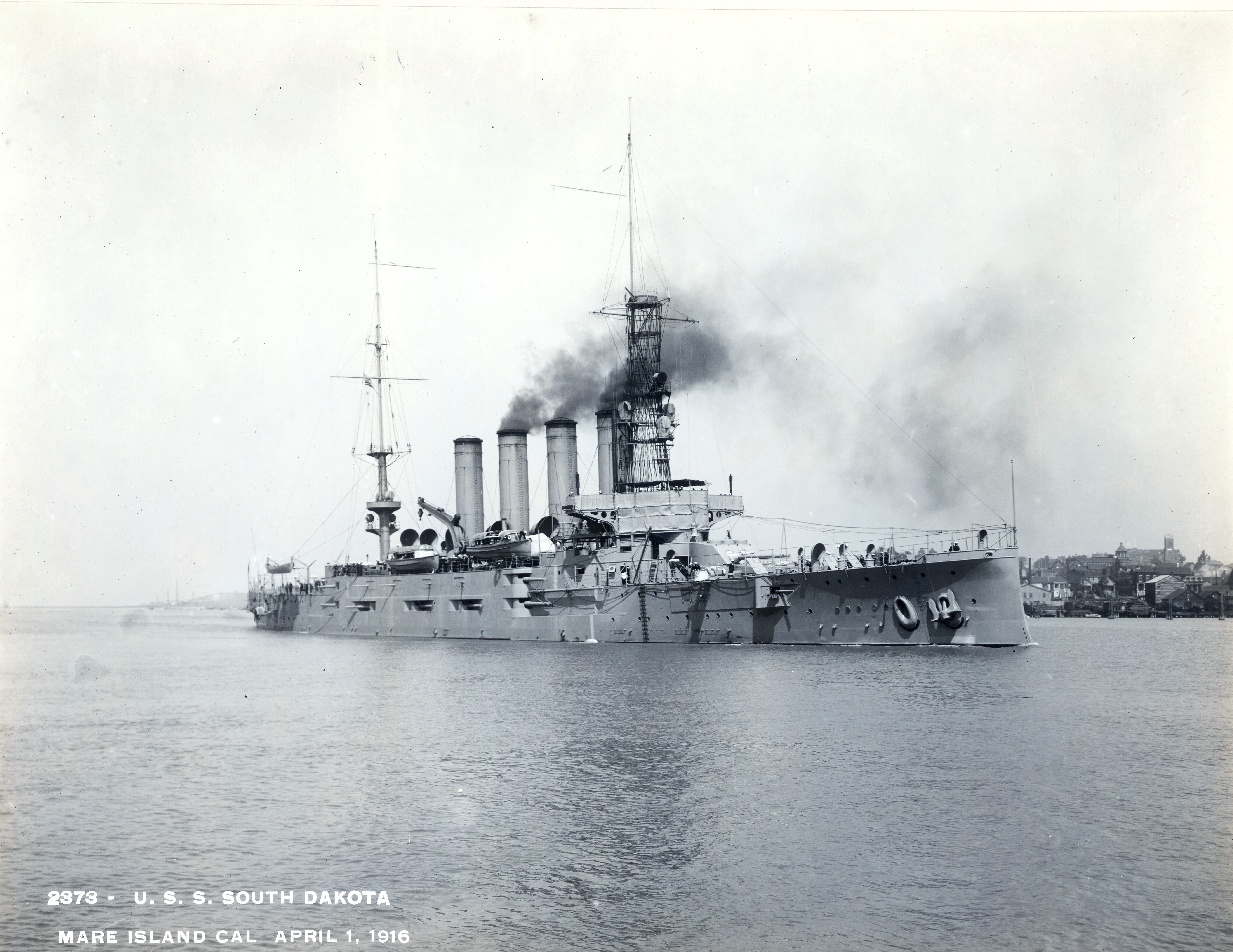
USS South Dakota (ACR-9)
Congress authorized her construction in 1900, the Union Iron Works in San Francisco laid her keel in 1902, and the Governor of South Dakota's daughter smashed a bottle across her bow in 1904. The USS South Dakota was built for war at a time when armored cruisers were the cutting edge of American naval power. She would serve through the First World War and beyond, patrol the Pacific and the Atlantic, and eventually find her way to a quiet harbor in British Columbia, where her hull now serves a purpose her designers never imagined.
Steel and Steam from San Francisco
The USS South Dakota was a Pennsylvania-class armored cruiser, designated ACR-9. Her hull and machinery cost $3,750,000, a substantial sum when the contract was signed. Vertical triple expansion engines and 16 Babcock and Wilcox boilers drove two propellers, giving her the speed expected of a turn-of-the-century warship. Four funnels, one cage mast, and one military mast created a silhouette distinctive enough to identify from a distance. Grace Herreid, daughter of South Dakota Governor Charles N. Herreid, sponsored the launch on July 21, 1904. Commissioning came on January 27, 1908, after Captain Charles E. Fox oversaw her final inspections.
Two Oceans and a Renamed Ship
The South Dakota spent her active years in both the Atlantic and the Pacific, part of the expanding American fleet that projected power across two oceans in the early twentieth century. She served during World War I, when armored cruisers patrolled shipping lanes and escorted convoys. At some point during her career she was renamed Huron, a common practice when the Navy wanted to free up a state name for a newer, more powerful vessel. Under either name, she represented the industrial ambition of a nation building its way toward naval supremacy, one boiler room and gun turret at a time.
The Long Voyage Home
By the 1920s, the Huron's era had passed. Ordered home from Manila, she departed on December 31, 1926, and arrived at the Puget Sound Navy Yard on March 3, 1927. Decommissioning came on June 17. She sat in reserve for two years before being struck from the Naval Vessel Register on November 15, 1929. On February 11, 1930, she was sold for scrapping to Abe Goldberg and Co. in Seattle, in compliance with the London Naval Treaty's limitations on naval armament. The treaty demanded that nations reduce their fleets, and ships like the Huron paid the price.
A Warship Becomes a Breakwater
The South Dakota's story did not end at the scrapyard. Her hull, or portions of it, eventually made its way to Powell River, British Columbia, where it joined a line of decommissioned vessels forming a floating breakwater. Alongside the concrete tanker SS Peralta and other retired ships, the former armored cruiser now shields the harbor from the chop of Malaspina Strait. It is a peculiar afterlife for a warship that once carried guns and boilers across two oceans. From the air, the breakwater appears as a dark line of angular shapes just off the Powell River waterfront, each hull a chapter of maritime history slowly settling into the sea.
From the Air
The USS South Dakota's remains are located at approximately 49.87°N, 124.56°W as part of the floating breakwater at Powell River, British Columbia. The breakwater line is visible from altitude along the waterfront of Powell River. Powell River Airport (CYPW) is approximately 3 nm south. Approach from the west over Malaspina Strait for the best view of the breakwater and the former mill complex. Comox (CYQQ) lies roughly 30 nm to the southwest across the Georgia Strait.