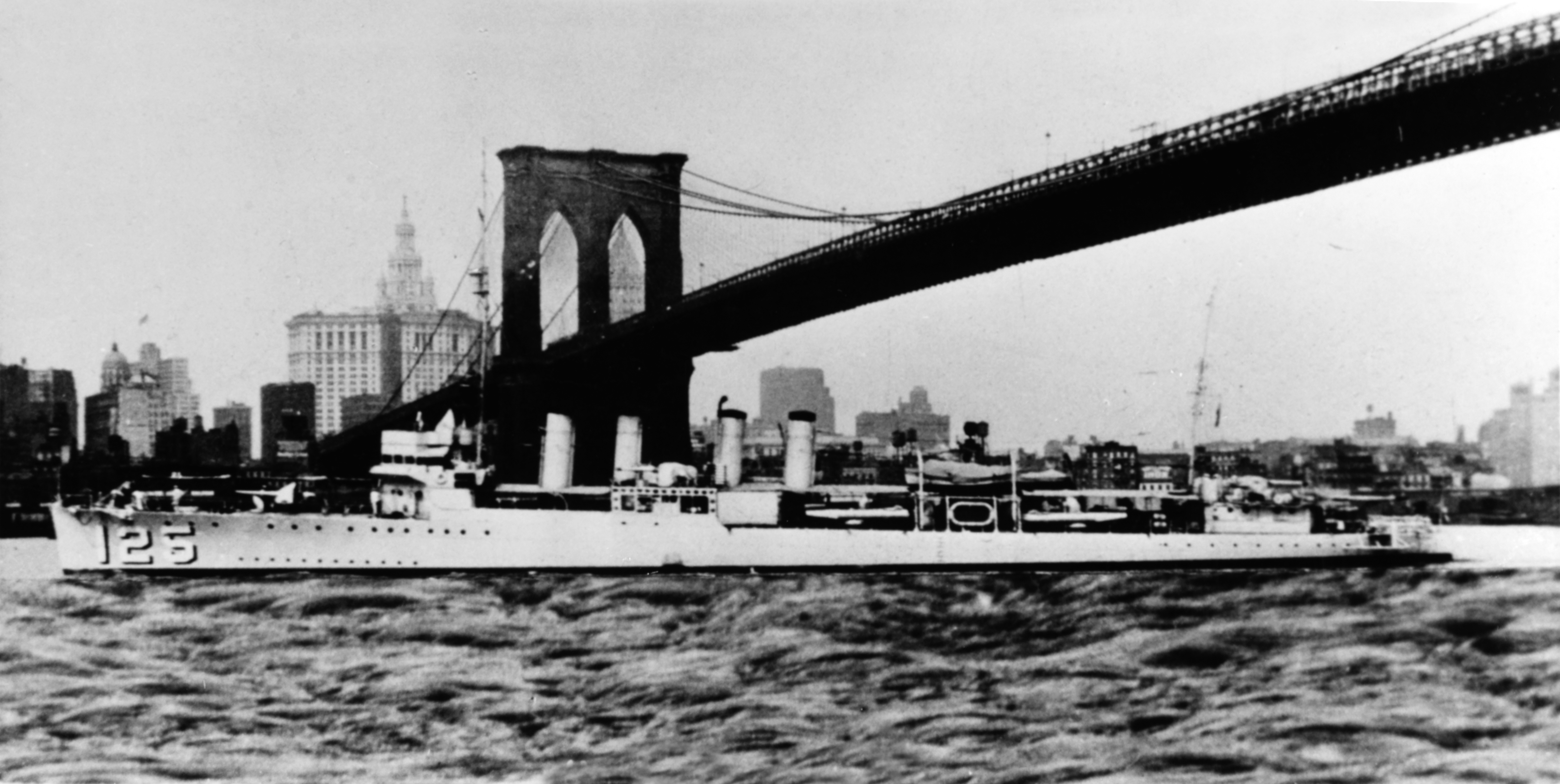
USS Tattnall: Constantinople, Monte Cassino, Kamikaze Alley, and a Canadian Beach
At 0215 on April 30, 1945, a twin-engined Japanese aircraft crossed the stern of USS Tattnall from 3,000 yards. Her 40mm gun crews opened fire, setting one engine ablaze. The plane pulled away, circled, and came back. This time the gunners finished it. Minutes later, a kamikaze bore in from starboard. Tattnall went to full speed, turned hard to port, and the attacker splashed into the sea so close to her bow that debris pierced the hull above the waterline. No one aboard was killed. For a destroyer that had been in and out of commission since 1919, bouncing between Constantinople and the Caribbean, the Mediterranean and the Pacific, this was just another night at war.
From the Golden Horn to the Panama Canal
Laid down at Camden, New Jersey, on December 1, 1917, by the New York Shipbuilding Corporation and commissioned on June 26, 1919, Tattnall was a Wickes-class destroyer named for Captain Josiah Tattnall III of the antebellum U.S. Navy. Her first assignment sent her to Constantinople, where she spent nearly a year operating in Turkish waters, visiting ports in Egypt, Greece, Russia, and Syria while carrying passengers and mail through a region still reeling from the collapse of the Ottoman Empire. After returning to the United States in 1920 - receiving her DD-125 hull number during the voyage home - she joined the Pacific Fleet and patrolled the California coast until being decommissioned at San Diego in June 1922. Recommissioned in 1930, she cycled through training squadrons, rotating reserves, and the Scouting Force before landing in the Canal Zone with the Special Service Squadron.
The Atlantic: U-Boats and a Fake Invasion
When the United States entered World War II, Tattnall began escorting convoys through the Windward Passage between Cuba and Hispaniola - one of the most dangerous corridors during the Caribbean U-boat blitz. She made many sonar contacts and dropped many depth charges, but registered no confirmed kills. In July 1943, the old destroyer was converted into a high-speed transport, redesignated APD-19, and named flagship of Transport Division 13 - the only high-speed transport division in the entire Atlantic theatre. Sent to the Mediterranean, Tattnall was tasked with feigning a landing near Civitavecchia, north of Rome, to draw German reinforcements away from the American forces breaking through at Monte Cassino. The ruse worked: the reinforcements never arrived, and German radio the next day announced an Allied invasion that had never happened.
Elba, Southern France, and the Special Service Force
On June 17, 1944, Tattnall's boats went ashore on Elba and Pianosa, taking machine gun fire but suffering no serious damage. After convoy duty between Italian, Sicilian, and North African ports, she loaded members of the American-Canadian 1st Special Service Force - the legendary 'Devil's Brigade' - for the capture of the heavily fortified Hyeres Islands east of Toulon. On August 15, the five ships of Transport Division 13 put 1,600 troops ashore, and the islands were secured within three days. For the next two weeks, Tattnall shuttled reinforcements into southern France and evacuated wounded Allied soldiers and German prisoners of war. The destroyer-turned-transport had become a jack-of-all-trades, equally capable of delivering commandos to a hostile beach and ferrying casualties to safety.
Okinawa and the Final Voyage North
After returning to Norfolk for overhaul, Tattnall transited the Panama Canal and made her way across the Pacific, reaching Okinawa on April 19, 1945. She spent the next weeks on picket duty, guarding the screen stations that ringed the island against kamikaze attack. On May 25, her crew stood at general quarters for eighteen consecutive hours as nearby ships Barry and Roper were hit - Barry later sinking. Through the end of the war, Tattnall patrolled the Philippines and escorted convoys to Ulithi and Hollandia. Decommissioned at Puget Sound on December 17, 1945, she was sold to the Pacific Metal Salvage Company of Seattle in October 1946. Her stripped hull was towed north to Royston, British Columbia, and beached as part of a breakwater where, as of 2009, portions remained visible - the last posting of a ship that had served across four decades and two world wars.
From the Air
Located at 49.653N, 124.950W off the shore of Royston, British Columbia, in the Comox Valley on Vancouver Island's east coast. The Royston breakwater is a line of deliberately grounded decommissioned warships visible from the air, particularly at low tide, as dark irregular shapes along the shoreline south of the Trent River mouth. Nearest airport: CFB Comox (CYQQ) approximately 8 km north. Best viewed at 1,000-2,000 feet on a low-tide approach from the Strait of Georgia. The breakwater protected log booming operations in the harbour. Denman Island lies across Baynes Sound to the southeast.