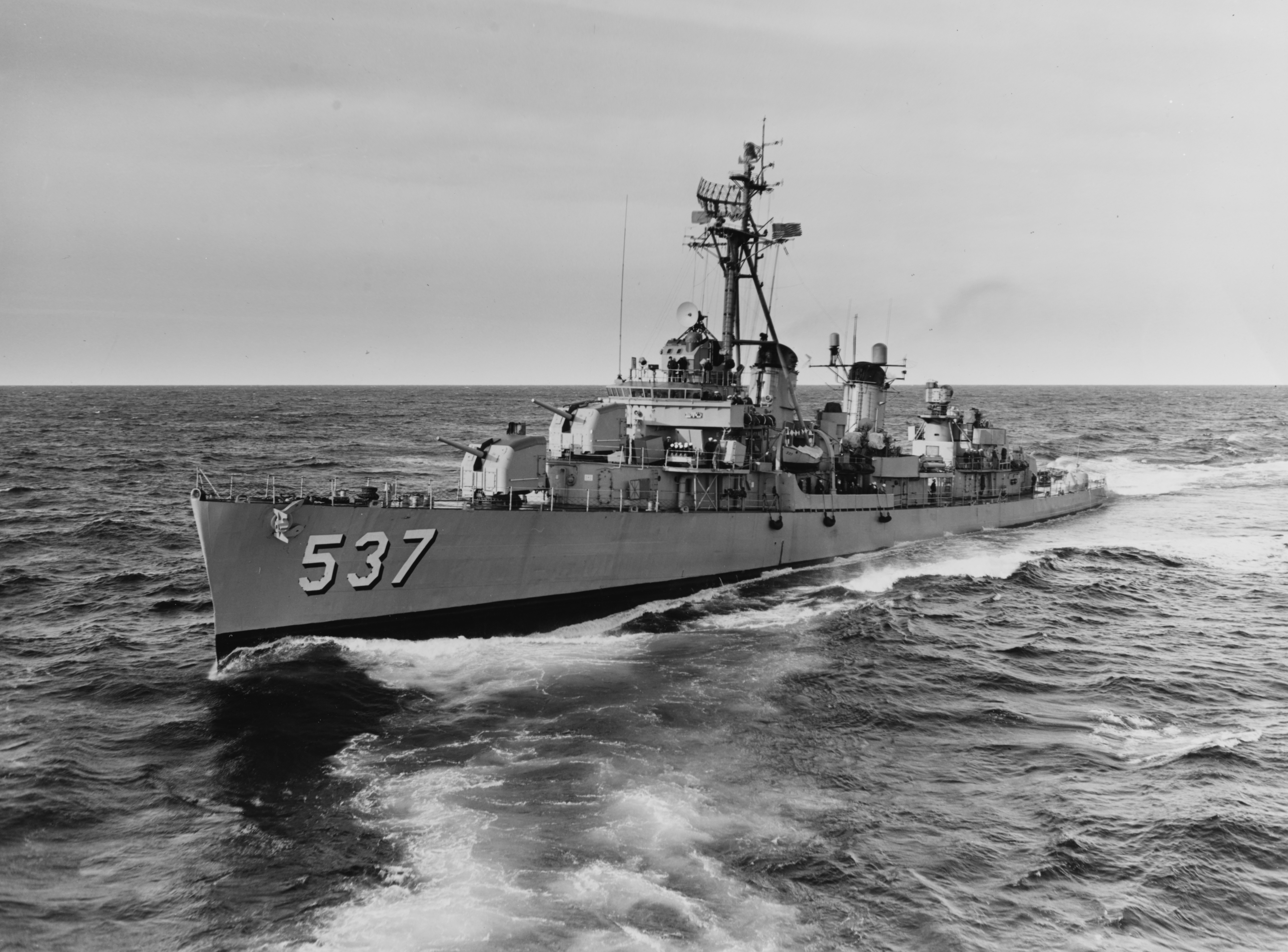
USS The Sullivans: Five Brothers, One Ship, and a Lucky Shamrock
President Franklin Roosevelt personally changed the name. The Navy had planned to call her Sullivan, but Roosevelt insisted on The Sullivans - plural, emphatic - to make clear the ship honored all five brothers. George, Francis, Joseph, Madison, and Albert Sullivan, aged 20 to 27, had died together when the light cruiser Juneau was sunk by a Japanese submarine during the Naval Battle of Guadalcanal on November 13, 1942. It was the greatest military loss by any one American family during World War II. The destroyer that bore their name became the first ship in Navy history commissioned to honor more than one person. Their mother, Mrs. Thomas F. Sullivan, sponsored the launch on April 4, 1943.
Into the Pacific Crucible
Commissioned on September 30, 1943, The Sullivans wasted no time. By January 1944, she was steaming out of Pearl Harbor with Task Group 58.2, bound for the Marshall Islands. At Kwajalein, she screened carriers Essex, Intrepid, and Cabot during near-continuous air strikes against Roi and Namur. When the task force raided Truk in February, the surprise was complete - 'No enemy opposition of any kind was encountered,' her commander wrote. But the Japanese struck back, torpedoing Intrepid in the darkness. The Sullivans stood by the stricken carrier and escorted her to Majuro for repairs. Through 1944, the destroyer fought across the Pacific: the Palaus, New Guinea, Saipan, the Philippine Sea. On Independence Day, she bombarded Iwo Jima's airfields, destroying five parked bombers and likely damaging eight more.
Rescuer of the Desperate
The Sullivans earned a reputation not just for fighting but for saving lives. During the fierce air battles off Formosa in October 1944, when 50 to 60 Japanese aircraft attacked over six hours and the formation executed 38 emergency turns, she helped guard the cruiser Houston after it took two torpedo hits. The Sullivans pulled 118 Houston crewmen from the water, keeping them aboard for days before they could be transferred. Her commander, Ralph J. Baum, received the Silver Star for directing the rescue and salvage efforts. In May 1945 off Okinawa, when a kamikaze devastated the carrier Bunker Hill, The Sullivans closed immediately and rescued 166 men forced overboard by raging fires. She saved four more sailors from a sinking small boat during a storm at Ulithi. Wherever ships were burning or sinking, The Sullivans appeared.
The Lucky Shamrock
On December 18, 1944, Typhoon Cobra tore through the Pacific Fleet with catastrophic force. Three destroyers sank outright; several more ships were badly damaged. The Sullivans, her lucky shamrock painted on the funnel, emerged untouched. Two days later she was searching for men lost overboard from other ships. The shamrock seemed to work through repeated close calls: kamikazes that passed just over her masthead, collisions averted by seconds, battles where nearby ships were hit while she escaped. Off Okinawa in March 1945, a kamikaze bore down on the destroyer while her motor whaleboat was still in the water transferring medical officers to a stricken sister ship. As soon as the boat cleared, The Sullivans leapt to flank speed, maneuvering radically as her guns blazed - the Zeke passed overhead and escaped, but so did the ship.
Cold War and Cuban Crisis
The Sullivans earned nine battle stars in World War II and was decommissioned in January 1946. The Korean War brought her back. Recommissioned in July 1951, she screened carriers off Korea, bombarded railroad targets at Songjin, and on Christmas Day 1952 scored direct hits on a railroad bridge while fifty rounds of enemy artillery splashed around her without connecting. She came home the long way - through Hong Kong, Singapore, Colombo, Bombay, the Suez Canal, and Cannes. In the years that followed, she supported Marine landings at Beirut during the 1958 Lebanon crisis, stood watch during Alan Shepard's Mercury spaceflight in May 1961, and joined the naval blockade during the Cuban Missile Crisis in October 1962. She earned two more battle stars in Korea before finally being decommissioned on January 7, 1965.
A Ship That Refuses to Sink
Declared a National Historic Landmark in 1986, The Sullivans now rests at the Buffalo and Erie County Naval and Military Park in Buffalo, New York. But 'rests' may be generous. In April 2022, a severe hull breach caused the ship to partially sink, with part of her settling on the riverbed. The damage to her interior was considerable. She reopened for limited visits in August 2022, though by June 2024 only the main deck and part of the superstructure remained accessible. The park has been winterizing the ship, adding leak-warning sensors and shoring up bulkheads, while planning a drydock move that will cost an estimated $10 to $12 million. The Sullivans is fighting her last battle - against time and the elements - with the same stubbornness that carried her through the Pacific.
From the Air
Located at 42.88N, 78.88W at the Buffalo and Erie County Naval and Military Park on the Buffalo River near its confluence with Lake Erie. The ship is moored alongside the cruiser USS Little Rock and is visible from the air as a gray warship at the waterfront, just south of downtown Buffalo. The nearest airport is Buffalo Niagara International Airport (KBUF), approximately 5 nm to the east-northeast. Best viewed at 1,500-2,500 feet AGL. The ship's listing and waterline condition may be visible from low altitude.