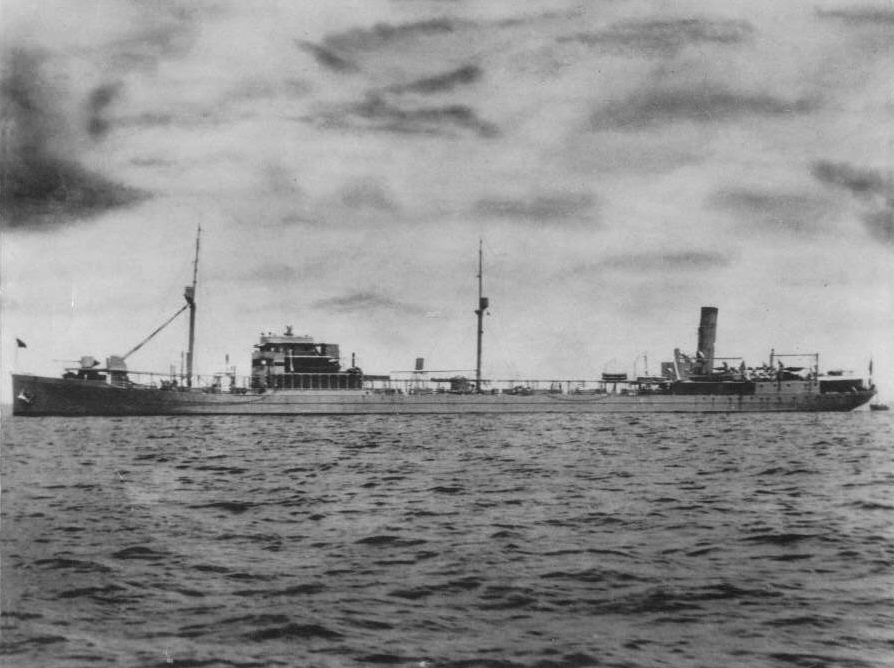
USS Trinity (AO-13)
On December 8, 1941, USS Trinity was pumping fuel at the docks at Sangley Point near Manila when word came from Admiral Thomas C. Hart: "Japan has commenced hostilities — govern yourselves accordingly." Trinity was carrying something the Asiatic Fleet could not fight without — fuel oil. That made her both invaluable and a target. In the days and weeks that followed, she became one of the most traveled ships in the Pacific War, threading through contested waters from the Netherlands East Indies to the Persian Gulf and back again, keeping Allied warships moving when the entire eastern theater was in danger of grinding to a halt.
Built to Serve
Trinity was laid down at the Newport News Shipbuilding and Drydock Company in Virginia on November 10, 1919, and commissioned on September 4, 1920. Her early service took her to the Mediterranean — delivering fuel oil to American ships in the Adriatic and stores to the naval base at Constantinople. She plied the U.S. East Coast and Caribbean, was decommissioned in 1923, and lay inactive through the rest of the decade. But as tensions in Europe and Asia rose, the Navy needed every hull it had. Trinity was recommissioned in 1938 and transferred to the Pacific, eventually carrying oil from the Gulf of Mexico to Dutch Harbor, Alaska, then shifting to voyages between the U.S. West Coast, the Netherlands East Indies, and the Philippines. By late 1940, she was assigned to the Asiatic Fleet.
Escape from Manila
When Japan struck, Hart acted quickly to protect his most vulnerable ships. Trinity, along with oiler USS Pecos and seaplane tender USS Langley, was sent south from Manila Bay immediately — shepherded by destroyers Pope and John D. Ford. Two days after they departed, 80 Japanese bombers and 52 fighter planes destroyed the Cavite navy yard. Trinity had left just in time. The convoy reached Balikpapan, Borneo, on December 14, and Trinity began fueling Allied warships in the shrinking perimeter of resistance. The Malay Barrier was being compressed from every direction.
Torpedoes in the Beagle Gulf
In January 1942, Trinity was ordered south to Australia. On the morning of January 20, escorted by two destroyers in the Beagle Gulf about 40 nautical miles west of Darwin, Japanese submarine I-123 mistook her for a transport and fired four Type 89 torpedoes. All four missed. Trinity sighted three of them. Destroyer USS Alden raced in, made sound contact, and delivered a depth charge attack at 06:41 — but I-123 escaped. It was a near thing. Had the torpedoes found their mark, the fuel supply for Asiatic Fleet submarine forces operating in the Malay Barrier would have been catastrophically disrupted. Darwin received Trinity's oil instead.
The Persian Gulf Run
As Java fell and Allied forces retreated to Australia, Trinity was dispatched on one of the war's more unusual missions: sailing to Abadan, Iran, to collect refined fuel oil. She was the first U.S. warship in recent memory to visit that part of the world. While there, she gathered intelligence on port conditions in Iraq and Iran, including observations of the supply route through Abadan that was funneling war materials to the Soviet Union. She also collected oceanographic data on the Persian Gulf — scientific work conducted in the middle of a shooting war. COMSOWESPAC kept her on the Persian Gulf–Fremantle run for months, calling at Basra, Bahrain, Diego Garcia, Bombay, and half a dozen Australian ports.
To the End of the War and Home
In 1943, Trinity moved her base to Milne Bay, New Guinea, fueling ships along the Buna–Cape Cretin coast and shuttling between Milne Bay and Brisbane. By 1944 she was working the islands — Manus in the Admiralties, Humboldt Bay and Hollandia on the New Guinea coast, Biak in the Schouten Islands. In May 1945, she arrived at Leyte in the Philippines — waters she had been driven from in those first dark days of the war. She was decommissioned in May 1946, sold to a commercial firm in 1951, and renamed Seabeaver. She received one battle star for her World War II service: a single decoration for years of unglamorous, essential, dangerous work.
From the Air
The torpedo attack on Trinity occurred at approximately 12.09°S, 130.09°E in the Beagle Gulf, 40 nautical miles west-northwest of Darwin, Northern Territory. Darwin Airport (YPDN) lies to the southeast. From the air, the Beagle Gulf stretches wide to the northwest, with Melville Island's low northern shoreline visible in the distance. These are the same waters traversed by the desperate remnants of the Asiatic Fleet in January and February 1942.