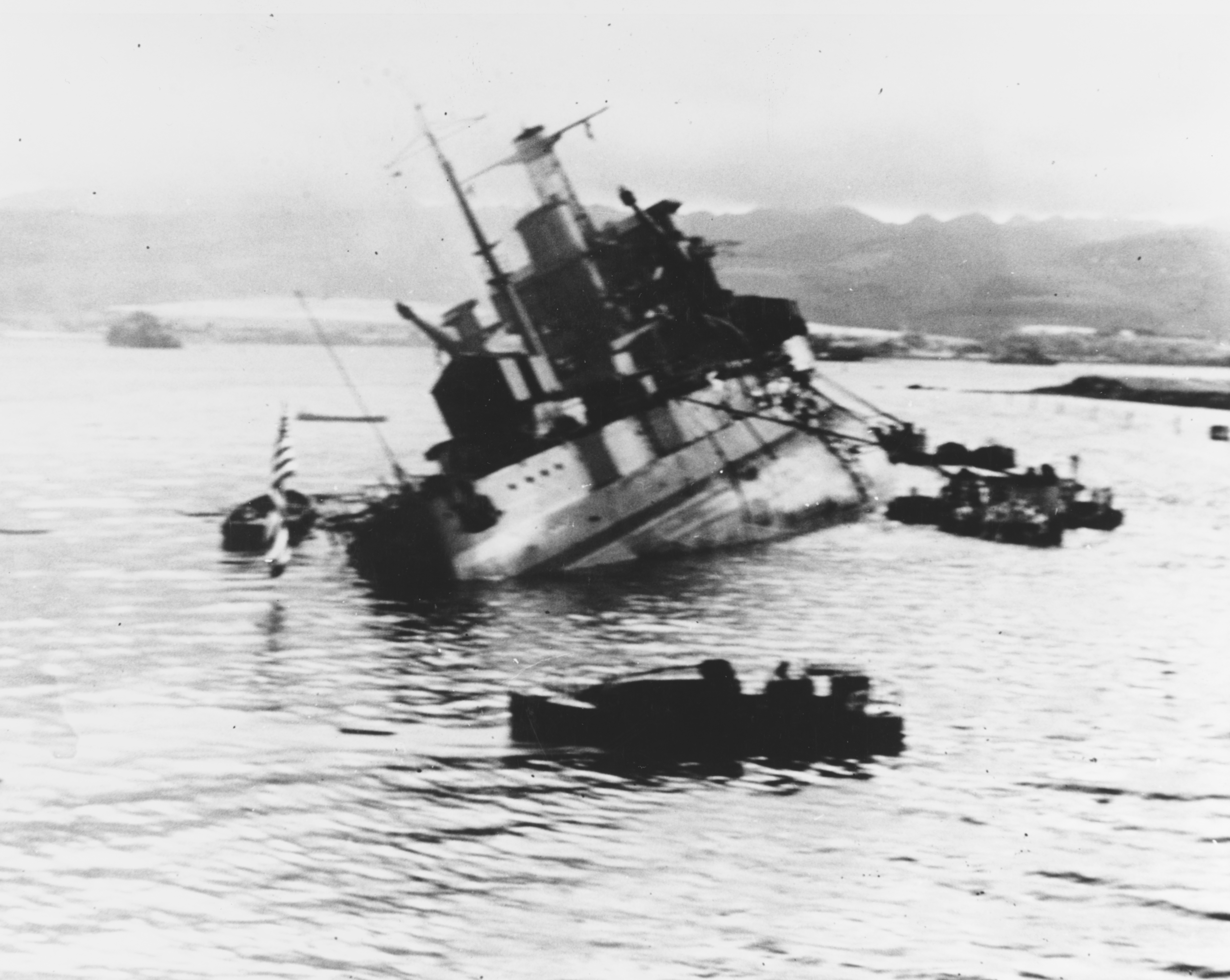
USS Utah (BB-31)
The Japanese pilots who attacked her were looking for aircraft carriers. USS Utah was moored at berth F-11 off Ford Island on the morning of December 7, 1941, occupying a spot where American carriers normally anchored. Six torpedo bombers from the carrier Soryu broke formation and launched against her, apparently mistaking the wooden boxes covering her empty gun barbettes for turrets. Two torpedoes struck home. By 8:12 a.m. -- barely twelve minutes into the attack -- Utah had rolled onto her port side and settled into the mud of Pearl Harbor. Fifty-eight men died. Her rusting hull remains there today, partially above water, on the quiet northwest side of Ford Island where most tourists never go.
A Dreadnought's Long Career
Utah was built by the New York Shipbuilding Corporation, laid down in March 1909 and commissioned in August 1911 with ten 12-inch guns in five twin turrets and a crew of over a thousand. Her career reads like a survey of American military engagement in the early twentieth century. In 1914, she and her sister ship Florida were the first American vessels on the scene during the U.S. occupation of Veracruz, landing a thousand Marines and Bluejackets to begin the occupation during the Mexican Revolution. During World War I, she was stationed at Bantry Bay, Ireland, covering convoys against German surface raiders. She escorted the liner carrying President Woodrow Wilson to the Versailles peace negotiations and later transported General John J. Pershing on a goodwill tour of South America. In 1928, she carried President-elect Herbert Hoover from Montevideo to Hampton Roads. For a battleship, she was remarkably well-traveled and diplomatically employed.
The Ship the Navy Shot At
Under the London Naval Treaty of 1930, Utah was demilitarized and converted into a radio-controlled target ship, redesignated AG-16. Her primary and secondary weapons were removed, though the turret structures remained. What replaced them was something remarkable: a remote-control system that let the Navy sail a full-size warship without anyone aboard. Electric motors responded to radio signals, opening throttle valves, moving the steering gear, and regulating fuel supply. A Sperry gyro pilot held the course. For nearly a decade, cruisers and battleships practiced their gunnery against Utah while she maneuvered under remote control, simulating the evasive actions a real target would take. She also trained anti-aircraft gunners, testing experimental weapons like the 1.1-inch quadruple-mount gun. It was strange, unglamorous work for a ship that had once carried presidents and generals, but it prepared the fleet for the kind of war that was coming.
Twelve Minutes
On the morning of December 7, Utah had just completed another round of anti-aircraft training. Some crewmen saw the approaching Japanese aircraft and assumed they were American. Then bombs began falling near a seaplane ramp on Ford Island. The six torpedo bombers that broke off to attack Utah launched six torpedoes; two struck the hull, and a third missed Utah but hit the cruiser Raleigh. Flooding overwhelmed the ship almost immediately. As the crew abandoned ship, Chief Watertender Peter Tomich stayed below decks, keeping boilers and machinery running so others could escape. He received the Medal of Honor posthumously. Commander Solomon Isquith, the senior officer aboard, reached shore and heard knocking from men trapped inside the capsized hull. He found volunteers, borrowed a cutting torch from the damaged Raleigh, and cut four men free. In total, 461 of Utah's crew survived. Fifty-eight did not.
The Forgotten Memorial
Unlike the battleships sunk along Battleship Row, Utah had no military value worth salvaging. The Navy attempted to right her using the same parbuckling method that recovered the capsized Oklahoma, but Utah slid toward Ford Island instead of gripping the harbor bottom. The effort was abandoned with the hull rotated only 38 degrees. She was decommissioned in September 1944 and stricken from the Naval Vessel Register. The men who died aboard were never removed, and the wreck is considered a war grave. In 1972, a memorial was erected on the northwest side of Ford Island: a 70-foot white concrete walkway extending to a platform with a brass plaque and flagpole. Unlike the Arizona Memorial, which draws millions of visitors by tour boat, Utah's memorial is accessible only to those with military identification, and a color guard stands watch. As of 2024, seventeen former crewmen who survived the sinking have had their cremated ashes interred in the wreck, choosing to rejoin shipmates in death. The ship's bell, restored by the Naval History and Heritage Command, was returned to the University of Utah on December 7, 2017.
From the Air
Coordinates: 21.3687°N, 157.9623°W. The wreck of USS Utah lies on the northwest side of Ford Island in Pearl Harbor, partially visible above the waterline as a rust-colored shape near the Ford Island shoreline. The small white memorial walkway extends from the island. Best viewed from 1,500-2,500 ft AGL. Nearby airports: Daniel K. Inouye International (PHNL), Hickam Field (PHIK). The Arizona Memorial and Missouri are on the opposite side of Ford Island.