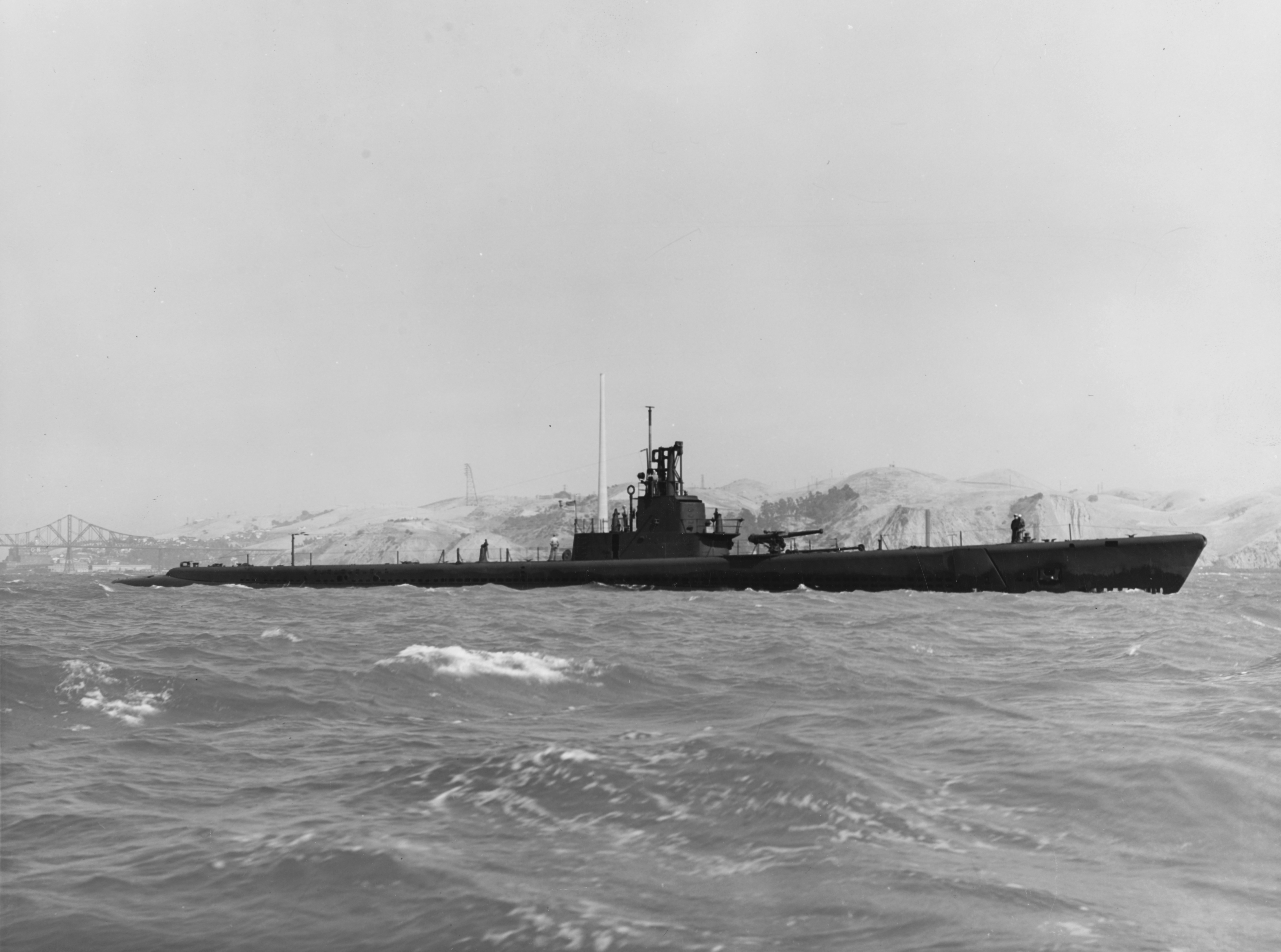
USS Wahoo (SS-238)
Before his first patrol as commanding officer, Lieutenant Commander Dudley Walker Morton gathered the crew of USS Wahoo and made a speech that would become submarine legend. The boat, he told them, was expendable. Anyone who wanted to stay behind in Brisbane had thirty minutes to request a transfer, with no hard feelings. Not a single man accepted. That moment in January 1943 marked the beginning of the most aggressive patrol record in the U.S. submarine fleet, a run of destruction that would end ten months later in the cold waters between Japan and Russia.
From Timid to Lethal
Wahoo was built at the Mare Island Navy Yard in Vallejo, California, her keel laid down on June 28, 1941, six months before Pearl Harbor. She was launched on Valentine's Day 1942 and commissioned on May 15 under Lieutenant Commander Marvin 'Pinky' Kennedy. Her first two war patrols, in the waters around Truk Atoll, were marked by caution and missed opportunities. Torpedo after torpedo either missed or malfunctioned, the plague of the early-war Mark 14 steam torpedo. The submarine's executive officer, Lieutenant Richard O'Kane, watched targets escape and grew frustrated. When Morton took command before the third patrol, everything changed. O'Kane stayed as his XO, and together they forged a boat that would redefine what a submarine crew could accomplish.
The Expendable Boat
Wahoo's third patrol was a masterpiece of aggression. With no proper charts of Wewak harbor, a Japanese supply base on New Guinea's north coast, Motor Machinist's Mate Dalton 'Bird Dog' Keeter produced a cheap school atlas bought in Australia. From its tiny map of New Guinea, the crew blew up a usable chart. Wahoo penetrated the harbor and sank the destroyer Harusame with a shot fired at 800 yards as the warship bore down on them. The patrol continued with the sinking of several more ships, including the transport Buyo Maru. Morton's record over three consecutive patrols set a standard not only for tonnage sunk but for the speed at which he achieved it: a claimed total of over 93,000 tons sunk and 30,000 tons damaged in just 25 days of actual patrolling. The submarine earned a Presidential Unit Citation.
The Cursed Sixth Patrol
Not every patrol was triumphant. In August 1943, Wahoo entered the Sea of Japan for the first time, hunting along the Hokkaido-Korea shipping route. Over four days, the crew sighted twelve Japanese vessels and attacked nine. Every attack failed. Torpedoes broached, ran erratically, or detonated prematurely. Ten torpedoes malfunctioned in succession, a devastating run of bad luck compounded by the systemic flaws of the Mark 14 torpedo that haunted the entire American submarine force. ComSubPac ordered Wahoo home. On the way out, Morton's crew captured six Japanese fishermen from a sampan and took them aboard as prisoners of war. The patrol was a humiliation for a boat that had been the pride of the fleet, and Morton took it personally.
The Last Patrol
Morton asked to return to the Sea of Japan. Permission was granted. For his seventh patrol, he loaded a full complement of the newly available Mark 18 electric torpedoes, refusing to risk another round of defective Mark 14s. Wahoo departed Pearl Harbor, topped off at Midway on September 13, 1943, and headed for La Perouse Strait. The plan called for Wahoo to enter the Sea of Japan first, with USS Sawfish following days later. Morton was to leave his assigned patrol area south of the 43rd parallel at sunset on October 21 and report by radio after passing through the Kuril Islands. He never did. Between late September and early October, Wahoo sank four ships totaling approximately 13,000 tons, including the 8,000-ton Konron Maru, whose loss with 544 lives enraged the Japanese navy. The Maizuru Naval District ordered a search-and-destroy operation for American submarines.
Found After Sixty-Three Years
On October 11, 1943, as Wahoo attempted to exit through La Perouse Strait, Japanese antisubmarine forces were waiting. An aircraft spotted a wake and oil slick, and a combined air and sea attack with bombs and depth charges fatally holed the submarine. She sank with all seventy-nine crew members. Wahoo was declared overdue on December 2 and stricken from the Naval Vessel Register four days later. No American submarine entered the Sea of Japan again until June 1945. For over six decades, Wahoo lay undiscovered in the strait. Beginning in 1995, an international team led by a relative of Commander Morton searched for the wreck. In 2006, the Russian dive team Iskra located the hull intact in about 213 feet of water, sunk by a direct bomb hit near the conning tower. On July 8, 2007, the U.S. and Russian navies held a joint wreath-laying ceremony at the site. In May 2024, Russian divers installed a commemorative plaque on the wreck with the inscription 'Russians remember.'
From the Air
USS Wahoo's wreck lies at approximately 45.81°N, 142.06°E in La Perouse (Soya) Strait between Hokkaido, Japan and Sakhalin, Russia, in about 213 feet (65 m) of water. Nearest airports: Wakkanai (RJCW) on the Japanese side, approximately 20 km south of the wreck site. Cape Soya, Japan's northernmost point, is visible nearby. The Wahoo Peace Memorial at Cape Soya is dedicated to both the American crew and the Japanese who died from Wahoo's attacks. Recommended viewing altitude: 5,000-10,000 ft for strait detail.