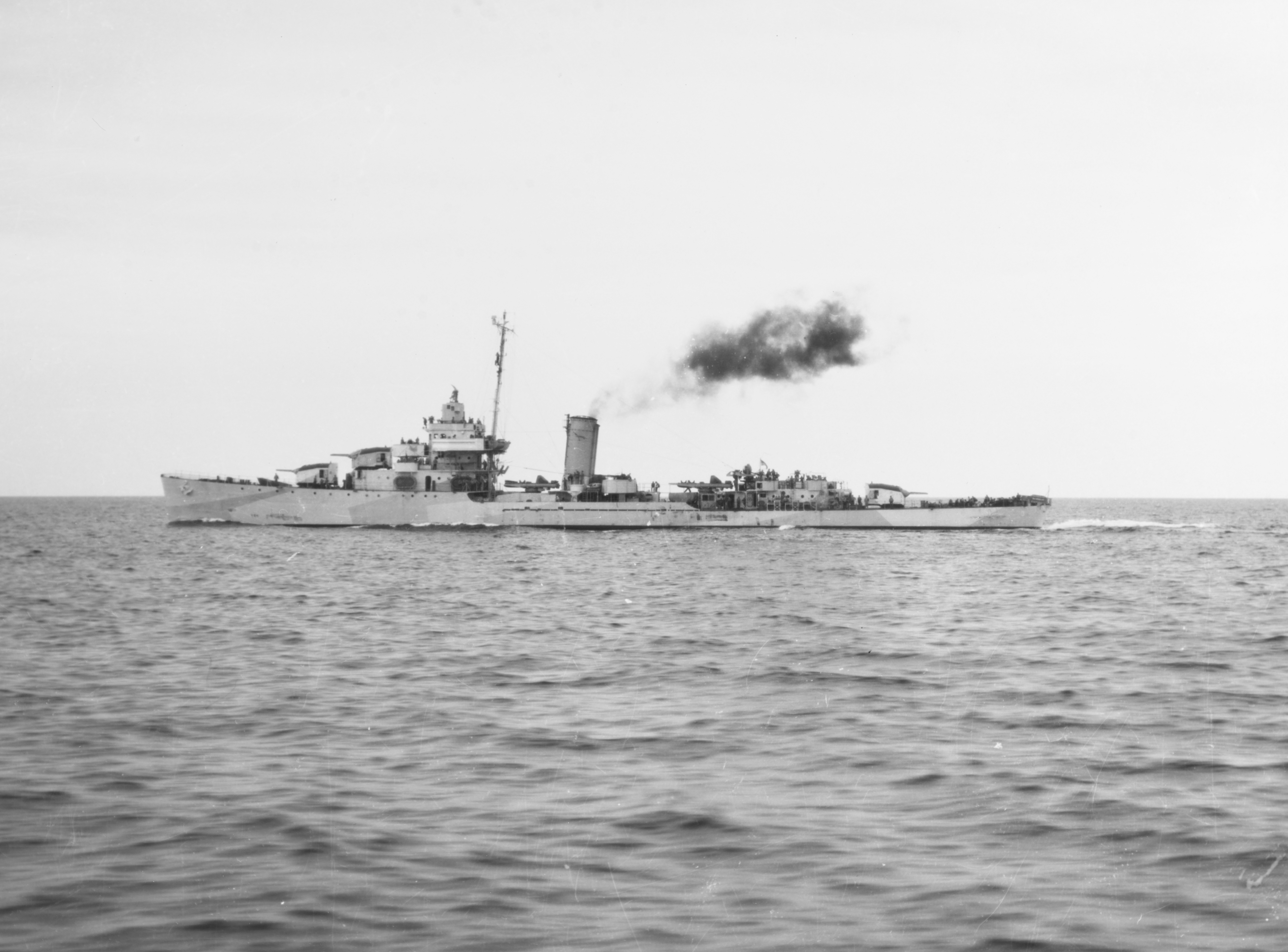
USS Warrington (DD-383)
On the morning of June 9, 1939, the destroyer USS Warrington moored at Fort Hancock, New Jersey, and took aboard King George VI and Queen Elizabeth for passage to Manhattan. It was a peacetime assignment, ceremonial and brief, the kind of duty that makes a good line in a ship's log. Five years later, Warrington lay on the ocean floor east of the Bahamas, broken apart by a hurricane that killed 248 of her 321 crew. Between the king's visit and the ship's death, Warrington fought across the Pacific, dodged torpedoes, shot down Japanese planes, and bombarded enemy positions in New Guinea. She survived all of it. What she could not survive was a September storm and a set of ventilation ducts that let the sea pour into her engineering spaces.
Prewar Ceremony and Patrol
Warrington was laid down on October 10, 1935, at Kearny, New Jersey, by the Federal Shipbuilding and Drydock Company and commissioned on February 9, 1938, at the New York Navy Yard. Named for Lewis Warrington, a naval officer during the Barbary Wars and the War of 1812 who also served briefly as Secretary of the Navy, she was the second ship to carry his name. Her early career read like a tour of prewar American naval life. She ran shakedown cruises to the West Indies, trained off Cape Cod and the Virginia Capes, and participated in fleet exercises alongside aircraft carriers. In February 1939, she escorted the cruiser carrying President Franklin D. Roosevelt and Chief of Naval Operations Admiral William D. Leahy to observe fleet maneuvers off Key West. Months later came the royal escort duty at Fort Hancock. By June 1939, she had transited the Panama Canal and settled into San Diego as her new home port, drilling with the Battle Force along the California coast. Pearl Harbor would soon pull her from these peacetime rhythms entirely.
War in the Pacific
Warrington was moored at Charleston, South Carolina, on December 7, 1941, when word arrived of the Japanese attack on Pearl Harbor. She put to sea the next morning and spent the first weeks of the war patrolling the Atlantic coast. By January 1942, she had transited the Panama Canal and reported to the Southeast Pacific Force at Balboa, where she spent the next sixteen months escorting merchant and troop ships between Panama and the Society Islands and hunting submarines as far south as Callao, Peru. After the Guadalcanal landings in August 1942, her convoy runs took on sharper urgency: the ships she escorted carried supplies and reinforcements for America's first Pacific offensive. In December, she escorted a battleship damaged in the Naval Battle of Guadalcanal into Balboa for the long journey to repairs in New York. The destroyer's war was not glamorous. It was the grinding, essential work of keeping supply lines open across thousands of miles of ocean.
Bougainville and the Guns of New Guinea
By late 1943, Warrington had joined the southwestern Pacific theater. On November 8, she escorted troop ships into Empress Augusta Bay, Bougainville, as part of the island's invasion force. While the transports unloaded reinforcements near Cape Torokina, the air raid warning sounded just before noon. Warrington opened fire on two Japanese planes crossing her stern. The first began smoking almost immediately and crashed directly behind the ship. The second shuddered under combined fire from the screening vessels and splashed down trailing pieces of fuselage. Within thirty minutes the transports were back at work. Months later, in May 1944, Warrington and the destroyer Balch conducted shore bombardments at Wakde Island in support of the 6th Army's advance through New Guinea. Dense jungle made specific targets impossible to identify, so the destroyers laid down area fire across their designated sectors. The commanding general ashore sent a message praising their cooperation and noting that the gunfire had been of great assistance to the troops.
The Hurricane That Won
In the summer of 1944, Warrington returned to the United States for repairs at the New York Navy Yard. After completing her yard period and additional alterations at Norfolk, she departed on September 10 in company with the stores ship Hyades, bound for Trinidad. Two days out, along the Florida coast, the two ships encountered deteriorating weather. Warrington received word that she was steaming directly into the Great Atlantic Hurricane of 1944. That evening, the storm forced her to heave to while Hyades continued alone. Through the night, Warrington rode with wind and sea on her port bow, holding her own. But by the early morning hours of September 13, conditions had overwhelmed her. She lost headway and began shipping water through ventilation ducts into her engineering spaces. The flooding killed her electrical power, which killed her engines, which killed her steering. She wallowed broadside in the swells, taking on more water with every roll. Her radiomen tried desperately to raise Hyades but could not get through. A plain-language distress call went out to any station listening. By noon, the crew knew the fight was lost. The order to abandon ship came at 12:50. Warrington went down almost immediately.
Seventy-Three from Three Hundred Twenty-One
The search for survivors lasted days. Hyades, along with several other vessels including ATR-9 and ATR-62, combed the waters east of the Bahamas. They found seventy-three men alive: five officers and sixty-eight enlisted sailors. Two hundred forty-eight crew members were lost. Warrington's name was struck from the Naval Vessel Register on September 23, 1944, ten days after she sank. She earned two battle stars for her World War II service. The wreck lies somewhere in the deep water off the Bahamas, unmarked and unvisited, a destroyer that crossed the Pacific, bombarded enemy beaches, and shot planes out of the sky over Bougainville, only to be killed by weather on a routine transit in her own hemisphere. Her story is a reminder that the sea does not distinguish between combat veterans and peacetime transits. A ventilation duct, a shift in the wind, a storm that arrived faster than expected, and a warship that had survived everything the enemy could deliver was gone in hours.
From the Air
USS Warrington (DD-383) sank approximately at 24.99°N, 77.16°W, in deep water east of the Bahamas. The wreck site lies roughly 50 nautical miles east-southeast of Nassau. From the air, there are no visible surface markers. The nearest major airport is Lynden Pindling International Airport (MYNN/NAS) in Nassau, approximately 50 nautical miles to the west-northwest. Eleuthera Island lies to the northeast. When flying this area, the deep blue of the Tongue of the Ocean and the shallow turquoise banks of the Great Bahama Bank provide dramatic visual contrast.