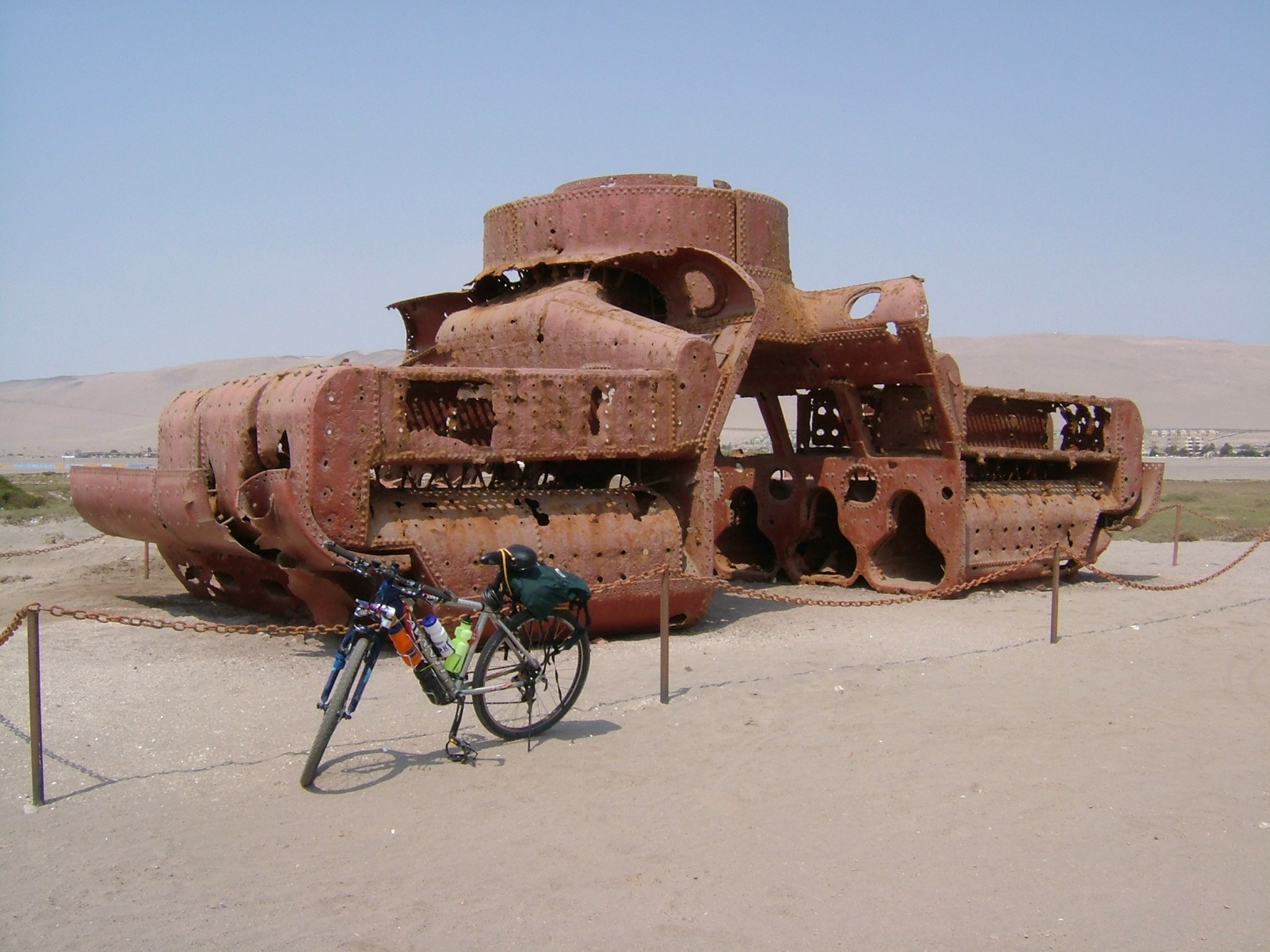
USS Wateree (1863)
A warship does not belong a quarter mile inland, sitting upright in the desert. But on the evening of August 13, 1868, the sidewheel gunboat USS Wateree ended up exactly there, deposited by a 46-foot tsunami wave on the coastal plain north of Arica, Peru. The ship was intact. The crew was alive. And the vessel that had spent ten months fighting its way around Cape Horn would never touch the sea again.
The Long Way to the Pacific
The Wateree was built at Chester, Pennsylvania, by Reaney, Son & Archbold, launched on August 12, 1863, and commissioned at the Philadelphia Navy Yard on January 20, 1864, under Commander F. E. Murray. Assigned to the Pacific Squadron during the final years of the Civil War, the ship departed Philadelphia and spent ten grueling months rounding Cape Horn. The voyage was hard on the shallow-draft gunboat. Heavy weather battered the hull, and the wood-fired boilers consumed fuel faster than the ship could resupply, forcing numerous stops along the South American coast to load firewood. The Wateree did not reach San Francisco until mid-November 1864, limping into Mare Island Navy Yard for repairs and a hull scraping. After repairs, she put to sea in late February 1865 to patrol the Central American coast. When the Pacific fleet was reorganized in 1866 into North and South Pacific Squadrons, the Wateree drew the southern patrol, covering everything from Panama to Cape Horn.
Dust at 5:20
By August 1868, the Wateree was anchored at Arica, having moved south to avoid a yellow fever epidemic in Callao. She was enforcing the Monroe Doctrine in the aftermath of Peru's declaration of war against Spain. At 5:20 in the evening on August 13, the crew observed clouds of dust rising from the city and watched buildings collapse. The 1868 Arica earthquake had struck. The sea, strangely, remained calm. The Wateree sent boats ashore to offer medical assistance. Then the water began to move. A series of ten tsunamis struck the harbor. The first surge reached 34 feet above the high-tide line. Every ship at anchor went aground in the outward flow that followed. The next inward surge, 46 feet high, snapped anchor chains like thread. It picked up the Wateree and carried her 450 yards inland, depositing her three miles north of Arica at 7:20 in the evening. The accompanying store ship USS Fredonia was not so fortunate: she was destroyed, drowning all aboard except two enlisted men and three officers who happened to be on shore.
A Ship on Dry Land
The Wateree came to rest upright and structurally intact. Her flat-bottomed hull, designed for river operations, had ridden the wave rather than being tumbled by it. The boatswain, who had gone ashore with the medical party before the tsunami, was the only crew casualty. With their ship permanently grounded, the crew turned to the shattered city. They distributed stores to the civilian population of Arica and provided what aid they could. The Navy judged the Wateree too far inland to salvage and sold her on November 21, 1868, for $2,775 to William Parker. The hull that had once carried cannons through the Straits of Magellan began a second career on dry land. It served as an emergency hospital, then an inn, then a hospital again, and finally a warehouse. For nine years, the Wateree sat in the desert, a gunboat without a sea.
Taken by the Sea a Second Time
On May 9, 1877, another massive earthquake struck the coast. The resulting tsunami reached the Wateree's resting place and this time destroyed what remained of her. Today, all that survives are parts of her boilers, mounted on the shore north of the present town of Arica and maintained as a National Monument of Chile. Arica itself changed nationality in the decades after the Wateree's grounding. During the War of the Pacific, the city passed from Peruvian to Chilean control. The boilers of a U.S. Navy sidewheel gunboat, built in Pennsylvania, wrecked in Peru, and monumentalized in Chile, mark one of the strangest final resting places of any vessel in naval history.
From the Air
Located at 18.44°S, 70.30°W on the coast of far northern Chile near the Peruvian border. The remains of the Wateree's boilers are mounted on the shore north of the modern city of Arica. From altitude, the coastal strip is narrow with the Atacama Desert rising steeply to the east. The area where the ship was deposited inland is now part of the urban sprawl north of Arica. Nearest airport is Chacalluta International Airport (SCAR/ARI) in Arica, just a few kilometers away. Sea-level elevation at the monument site.